• About Ralph Friedly

Ralph Friedly

Category Archives: Uncategorized

My World of Work

08 Saturday Nov 2014

Posted by ralphfriedly in Uncategorized

≈ 3 Comments

Tags

Barbara Erickson, Bob Mullen, Dwight Long, Ford Plant Metuchen NJ, Georgene Harding, Johns Manville, Leo J. Bartolonzo, Mack Trucks, Moore's Trucking Co., Navajo Freight Lines, Nu-Car Carriers, Pete Skierski, Tony Pappas, Trinket Barksdale, Union Carbide, Van Chesky Nursery, Westinghouse

When I was a child I worked for my father, a part time farmer in New Jersey who raised what today would be called market crops, which included strawberries, sweet corn, tomatoes, peppers, green beans, lima beans, okra, eggplant, cantaloupe and squash. All of the children helped in this enterprise, the older ones assisting my father in planting, cultivating, weeding and picking and the younger ones selling produce at our little roadside stand.

Dad had an enviable and uncommon attachment to the soil which I never completely shared. While I will ever remember the sweet smell of freshly turned soil from a spade or a plow, the smell of dew laden cornstalks and the sound of twisting off ears of sweet corn, the taste of a juicy freshly picked New Jersey tomato, or the sweetness of a strawberry right off the vine, my love of the soil and the gifts it gave was never like his. I can remember rebelling and telling him that I didn’t want to spend my life “planting lima beans eyes down”, that I wanted more from life.

My father also had a peculiar attitude about work. If someone was sweating and breathing hard, if they used their muscles, he admired them because they “knew how to work”. The nature of the “work” did not matter, nor the results, nor whom the work benefitted. To my Dad, moving pianos was honorable work, stacking bales of hay was great work, hoeing weeds in the hot sun was worthy work. I can remember clearly that one of my brothers, a successful building contractor, described an employee using the words “he can really work!” – a legacy from our father no doubt. Although I did work hard as a boy I don’t think that I ever earned any “he can really work” accolades from my father, although another brother always did.

But the ethic of work was nevertheless firmly established and I always thought I should be working. So I did – I worked at a wide variety of jobs before finally earning my degree and committing myself to a career in education. Although it was sometimes difficult to obtain work (I can’t begin to tell how many hundreds of applications I have filled out over the years), I always kept trying until someone called and offered me the job. Also, I look back on my work history before education with great pleasure – I worked with good people, learned to appreciate all kinds of work and learned skills that I have used all my life.

download (2)

My first job (for real, regular money, unlike working for my father) was with Van Chesky’s Nursery, a place close to my home that I had traveled past many times as a child. Mr. Van Chesky was an old Dutchman whose rows of healthy and carefully tended shrubs, trees and flowers had earned a substantial market in central New Jersey. My job was hoeing weeds down these long rows of plants for 75 cents an hour, actually not too bad for a young kid of 16 years old. This was familiar work too, having done the same for my father for no pay for a long time. I really enjoyed the work and happily cashed my first paycheck of $30.00 in one dollar bills, so that I had a huge wad of money that made me feel very successful and powerful.

Another job I had later in high school was painting for a local gentleman who suffered from “shell shock”, called PTSD today, evidently caused by combat in World War II.  Sid Johnston was a big man with a head of snow white hair whose malady caused a number of nervous mannerisms – sudden movements (very bad when cutting in windows!), emphatic and varied wheezing noises and a colorful vocabulary of curse words, which punctuated and flavored our workday. Sid also had a curious attitude toward Catholic nuns whom he evidently felt had extraordinary powers. On our drives to a job, if encountering some nuns crossing the street in front of us or strolling on the sidewalk in town, an explosion of wheezing accompanied by a stream of colorful invective would result, and he would be convinced that somehow he would have a bad day – spill a bucket of paint, fall from a ladder, have a flat tire or encounter some other terrible misfortune.

Home improvement paint

But I learned valuable painting skills from Sid Johnston that I use to this day, some 55 years later. And recalling the days of working with him as well as with several other friends that he also employed, notably Joseph Wenger, my best friend in high school and Jack Vorhees, an older, college age friend (our employment was somewhat sporadic, depending on the jobs Sid would obtain), gives me pleasure today. Sid was a strange caricature of a troubled and wounded man who nevertheless had a big heart and a generous and ready checkbook when the account was flush.

During my high school years I also worked, again with Jack Vorhees, for a painting contractor in Plainfield, New Jersey. The jobs we worked were a combination of exterior and interior painting in the Plainfield area. Two things I recall about our boss. First, many of his paychecks bounced, requiring frantic calls to him, new checks written, and repeated trips to the bank which finally put our earnings in our pockets. And secondly, this contractor faked paint quality to increase his bottom line. An elderly lady had wanted her house interior painted with what was then the premium interior latex paint – DuPont Lucite. Our boss bought the cheapest latex paint he could find and then had Jack and I pour it into empty DuPont Lucite cans which we then used to paint this lady’s rooms.

colorchart2011

After I graduated from high school and returned to New Jersey from Ohio I obtained a summer job at a dye company in Plainfield, New Jersey. The name of the company escapes me now but it was a small place which mixed dyes to color products manufactured by a variety of other companies, I believe mostly paint and plastic companies. I and the other employees worked at benches where we prepared shipments consisting of whatever colors and quantities were ordered. The dyes were contained in metal barrels and employees prepared orders by weight. Since the dyes were strong and concentrated, the quantities were accordingly rather small, so colors were weighed out and placed in specially labeled paper bags for shipment. In retrospect, working in this place during pre-OSHA times was likely quite dangerous. I can remember blowing my nose after work and being amazed at the multi-colored mucous that appeared in the tissue. I should probably have been very thankful that this job was short lived.

L021554

During the summer of 1960 I worked at the Westinghouse plant on Route 27 in Edison, New Jersey which at that time manufactured television sets. The position was an assembly line expeditor, a job whose function was to make sure required parts were on the assembly line so that the line did not slow down or stop. So it was my task to make sure that the proper coils, capacitors, condensers, circuit boards, connectors, wire bundles, cases, knobs and other parts were on the line and available to workers assembling the television sets as they moved down the production line. On several occasions the quality control department would reject certain lots of parts and I when I could not locate quantities of approved parts, I was surprised to be directed to get these on the line anyhow, simply to keep it going. I recall the plant being toured by a group of Japanese people and I couldn’t help but think they must be chuckling to themselves at Westinghouse’s production methods. And knowing that rejected parts were still going into these television sets certainly determined that I would never buy a Westinghouse television.

Bakelite Jewelry

Later I worked at the Union Carbide plant in South Bound Brook, New Jersey. This plant had had the distinction in the early 1950’s of manufacturing an early plastic called Bakelite, which at the time because of its non-conductive properties was used for telephone casings and radio cabinets. It was also used in the manufacture of many household items and children’s toys. At that time the term “Bakelite” was often used as a generic term for any kind of plastic, in much the same way that the download (3)name “Frigidaire” was commonly used instead of “refrigerator”. At the time I worked at Union Carbide, the area of the plant in which I worked manufactured rolls of vinyl covered fabric material known then as “naugahyde”. My work was to assist in the mixing and dying of the vinyl and operate the machinery that heated, extruded and pressed the vinyl material onto the base textile material and wound it into huge rolls for shipping. This was the first job I ever had which required rotating shifts – successive weeks of days 8-4:30, then afternoon-evenings 4-12:30 and after the nightshift 12-8:30, back to days. Frankly I don’t know how people do this. Days and afternoons were fine, but the night shift killed me. I simply could not sleep soundly enough during the day to get ready for a shift starting at 12:00 midnight. It’s no wonder that it’s still commonly called the “graveyard shift”.

Recently I saw a documentary on Free Speech TV called “Plastic Planet” which mentioned a link between exposure to polyvinyl chloride (PVC), the material I worked with at Union Carbide and Reynaud’s Disease, also called Reynaud’s Phenomenon, a malady which affects my fingers and hands when I am cold. The problem first appeared in my mid-thirties and it’s quite likely that it is caused by my time at Union Carbide. I am sure that today, federal regulations require protection for workers from this potentially harmful exposure, but unfortunately I do not recall being required to wear any protective clothing, masks or gloves at the time I worked there.

download

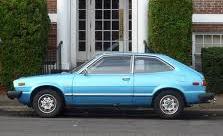
In the summer of 1961 I had finished my sophomore year at Rutgers and was deeply in debt to the fraternity that I had been invited to join that year. In spite of waiting tables, doing dishes and whatever else I could do at the fraternity to defray my expenses, I still owed considerable money for meals and dues. So late that summer I was overjoyed to have obtained a job on the assembly line at Ford Motor Company’s Metuchen assembly plant.

Working at Ford was an incredible experience, seeming like it was on the front line of American industry. As a new employee, I worked at a variety of stations on the assembly line, mostly filling in for absent workers or workers who were on vacation. They ranged from screwing on nuts and bolts to installing window trim to applying some kind of substance to specified areas on the car bodies before painting. The duties at each assembly line station were carefully calibrated by time and motion studies to exactly fill the time each car came by, as I recall, every 90 seconds. So you had to really hustle, moving along with the car body doing whatever the job required, then dropping back to do the same tasks all over again during the next 90 seconds. The job was mind-numbing for its repetition and inherent boredom. So many times my mind would drift off and suddenly I couldn’t really remember whether I had gone through all the motions or not – doing the same thing every ninety seconds can freeze one’s awareness completely.

And since each set of tasks was meticulously structured to take exactly 90 seconds, when I was learning a job, it was really difficult to keep up, even working at top speed. If I fell behind I couldn’t call for someone to slow down or stop the line. I just worked in a frenzy, as fast as I could and if I fell behind and was following a given car up the line so far that I was in the next worker’s territory, I just had to skip a task in order to catch up and simply hope that someone in quality control would catch the skipped task later down the line.

I thought it really interesting that some car bodies had a metal disc hanging from the top, indicating that this particular car was going to be purchased by a plant worker. This circle was the sign to do an extra careful and thorough job on the car: the guys welding the bodies gave it double welds and so on.

I met some wonderful people while working at Ford. There were many highly educated Hungarian refugees on the line, since this was a few years after the Hungarian Revolution and many Hungarian emigrants had settled in nearby New Brunswick. I also recall a very bright man from North Carolina, Joe Sprinkle, who became a friend and confessed that during the mental paralysis imposed by endless repetition on the assembly line, he exercised his mind by composing poems and then writing them down during his breaks. And as I recall, they were pretty good poems.

download (4)

This job was an opportunity to get to know unions a bit better also. I was a member of Local 980 of the United Auto Workers, which represented the 800 or so workers at the Metuchen plant and as a member, participated in several wildcat strikes. I guess I should not say participated, because I don’t recall ever knowing the causes. I just remember the assembly line slowing and then halting and the UAW shop steward telling me to stop working, leave the plant and join the other workers at the Union headquarters close by. I regretted the strikes because I lost my high hourly pay, about $2.70 per hour, for the time we were on strike. But it was pleasant to always feel part of something bigger and to share in the considerable power the UAW wielded.

I will never forget the distinctive smell the Ford plant had – a not unpleasant smell and best described as the odor of hot metal, that you got a first whiff of as you approached the plant and entered the parking lot. I can remember years later smelling this familiar odor if the wind was right while driving by the plant on Route 1 and having the memories of my time on the assembly line at Ford come flooding back. The cars we assembled then were Mercury Comets and Ford Falcons. The Metuchen Assembly Plant was to later make Mustangs for many years and had been assembling Ford F150 pickups before it finally closed in 2004.

Mixed with my mostly positive memories of this mass production assembly line job was the sad experience of being called to the personnel office and being informed that I would no longer be employed there. Back x-rays which were taken during the very thorough physical when I got the job, had finally come back, revealing that I had scoliosis, a condition which up to that time, I never knew I had. And since Ford feared that I perhaps could not perform up to their physical standards, or perhaps that I might injure myself on the job because of this condition, I was dismissed. This news dashed my dreams of saving enough money to return to school second semester, but at least I had been able to pay off my debt to the fraternity. The job had lasted only seven weeks but in that short time had provided a huge number of vivid and indelible memories.

a9b42c6a7c2ae26cc137acc875d15534

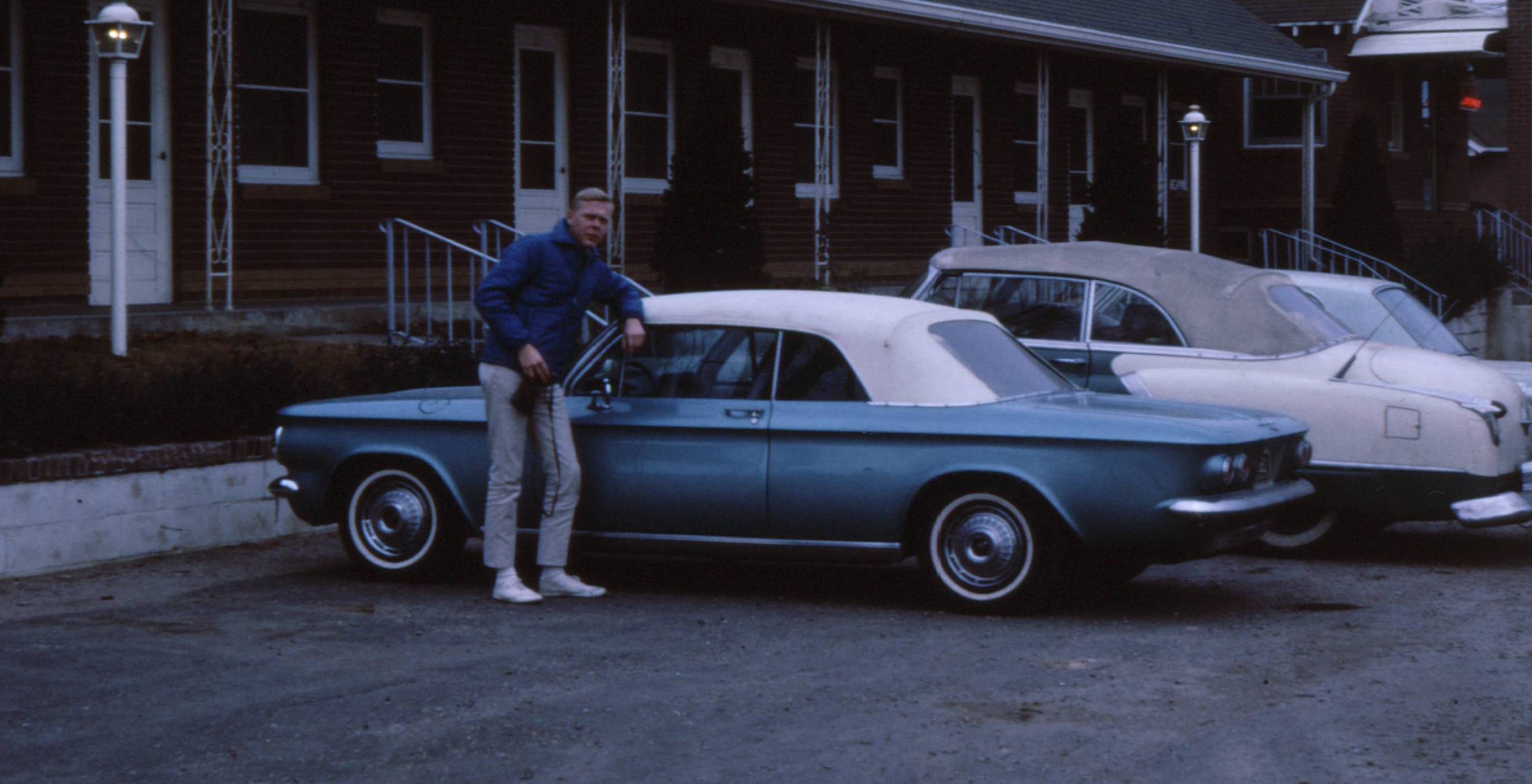
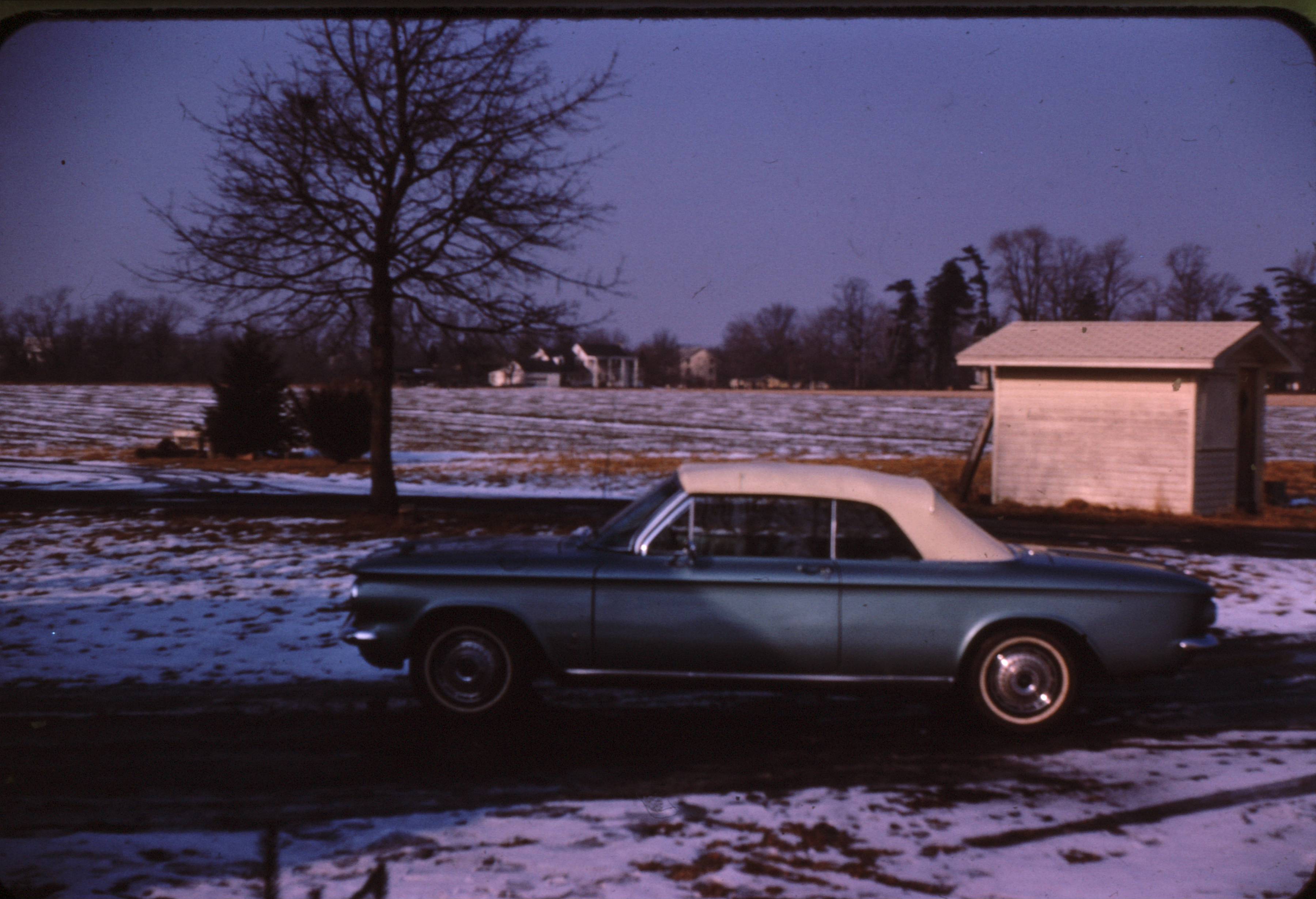
After the trauma of losing my job at Ford and seeing my dreams of financial solvency dashed, I left New Jersey, moved to Colorado and found a job as a file clerk at the Navajo Freight Lines main headquarters on Santa Fe Drive in south Denver. This was a very boring clerical job, filing freight bills alphabetically and numerically in an area of high metal cabinets full of long file drawers. But the surroundings were pleasant, the job was easy, I worked with some very good people, and in this, my first clerical job, I could dress well. I will always remember several of my colleagues in this job – Barbara Erickson, a lovely girl from Iowa (or was it Kansas?), Trinket Barksdale, who lived in Broomfield, north of  Denver, and a very good friend, Dwight Long, with whom I had a great relationship. Later, when I left Navajo Freight Lines, Dwight had also quit, so we drove back east in a little caravan – Dwight and his wife driving their two cars and I driving my ’62 Corvair. Dwight and Jeanette were returning to Pittsburgh and I of course was returning to New Jersey to resume school again.

While at Navajo Freight Lines I was involved in an interesting professional experience that I have often related to others. After serving as a file clerk for a number of months, a job opened up for a clerk-typist position which required a minimum typing speed of 30 words per minute. I could not type but badly wanted the raise that came with this possible promotion so applied for it anyhow, lying about my apocryphal typing skills. On a Friday I was informed I had the job providing I pass a typing test to be given on Monday. So that evening I rented a typewriter and bought a typing instruction book. By Sunday night and after about 30 hours of furious self-instruction and practice, I could type at about 40 words per minute. So I passed the typing test on Monday with flying colors and got the job. I guess I have often told that story as an example of being resourceful and tenacious, not as an example of lying and being forced to make good on the lie.

130

When I returned from Denver in 1962 I lived at home again (still chaotic but it was great seeing my little brothers again) and resumed my college career, enrolling in night school at Rutgers. I found a job working at Mack Truck Parts in Somerville, again a clerical job with various duties including typing. This center sent parts from its huge warehouse to Mack maintenance and repair facilities all over the country. The job itself was not very noteworthy and did not pay well but it kept me going as I started night school and searched for another job. The highlight of my time there was buying Mack t-shirts for my little brothers with the Mack bulldog trademark and the legend, “Built Like a Mack” on the front.
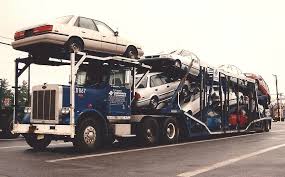
download (1)

I do not recall if I found the next job at Nu-Car Carriers because Mack laid me off or because it was the higher paying job I was looking for, but at any rate sometime in 1962 I began working in the dispatch office for the company that transported new vehicles to dealerships across the east that were manufactured at the very same Ford plant at which I had worked a couple of years earlier. I enjoyed this job very much, not only because of the assembly line memories that returned with the hot metal smell occasionally wafting into the office from the adjacent  plant, but because of the gracious people with whom I worked. The dispatcher, Dave Dowling, was an extraordinarily bright young man who enjoyed sharing his knowledge and views on every subject imaginable and with whom I had many stimulating conversations and arguments. Angelo (can’t remember his surname), the other main guy in the office, was a kind and sociable man with a great smile and sense of humor who teased me by posting my engagement announcement on our office bulletin board with his written comment, “and she makes more that he does!”, which was true.

At Nu Car Carriers, my job consisted of clerical duties relating to matching orders from Ford dealers spread along the east coast with the cars driven from the end of the plant assembly line to our storage lots. Vehicles were then queued up for loading onto our trucks and the loaded trucks were lined up for our drivers to board and drive to their dealer destinations.

From 1963 to 1965, while I was still going to school at night, I worked as an accounting clerk for Johns Manville Research, a facility in Finderne, New Jersey, a couple of miles from the big Johns Manville plant in Manville. In this position I simply made calculations with figures from different sources and prepared daily, weekly and monthly reports. It was here that I learned how to use a 10 key adding machine very efficiently without looking at the keys, a skill that, like typing or riding a bicycle, has never left me.

Johns Manville 2012

It was also in this job that I learned how to skillfully waste time. Since the job had a set number of periodic tasks, I got very good at them and found a little extra time on my hands. So I learned how to walk around the research facility with a pencil over my ear and a bunch of papers in my hands, looking like I was on a mission to obtains some facts or figures, but really going nowhere in particular, just having a good time finding out what was happening in different parts of the building and making some new friends.

I seem to recall all the people that I worked with in this office quite easily, even after more than 50 years, perhaps because this is where I worked when President Kennedy was assassinated and of course, like everyone else at that time, remember where I was and whom I was with. Mr. Leo Bartolonzo was our boss, the director of finance for Johns Manville Research. I remember being quite impressed with Mr. Bartolonzo because he was an art history major working in finance and as such, was a living example of the value and broad applicability of a liberal arts degree. He had a very attractive secretary, whose name I do not recall. Others in the office were Tony Pappas, my boss and Bob Mullen, another accountant, who also worked some evenings and weekends as a football referee in high school and college games. Pete Skierski was another accountant, as well as a young lady, Georgene Harding. I was in this office with these people when Tony’s wife called and gave him the tragic news about President Kennedy.

Everyone at Johns Manville Research was a pleasure to work with and I missed them all very much when I finally earned my bachelor’s degree and left for my first teaching job. It was at this time that Bob said to me, “Gee Ralph, you are leaving this eight to five job with two weeks of vacation a year, for a job working six hours a day and Christmas and spring breaks and all summer off, you lucky guy!” Right, Bob did not know, nor did I completely realize at the time, how wrong he was. Being “on stage” for six hours per day and keeping 30 or so little fourth graders interested and involved in their learning was infinitely more tiring than my eight to five days at Johns Manville Research. Plus evenings and weekends were always filled with grading papers, writing lesson plans, taking courses and writing papers. During my first year of teaching I was busier than I had ever been in my life. And “summers off”? I never had a summer off as an educator. I was always working, taking courses, earning a degree or taking district staff development courses.

Before I leave Johns Manville, I want to digress in order to describe a phenomenon relating to that corporation’s key ingredient in its products – asbestos. We lived on church property located about two miles from the main Johns Manville plant in neighboring Manville, New Jersey. One sunny morning in early summer we were shocked to wake up and see what looked like snow outside because the grass, trees and bushes everywhere were coated with a white fluffy substance. These white fluffy particles were asbestos which had mistakenly been somehow released from somewhere in the Johns Manville factory and had been blown our direction by the breeze. This summer “snow” disappeared quickly in the wind and rain so my family and I thought little of this incident at the time and were in fact amused. But years later it was chilling to learn about the deadly qualities of this then commonly used mineral and to realize that our proximity to the Johns Manville plant and direct exposure to asbestos in this incident presented a serious threat to our health. In addition, I have often thought of the many times I observed asbestos being experimented with at Johns Manville Research and have wondered if I will suffer any ill effects someday because of this exposure.

3763581230_f61e57fa86

After I began teaching, even though I was working at my new profession full time and taking Masters Degree courses from Rutgers on the weekends and summers, I unfortunately found it necessary to augment the family income with part time work. One of the part time jobs I had was again working for a trucking company – Moore’s Trucking Company in Piscataway Township, New Jersey. This job began at 9:00 at night and could end anywhere from 11 or so to around 1:00 AM, depending on how many shipments were waiting on the docks, which determined how quickly the trucks could be loaded for the next day’s trips. I would usually try to take a nap when I got home from teaching so I would have the energy for this evening job. And when I came home late, it was sometimes very difficult to get to sleep so that I could do my little kids justice in the classroom. Since we had a veritable pharmacy in the bathroom cabinet back then, thanks to my spouse’s professional contact with drug company detail men, I got into the habit of taking a pill to relax me for the nap after teaching, then another pill to wake up to go to the evening job, sometimes a pill to go to sleep again, and then perhaps a pill to energize me for the day of teaching. I don’t recall exactly what these pills were but I guess they were in the families known as “uppers” and “downers”. Yes, and today I wonder what effect these drugs have had on my health at this point in my life.

During my first three years of teaching I also held two other part time jobs. For awhile I worked in the evenings for Morrison Steel in New Brunswick as an inventory clerk, going through piles of invoices and subtracting quantities of steel pieces that were sold – angles, channels, T’s, beams, pipes, plate, rolled steel and so on, from inventories. A pleasant man by the name of Tom, again I can’t recall the surname, taught me the job and worked with me on this task every evening. This job began at a specific time and was over at a specific time, so at least my sleep did not suffer.

The third job was working for a janitorial firm that cleaned offices every night. I reported for work nightly at an office building in New Brunswick and emptied waste baskets, dusted and mopped floors and cleaned bathrooms. I do remember being very surprised that the men’s bathroom was much easier to clean that the women’s because frankly, the women were much sloppier, something that I was not expecting. In this job I did learn some additional lifelong skills – how handy paper towels were to shine up sinks, fixtures and faucets and when you did it right, how quickly a bathroom could be made to sparkle.

All three of these jobs were, thankfully, short lived. During my first three years of teaching, thanks to boundless youthful energy, I was able to not only teach joyfully and successfully and increase our income successfully through these part time jobs but also complete a 46 credit Masters Degree at Rutgers which provided full certification as well as the degree, which I received in the spring of 1968.

I performed the one final non-education job in my life in 1971 after my year in Cambridge, Massachusetts attending Harvard University. I guess this was my most significant experience about being overqualified for certain jobs. During the last month of my year of school, my search for an administrative position was rewarded by being appointed Assistant Principal of Duxbury Elementary School in Duxbury, south of Boston. I was overjoyed to get this position in a pro-education community like Duxbury, but unfortunately the job did not start until August and having finished my year of school in June, I badly needed to find a way to earn some money to tide us over until my first Duxbury paycheck. I applied for many jobs but was turned down for all, I am sure because prospective employers knew my qualifications and rightfully decided that I would not stay. So in desperation, I took a job that required no degree, no experience, and unfortunately, no pride or self respect – door to door surveying and giving out free samples.

I recall that I was to ring the doorbell, introduce myself and inquire if I might ask a few questions and then leave some samples. Many times doors were not answered, or were slammed in my face. But those who were innocent enough, idle enough or lonely enough, did choose to answer the questions and receive my samples. This goody bag contained a variety of products, several of which I cannot recall, but I do remember Palmolive Dishwashing Liquid and Chipos, the former being a good product and really nothing much new, but the Chipos, I guess a forerunner of today’s highly processed Pringles, were a “new fashioned” potato chip made of “dried potato granules”, very tasty but probably not very nutritious.

So I and several colleagues loaded up our vehicles (a job requirement was to own a vehicle) at a depot in the morning and set out for residential sections of several towns west of Boston – I do remember that Dedham was one of them – and carve up these areas with code symbols that we wrote on the pavement with huge pieces of chalk in order to indicate if we had entered an area or had finished it. My God, what a job! When I looked at myself in the mirror in the morning and saw a man with a BA, an M.Ed and a Certificate of Advanced Study from very prestigious universities and then went out to survey unwilling people door to door distributing samples of Palmolive Dishwashing Liquid and Chipos, I had a tough time generating any self esteem. But I had to earn money somehow and this seemed the only way at the time.

So why do I think that this little autobiographical sketch of places I have worked in addition to my chosen profession of education is worth recounting? Well, I think that any one of these jobs and all considered collectively, gave me valuable insight into the general world of work and have provided an understanding of and sensitivity to the people who do different kinds of work. Experience on manufacturing assembly lines gave me firsthand knowledge of the principles of mass production and of the emotional stress of doing such jobs; the dangers I unwittingly encountered at Johns Manville, Union Carbide and the dye plant have made me aware of the need for government regulation to protect workers in the factories and citizens living nearby. Experiencing these different vocations has given me a strong sense of the honor of work, any kind of work, and of the necessity of different kinds of work being accomplished so that our society can function. Working in all these places has also convinced me that all work should be fairly rewarded. Working at any one of these jobs full time should have provided a decent living for anyone doing them. The rewards of worker productivity should be shared fairly with the worker, not go exclusively into the pockets of stockholders, managers and CEO’s. All workers, no matter what they do, should be treated honorably, since all this work, no matter who does it, is absolutely necessary.

And although I enjoyed all these jobs and learned a great deal from them, I am thankful that I found education as my real profession. Working with children, teachers and parents has been very rewarding but looking back over what now has become a reasonably long life, I am thankful too that I was able to experience so many other kinds of work and make those experiences important parts of my personal history.

Golden Rules for Living

07 Friday Nov 2014

Posted by ralphfriedly in Uncategorized

≈ Leave a comment

Tags

Golden Rules for Living

Many years ago I was given a business card by an acquaintance that featured the “Golden Rules for Living” on the back. Since then, these rules have meant a great deal to me, explaining some of the missing habits in my family as a child, additional opportunities relating to childrearing or teaching in a classroom and some of the perennial problems encountered in daily life.

The rules are simple, sensible and few in number, yet their power to make life easier and more harmonious in the home, the classroom and the workplace is undeniable. How many times have I become angry and frustrated to see a tube of toothpaste drying out and becoming impossible to cap because someone simply did not see the need to replace the top after removing it? How often have I wondered about the child, family member or colleague that leaves a spill or a pile of crumbs and doesn’t clean up? How many times have I shaken my head in wonder or rolled my eyes in disbelief when someone has taken something out of a desk or cupboard and did not put it back or left an appliance or light turned on that should have been turned off? How many hours have I wasted looking for something that someone took, used and did not put back? These are but a few of the frustrations that could be readily eased by simply following these simple “rules for living”.

This little set of rules to live by comes with some small variations in how they are written. Sometimes the list is 10 items long, sometimes 12 or more, but the lists are basically the same. They are simple, they are sensible and they are powerful. Parents should teach them to their children and teachers should teach them to their students.

Golden Rules for Living

If you open it, close it.

If you turn it on, turn it off.

If you unlock it, lock it.

If you break it, repair it.

If you cannot fix it, find someone who can.

If you borrow it, return it.

If you use it, take care of it.

If you make a mess, clean it up.

If you move it, put it back.

If it belongs to someone else and you want to use it, get permission.

If you don’t know how to operate it, leave it alone.

If it does not concern you, mind your own business.

And a little addendum:

If you want to be liked, leave things as you found them.

If you want to be admired, leave things better than you found them.

If you want to be respected, do things without having to be told.


However, upon considering issues in my life and the various versions of this list, I would like to suggest four more “rules for living” which would make the list more comprehensive. These are:

If you start it, finish it.

If you commit to doing a task, do it well.

If you don’t need it or don’t plan to use it, don’t buy it.

And finally:

If it has no utility or value, get rid of it.

Tennis Anyone?

10 Wednesday Sep 2014

Posted by ralphfriedly in Uncategorized

≈ Leave a comment

I love the game of tennis, although I have to admit that I have played little in the last decade or so. Yes, my tennis bag, containing several Head rackets, some practice balls and three containers of new balls still sits on a shelf beckoning to me, but a lack of suitable partners, lack of convenient courts and a lack of will (mostly the last I am sure) have conspired to prevent me from getting onto the court again.

images (1)

I last played singles with a parent from my school in Izmir, Turkey sometime in 2005 on a court at Sports International, a club to which we belonged and worked out at regularly. I also played around the same time with one of my teachers at a public court by the sea in Bostanli, Izmir. Some years before that, in the late 90’s, I had played several times on the courts at the US Embassy in Kuwait with one of the Embassy officials. But that has been the extent of my play since I left Arizona for Kuwait in 1996.

Tennis is a great sport for several reasons. First of all, it is an active sport – it is easy to get the heart rate up and burn the calories. Another positive aspect of tennis is that it is a “lifetime sport” – kids play tennis, middle aged people play tennis and yes, people my age play tennis. And tennis is easy to understand – the objective is simply to hit the ball over the net and keep it within the lines. And the 15 – 30 – 40 – game scoring and “love”, though not entirely logical, are easily learned. But it is sometimes a lonely sport – yes, you are playing against someone else so you can communicate with your opponent but you are not on a team – there is no one with whom to commiserate about a bad shot or a great shot from your partner unless you are playing doubles. Tennis has often been compared to boxing, because in the ring or on the court, you are alone. However, tennis players have pointed out that at least the boxer has his corner people to encourage, help and provide advice between rounds. Between games or sets, the tennis player is still alone.

download (1)

During my earlier tennis “career” I not only played with a doubles group for many years (much more about this later) but also joined a league and played singles matches with a variety of opponents, winning some matches and losing some, ending up somewhere around the middle of the rankings. One of my league opponents deserves special mention – a guy courageous enough to play tennis from a wheel chair. And, although I do not like to think about it or admit it, I lost to him. My God, you are thinking, how can anybody lose to a guy in a wheelchair? Well it’s easy to explain – if this guy got anywhere near the ball, he smashed it with a blistering forehand or backhand with great topspin and well out of my reach. Well, it would have been easy to keep the ball away from him with minimum effort since he had to move and turn his wheelchair with both hands, while the racket rested on his lap.  But….I could not bring myself to hit away from him, so unfair did it seem. So I spent virtually the entire match hitting the ball directly to him and experiencing him emphatically slam it out of my reach again and again. When I saw myself losing and realizing what a shame it would be to lose to a guy in a wheelchair, I thought I would change my tactics and begin hitting the ball out of his reach. But doing this a few times seemed so sadistic and cruel that I went back to again hitting the ball to him and of course lost the match. So there – I lost to a guy in a wheelchair.

Over the years I have not only enjoyed playing this wonderful sport but also watching it on television. When the “majors” are on, I watch as many matches as I can. So over the years I have enjoyed watching the magic created on the court by the many stars who have competed in Wimbledon, the US Open, the French Open and the Australian Open. Having played the game, however inexpertly, I can appreciate the polished skills of these professionals, and imagine the great feeling in my brain, hand, arm and legs if I could only make but one of the many incredible shots they make so routinely.

Before leaving this subject I need to mention a couple of my pet peeves relating to watching grand slam matches on television. First, I have a real problem with the maximum time between points rule not being enforced, especially with the worst offender, Maria Sharapova. This unpleasant, pouty and self absorbed player, who never bothers to recognize the accomplishments of her opponents, pursues an irritating ritual between points of standing facing the  back wall of the court and fiddling with her racket strings for awhile, then mincing up to the service line to bounce the ball a half dozen times, then another long pause to glare at her opponent, then finally the serve. If the serve is bad, most of the ritual is needlessly repeated instead of delivering a quick second serve. Even when receiving she persists in doing the back wall stare with her back to the court, even when her opponent is ready to serve.

Another relates to the irritating habit of announcers, the worst offender being Cliff Drysdale, constantly referring to the ethnicity of a player as in “the German”, “the Swiss”, “the Serb” or “the Scotsman”, e.g. “…great serve by the German…” or “…what a backhand from the Frenchman …,(or the Spaniard)!”. I find this irritating on two levels. First, I would dare say that unless it’s a Davis Cup match, most tennis fans don’t care about the country from which the player comes; they simply appreciate any player for his skill, endurance or tenacity. Second, if you extend this “Great shot by the ______” to all ethnicities, it gets a bit awkward with certain nationalities. For example, with the Japanese, Polish, Chinese or Jewish player, should the announcer say. “Great backhand from the Jap!”, “Fabulous serve by the Jew!” or “Incredible down the line forehand from the Polak!”, “What a return by the Chinaman!”? It would be much more tasteful if tennis announcers simply dropped all references to a player’s ethnicity and simply stuck to names instead.

1024px-Wimbledon.svg

To return to my tennis narrative, it was my good fortune, while traveling in Europe in early July 1992, to be in England during the second week of Wimbledon. My son and I drove into London from the resort where we were staying, hopped on the famous London Underground, got off the train at Southfields Station and took a short tram ride to the fabled grounds of Wimbledon. There we paid our money and got in to the actual tournament which was then in its latter stages. We did not get in to see any of the big stars – I think that day Jana Novotna was playing Steffi Graff for the ladies championship – but we were able to buy tickets to see an “old timers” exhibition doubles match which included the great Romanian player, Ilie Nastase. We also got to sample the famous “strawberries and cream” and bought a handful of souvenirs to share with other family members and with my Arizona doubles group.

Now, finally, about this group – from the late 1980’s (I really can’t remember when we began) to the summer of 1996 it was my pleasure to be a member of a tennis doubles group that met faithfully early every Saturday morning. Being part of this group of friends playing a game we all loved really was one of the great experiences in my life.

The group consisted of myself, Joseph Arpin, Hugh Callison, and Adrian Young. About Joe, it was my privilege to first meet Joe as the Sahuaro School art teacher in 1982, when I first came to Arizona to work in Washington School District as principal of that school. We had some great times at Sahuaro and we both still stay in touch with some of the teachers we worked with there. One of my great memories of Joe’s good work at Sahuaro was sketching out and supervising the painting of huge mural of a Sahuaro cactus with a mountain horizon and a setting sun behind it on the side of our gymnasium. The actual painting was done by our junior high students, supervised by Joe and their involvement in beautifying our school went a long way that year toward improving their behavior. Joe later remained with me when I transferred to Acacia School, so our professional relationship spanned fourteen years – 7 years at each school. Our personal friendship has extended to the present day.

Hugh Callison came to Washington School District in 1985 or so as our new Director of Fine Arts. I immediately hit it off with Hugh and enjoyed our many discussions of art and music very much. An accomplished trombonist, Hugh was also an excellent pianist and like most skilled musicians, could pick up almost any instrument and play it well. When the school district had to cut back because of budget problems, Hugh became a classroom music teacher and carried on his important work there, also moonlighting as a church choir director and as a piano instructor for Yamaha. Hugh also later provided the opportunity for my first rim to rim to rim Grand Canyon hike, but more about that in another article.

I first met Adrian Young through my spouse who had met him in an education course she was taking. Adrian had emigrated from New Zealand, married a girl from Texas and was then an apartment maintenance man in Phoenix and taking graduate courses to become certified as an elementary teacher. Adrian was the adventurer supreme, having traversed the globe paying his way with odd jobs and during those travels, met his wife in Texas. Interestingly, I believe that his  brother married his wife’s sister. Adrian eventually began teaching for Washington School District at our flagship whole language school, Sunnyslope, where for a time Hugh Callison was also the music teacher. Adrian was a superb athlete, excelling in many sports, including golf, distance running, rugby, soccer and, of course, tennis. Adrian and his family eventually joined me in Kuwait where they remained for several years after my return to the US.

I don’t recall exactly how we began this long association for tennis doubles. I seem to recall that Hugh and a friend of his played singles and somehow Joe and I, who had played singles a few times, were invited to join them for doubles. Hugh’s friend eventually withdrew and then Adrian joined us. And this was the group that stayed together from the late 1980’s until 1996 when I resigned my Washington School District job to take a position at the American School of Kuwait.

images (2)

How the four of us matched up as doubles players was quite interesting. Joe was an accomplished player, served very well with perfect form and could hit well from either his backhand or forehand sides. I was still a learner with an improving serve and developing strokes. Adrian was also an accomplished player with a great serve and strokes and also some incredible speed to cover the court. Hugh was a more like me – but with a slower serve and developing forehand and backhand, but an excellent net player. All considered, with Joe and I on one side of the net and Hugh and Adrian on the other, we were quite evenly matched, very competitive and played some great very exciting close games, sets, matches and tiebreakers.

One of the best features of our long doubles association was a treasured and appreciated refreshments tradition. Hugh, being a connoisseur of fine coffees, did the rest of us the favor of bringing along a big thermos of steaming delicious coffee, along with cream and sugar for certain of us. I think that he usually brought the Styrofoam cups as well. The other three of us took turns bringing doughnuts, blueberry muffins, coffee cake or something similar to accompany the coffee. So after every doubles match on those many precious and memorable Saturday mornings, we sipped the latest flavor or brand of Hugh’s coffee and ate something sweet, while reflecting on aspects of the tennis match or school matters, easy since we all worked for the same district. Or we reflected on greater things, like world affairs and elections, or occasionally on personal matters like wives, families and children.

Our Saturday doubles went on faithfully every Saturday for many years. When someone would have to be absent he or the others would invite a substitute. And there were several very amazing and memorable substitutes, among them a Kindergarten teacher at Acacia school, Theresa Frankel, who not only was an excellent player, but attractive and fun to play against as well. And there was Dr. Tom Halydena, an ASU professor who had employed my spouse as a research assistant for a year between teaching jobs. Tom was also a highly skilled player too, especially in doubles.

Our group met mainly at a public court near one of our Washington District schools but also made a practice of meeting at different public tennis courts around the city, playing on at least a half dozen different courts. We did so for many reasons, perhaps one set of courts was conveniently closer to several group members’ homes or to an impending Saturday morning obligation, or perhaps our “home” court was being repaired. During our sampling of different courts, we even wandered onto the tennis courts of some of the many Phoenix area resorts, pretending for that early morning that we actually had a right to be there. We also played once or twice at La Camarilla, the club to which I belonged and used primarily for working out, but at which I took a few tennis lessons and joined the singles league mentioned earlier.

Being a member of this group for so many years was a marvelous experience. Sweet also as the feeling of camaraderie, mutual support, respect and appreciation while playing, freely complimenting one another on a great return, a service ace, net shot or an especially long and taxing rally. We enjoyed winning but mostly played for fun, never getting upset about losing, while always appreciating the success of the opposing team or its members. We celebrated the purchase of a new racket or tennis shoes by one of us or other efforts to improve our respective games, like a new grip material or new racket shape. I recall Joe trying a version of the “Michael Chang” racket, with a slightly extended handle, to help his serve and reach (not that he ever needed it!). Or a couple of us would try a two-handed backhand (voila, effortless topspin!). Adrian of course could work his court magic with any racket, or maybe even a ping pong paddle, with his unbelievable speed, range and variety of shots. Best of all, however, was the conversation, the insight, the empathy, the repartee and the warm friendship that characterized our group. But, like all good things, it had to finally and sadly end. But, thank God, the memories remain and thrill to this day, some two decades later.

Today, I still see Joe occasionally to reminisce over old times, commiserate over politics in Washington or share our newest aches and pains. And Joe and I still share email from time to time. According to Facebook information, Hugh still divides his time between his home in Houston and his vacation home in Prescott, Arizona and Adrian is now back in New Zealand with his wife and son. I have often entertained the dream, however unrealistic after all this time and the different directions our respective lives have taken, of once more getting together, playing a set or two of doubles and sitting down again together to enjoy some of Hugh’s coffee and some blueberry muffins.

images


Mirror, Mirror, on the Car

30 Saturday Aug 2014

Posted by ralphfriedly in Uncategorized

≈ 1 Comment

Tags

car mirrors

There are approximately 800,000 accidents per year caused by the “blind spot” in the rear view mirror arrangement on American cars, many of them resulting in fatalities. I myself have been in two such collisions, both my fault, because I simply failed to see the driver to my rear left, pulled out to change lanes and struck or was struck by the vehicle on my left.

There is definitely a blind spot on American cars’ rear view mirrors. The mirror in the middle of the windshield shows just so much of what is behind you. And the driver’s left side mirror shows another view, but both miss the view of an obect to your left and behind you. The passenger side mirror plays no role in the “blind spot” issue.

The left side mirror in American cars is by regulation a flat mirror with “unit magnification”, reflecting an exact view of what it sees. Same with the mirror in the center of the windshield. The mirror on the right side of an American vehicle is convex, a wide-angle mirror, reflecting much more than the mirror on the left. And on this mirror, again by regulation, is stamped the legend “OBJECTS IN MIRROR ARE CLOSER THAN THEY APPEAR”. I am insulted by this message, required to be on every single American vehicle’s passenger side mirror. Anyone with any awareness at all can clearly realize that this convex mirror shows a wide angle view in which reflected objects recede more quickly than in the left or center mirrors.

I have driven many vehicles overseas in Europe and the Middle East. During my four years in Kuwait, I drove a Mitsubishi Pajero; in Turkey I drove a Renault sedan for three years; I drove my German brother’s Opel to Amsterdam and back; I rented an Audi sedan in Frankfurt in which  I drove to Vienna and back and more recently, I drove a Fiat around central Italy. And guess what? None of these vehicles had blind spots. Why? Because there were convex mirrors (wide angle mirrors like the ones on the right side of American cars) on both sides of the vehicle. And there were no insulting explanatory legends on either mirror. European car manufacturers evidently decided that people have enough intelligence to perceive that both mirrors are convex, wide angle mirrors, and that objects do indeed recede behind you much more quickly than in regular mirrors. And because both mirrors are convex, there is no blind spot. As the driver, I missed nothing with the “unit” mirror in the center and wide angle mirrors on both sides of the car. I knew what was on my right and behind the car and what was on my left and behind the car.

So what is wrong with us here in the US, that we are required to have a flat mirror on the driver’s side, a flat mirror on the windshield and a convex mirror on the right with that silly legend? These rear view mirrors, by their very nature and placement actually create the hazardous blind spot on the left rear side of the vehicle that is the cause of so many accidents.

These dangerous rules are enshrined in US transportation law and since their publication many years ago, have evidently not ever been questioned or reconsidered. Instead, we have automobile manufacturers inventing “blind spot detection systems” and other expensive electronic gimmicks that warn the driver when there is a vehicle in the blind spot. Or we have a multitude of other “solutions” like aiming the mirrors in inconvenient ways to reduce the blind spot or attaching a small convex mirror to the flat driver’s side mirror.

Would it not be far more reasonable and more economical to simply eliminate the blind spot by requiring convex mirrors on both sides of our vehicles? I cannot believe that our brilliant bureaucrats and technicians in Washington have not figured this out. On the other hand, the companies profiting from “blind spot monitoring systems” and the automobile manufacturers that charge for them probably like things the way they are.

The latest push by the Department of Transportation and the National Highway Transportation Safety Administration is to install rear view cameras on all vehicles. Also, I would expect that “blind spot monitoring” systems to also someday be required. While the former are likely necessary to eliminate fatal accidents while backing up, the latter are ridiculous, considering the much more reasonable alternative.

This automobile rear view mirror issue reflects (pardon the pun) yet again how much more reasonable and practical rules regulating certain areas of everyday life are in the European Union than in the U,S, Why can’t we learn from the EU in resolving the “blind spot” problem in American automobile rear view mirrors?


Making Time

23 Wednesday Jul 2014

Posted by ralphfriedly in Uncategorized

≈ Leave a comment

I love to drive. When I appear at a destination, east or west, and am asked, “Did you fly?” I have often answered proudly, “No, I drove”. Why do I still prefer driving cross country when, at a time of cut rate airlines and expensive gasoline, it may be cheaper to fly? Well I simply love the feeling of sitting behind the wheel with my foot on the gas pedal, in full control of my vehicle and my fate, with some good music or recorded books to listen to, some dried fruit and nuts to munch on, heading down the highway toward some distant destination.

I have often defended this preference with the rationale – I can leave when I want, stop when I want, take as much time as I wish, pause to see the sights or to visit friends, and so on – all of which are impossible to do when traveling by air. But…I have to admit that I rarely do any of these things and seem to be consumed instead with a desire to “make time” –  travel as many miles in a day as I can, and try to get to my destination as quickly as possible.

All this began with family trips when I was a child in New Jersey. Most summers, Mom and Dad, or sometimes just Mom, would load the car with a few suitcases and some food, then load it with us kids and off we would go, toward North Dakota to see Mom’s parents, the Baxstroms, or to Missouri to see the Friedly grandparents, or both. These trips usually included a stop at the church headquarters in Westminster, Colorado, north of Denver, where we had many church friends and where Mom and Dad met as high school students. As Dad got more committed to farming during the summer it became mostly Mom who took us, leaving Dad to stay at home and cultivate his crops.

9686886223_7a191f7af0_z

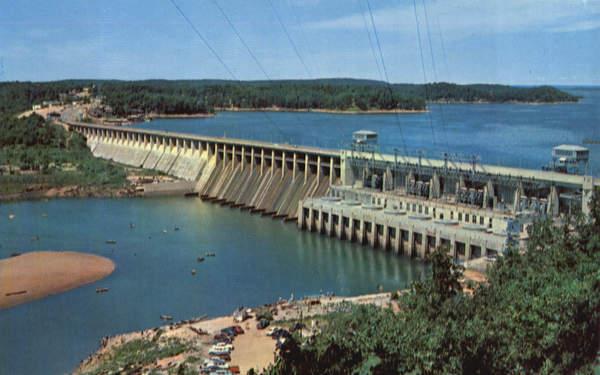
When traveling with the family as a child, we never stopped at motels. We would instead stop and stay overnight at relatives’ homes, if convenient, or at church “missionary homes”, both of which were scattered at convenient intervals across the country. Thus planning a day’s drive did not include stopping to see any of the sights, but just to get to the next place to stay overnight. There were some exceptions to this rule – on one trip I can recall visiting some Native American areas in Minnesota and the Dells of Wisconsin, seeing Bagnell Dam and boating on the Lake of the Ozarks in Missouri, seeing Mount Rushmore and buffalo herds in the Black Hills of South Dakota, the “Geographic Center of North America” in Rugby, North Dakota and visiting the “International Peace Garden” on the North Dakota – Canada border. But usually we whizzed right by these kinds of places to get to where we were headed.

Bagnell-Dam-in-Missouri-United-States

 download (5)

Usually the main thing for either Dad or Mom, whoever was the driver in charge for that given trip, was to “make time”. Many times, I can remember Dad or Mom just stopping along the road somewhere late at night, when whoever was driving simply could go no further, and sleeping. This was done perhaps behind a church in a small town (churches were deemed to be safe areas) or simply driving off the highway out into the middle of fields on a section or quarter road. I can remember so well Mom or Dad slumped over the wheel to sleep or leaning their heads between the seat back and the window while us kids in the rear seat flopped wherever we could, draped all over one another trying to get into a position where we could get some sleep.

 IMG_1094

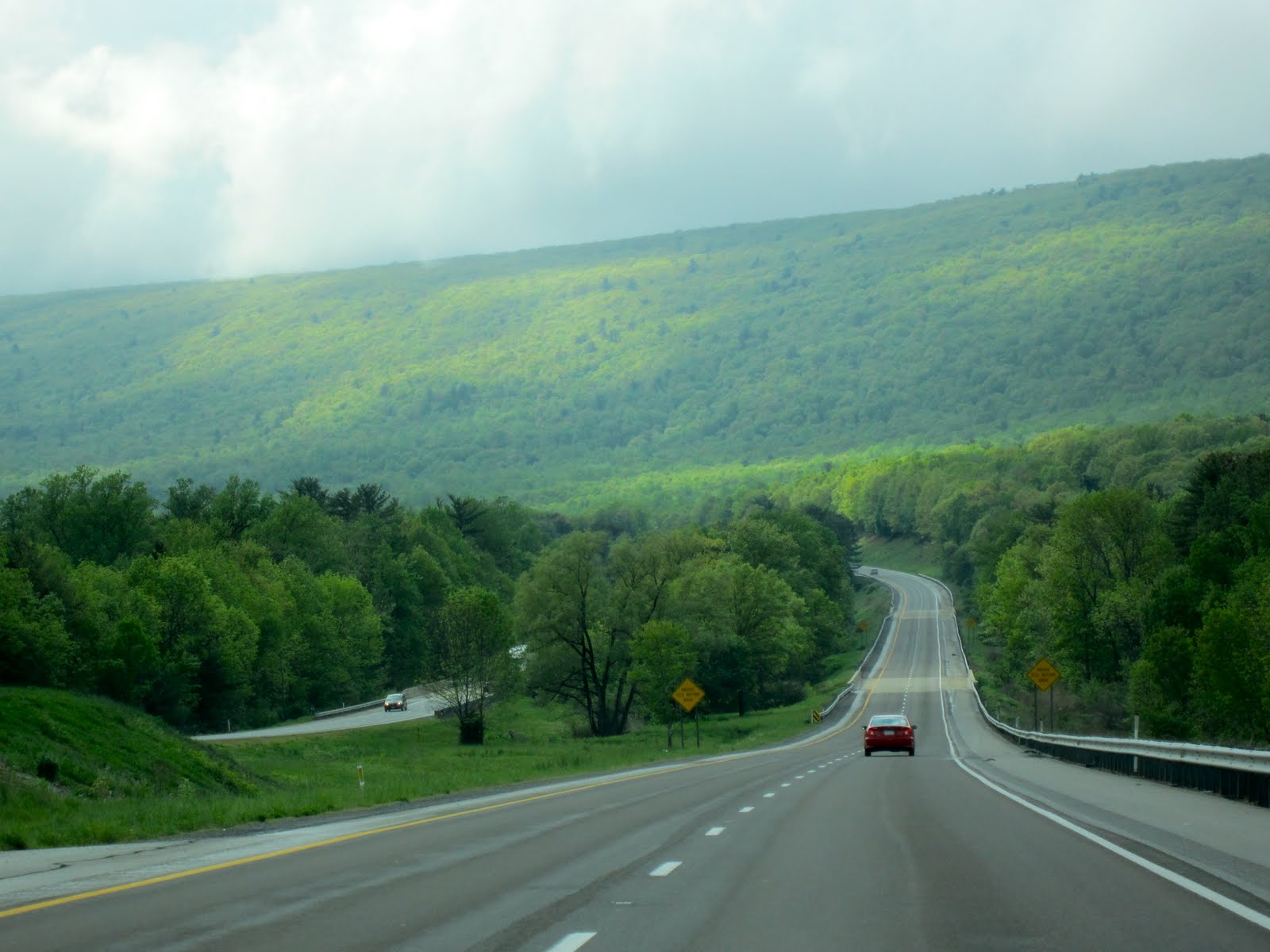
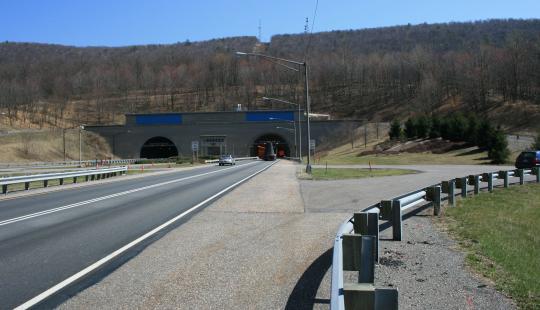
When leaving New Jersey, our first stop was always at Uncle Emil’s in Wooster, Ohio, a very convenient 500 mile trip, mostly on the Pennsylvania Turnpike. “The Turnpike”, then so called because it was the first such big toll road, was to us was one of the wonders of the world. To travel unimpeded by intersections or traffic lights, on a four lane highway with wide shoulders, through tunnels flattening out the  high ridges of the Appalachian mountains, was an incredible experience for drivers in the 1950’s, many of whom could doubtless recall how slow and difficult it was previously to travel east or west through Pennsylvania. So stage one of any trip west was this 500 mile jaunt, a good day’s drive and no sightseeing, just the regular stops at the Howard Johnson’s rest stops to go to the bathroom and buy some gas.

PTC_pa turnpike_1_E

The next stop could be a church missionary home in Cincinnati, Ohio, St. Louis, Missouri, or in Omaha, Nebraska. Or if you left early and drove fast and didn’t stop much, it was possible to get to Versailles, Missouri and Grandma and Grandpa Friedly’s on the very next evening. From there, it was possible to drive through Kansas and eastern Colorado and get to the church headquarters in Westminster on the third day. I remember the competition among us kids as we crossed the plains of eastern Colorado, all desperately craning our necks from the back seat to see who would be the first to spot Pike’s Peak, the first sign of the Colorado Rocky Mountains from US 36, 24 or 40. 

downloaddownload (2)download (3)

 Traveling America’s highways was quite different in the 1950’s. Before the Interstate Highway network you traveled east or west, once you left the Pennsylvania Turnpike, on US 40, US 24, US 30 or US 36. These highways were mostly two lanes and of course went through countless little towns. And on these highways you actually saw much of the country, got close to the local stores and markets, could stop and get fresh vegetables at a roadside stand, or stop at a little picnic table under a tree along the highway to make and eat sandwiches. Today, as John Steinbeck mentioned in “Travels with Charley” you can go coast to coast on the Interstates and not see much of anything.

460695841

On these long trips we children got used to playing a variety of games. One such activity was counting the cars of the railroad trains we saw. Another was to try to form the whole alphabet from license plate letters we saw on cars we passed or which passed us. Or we would form the alphabet from letters on signs and billboards along the highway. X’s and Z’s were very hard to come by, which added to the challenge and competition of the game.

DSC07891

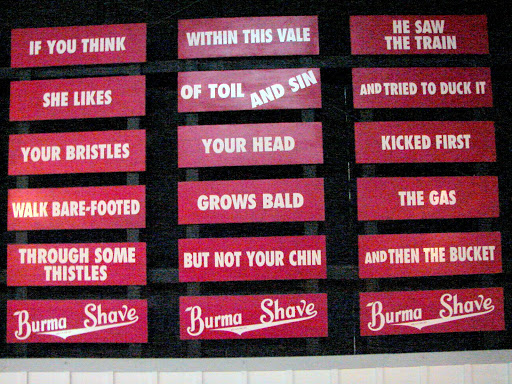
Another pleasure of the open road back in the 1950’s was reading Burma-Shave signs, which were a series of six or so red signs positioned about 200 feet apart along the shoulder with white lettering containing a clever jingle and ending with “Burma-Shave”. We eagerly looked for the next set of signs and recited the jingles in unison as each sign neared and became readable. A variety of nostalgia websites contain many of these jingles. Some examples: DRINKING DRIVERS…NOTHING WORSE…THEY PUT THE QUART…BEFORE THE HEARSE…Burma-Shave”, “DINAH DOESN’T… TREAT HIM RIGHT…BUT IF HE’D SHAVE…DINAH MITE!…Burma-Shave”, “DON’T LOSE… YOUR HEAD…TO GAIN A MINUTE…YOU NEED YOUR HEAD…YOUR BRAINS ARE IN IT…Berma-Shave”, and “BEFORE I TRIED IT…THE KISSES …I MISSED…BUT AFTERWARD-BOY…THE MISSES I KISSED…Burma-Shave”.

il_340x270.617327700_j55q

Another common sight while traveling by car in the 1950’s was the canvas water container hanging from car mirrors or radiators. These containers allowed the water inside to dampen the canvas, which then kept the water cold from evaporating surface moisture. You would see these bags mainly in the west of course since the more humid eastern air was not an effective evaporator/cooler.

Since the major east-west highways at that time often paralleled railroads, I also remember another dramatic sight – long rows of telegraph poles, laden with multiple cross pieces which in turn bore dozens of glittering glass insulators carrying scores of wires. These poles and wires undulated in a picturesque and dramatic wave pattern for as far as you could see.

8279480924_06469fe5fe_z

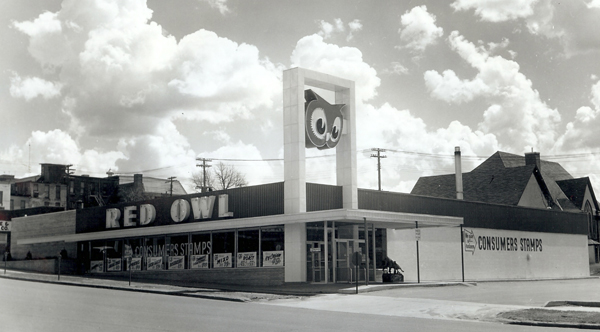
On these trips our diet was very basic. We opened cans of Van Camps pork and beans and ate spoonfuls directly out of the cans or maybe if we stopped, used paper plates and spoons we brought with us. We also bought loaves of bread, bologna and mustard and ate bologna sandwiches as we traveled. I can remember one time when Mom stopped in a little Midwestern town at a Red Owl supermarket where creamed corn was on sale at ten cans for a dollar. We ate nothing but creamed corn directly out of cans for the next couple of days.

0109.Grocers-1960-pix2

 We usually went to the bathroom when we stopped for gas. But if there was an emergency, we simply pulled over onto the shoulder and opened the two right side car doors on the ’49 Chevy or the ’54 Chevy wagon, and the child who needed to go went on the shoulder, the doors providing some privacy.

So “making time” on the big open American highway has been a huge part of my life. But it seemed that when traveling by car I was always pressured by time or circumstance to get someplace as quickly as possible. Even now, having the joy and privilege of homes in Vermont and Arizona and looking forward to some leisurely trips between them, it still seems that there is always something that makes speed essential – a couple of times the advancing winter weather when we returned to Arizona later than we wished, or family social events and home maintenance needs in other cases. Hopefully a leisurely trip during which I could drive through the south or through Canada, or through the Midwest to again see where my parents grew up, is right around the corner.

But up to now it’s mostly been driving as fast and as far in a day as I can because some deadline or other is staring me in the face. I did break my own record a couple of years ago when we had to get back to Arizona from Vermont (again, by a certain time) and drove from Paragould, Arkansas, where we had visited the last of Dad’s siblings, Aunt Burton, to Albuquerque, New Mexico, approximately 1100 miles in a day. A great drive to be sure, and I hope the last of them. I must slow down. I have passed so many roses in my life without getting even a whiff and at this point I should not care anymore about “making time”.

burmasigns


Massachusetts Driving Rules

23 Wednesday Jul 2014

Posted by ralphfriedly in Uncategorized

≈ Leave a comment

Tags

Massachusetts Driving Rules

My youngest brother recently vacationed in New England, starting by flying to Boston and renting a car. While on the phone with me he was lamenting how difficult it was to drive in the Boston area, saying that he had never experienced more difficult driving in his life.

I know what he means. When I moved to Cambridge in 1970 for graduate school I mostly got around on foot or by subway and left the car parked. But moving to the south shore the next year to work in Duxbury, I proceeded to get my full experience of the stress of driving in Massachusetts. An early experience occurred when I was driving to Boston on what was then called the Southeast Expressway. I was in the right lane minding my business more or less beside a driver in the left lane. Suddenly a motorist passed me on the right – but all there was on my right was the shoulder, mind you. Yes, he had passed me on the shoulder. I was so surprised and shaken that I had to get off the freeway, find a place to park and wait until I stopped trembling. But later experiences showed me that passing on the right and even on the shoulder was commonplace..

On many occasions, when at a traffic light, the light would turn green for me but drivers would continue to pass through the intersection, even though their light was red. Again, I was totally shocked and astonished, just as I was the first time someone pulled out in front of me to turn left, just sitting there, causing me to slam on my brakes and screech to a stop while he waited for traffic to clear from his right.

Over time, driving in and around Boston I continued to be surprised at the stupidity, reckless behavior and bad manners of Massachusetts drivers. I finally decided I would put together my own special list of “Massachusetts Driving Rules” and send them in to the Boston Globe as a letter to the editor. I never did, but reminded by my brother’s experience, I resurrected the list from my files and present it here. I am sure that most of these “rules” from the 1970’s still apply.

Freeway Rules

  1. Keep left except to pass; pass on right only; use the shoulder if necessary.
  2. If you accidently get off on the wrong exit, do not continue and get back on to find the right exit; simply stop and back down the exit onto the freeway. This way other motorists won’t take you for an idiot: they’ll simply think you are exiting.
  3. When traffic is merging, keep pushing in until the guy you are competing against “chickens out”. Do not ever take turns.
  4. When getting on to the freeway, the “YIELD” sign means keep going until the motorists in the right lane yield to you.

Other Rules

  1. When turning, first brake abruptly to confuse the driver behind you, then only signal (maybe… this is an option) as you begin rotating the steering wheel to the right or left to start your turn.
  2. At a stop sign, if the driver in front of you goes, you go.
  3. At traffic lights, regardless of whether the light is green, yellow or red, if the guy in front of you makes it, you can make it too.
  4. At dusk, always use your parking lights, not driving lights, in order to save energy.
  5. When turning right, whether signaling or not (remember that this is an option) ease the wear on your tires by swinging into the left lane and turning very widely.
  6. When turning left into two way traffic, do not wait for gaps in the traffic both ways. Simply pull out halfway, stopping traffic from your left. Then wait calmly for a break in the traffic from your right. Then proceed.
  7. When turning out onto a major road, wait until a vehicle is approaching on your left. Then turn abruptly out in front of them, accelerate slowly and do not exceed 35 miles per hour.

Retirement

18 Friday Jul 2014

Posted by ralphfriedly in Uncategorized

≈ 1 Comment

Tags

Retirement

I am finally becoming adjusted to one of the most difficult periods of my life. While the experts provide advice for dealing with life changing events like deaths, marriages, children, job loss and divorce, comparatively little attention is paid to retirement.o-RETIREMENT-facebook

The first problem for me was the difficulty of the transition from being useful and playing an essential role in an enterprise, to being essentially useless – going from having and exercising authority to having none, going from giving advice and guidance when it is sought, to realizing that they are no longer even solicited. There is certainly emotional and psychological satisfaction in feeling useful and this is obviously lost in retirement.

Another aspect of retirement with which I am still having difficulty, is that the education and training that took a professional lifetime of money, energy and time to accumulate and that had significant professional value either in the office or on the resume, have overnight lost all of their value. What good now are my hard-won doctorate, my countless professional trainings and the extensive professional reading? Where that education and training were extremely valuable in the work that I did, in retirement they have lost almost all of their value and for the most part lie dormant and dying in the depths of my mind.

Some of the evidence of this accumulation of education and skills were the hundreds of files of specially chosen professional journal articles pertinent to my professional interests and the massive professional library I had collected over the years. Finally throwing away all these precious files and giving away all of the books were traumatic actions that, while making life simpler, made me feel bereft of the comfort and support these documents and books had given me during my professional life. These documents were the armor and weapons for my professional roles and I initially felt weak, exposed and vulnerable when I suddenly did not have them.

Also the realization that all of the valuable experience accumulated over the years in different schools, school districts and international locations and that always served me well when tackling new challenges in a new location, was suddenly without value or utility, was difficult to accept. I had learned a great deal from having to adjust to new forms and varieties of professional challenges and suddenly, this wealth of experience was also worthless.

I am one person that has always enjoyed routines: the regular schedule for sleep, for meals, for showering, dressing, driving to work, the first cup of coffee in the office, the regularly scheduled meetings and the weekend schedule for home maintenance or shopping chores. That scheduled routine life has now been lost amid the utterly random “spontaneity” of retirement activities and duties. Maybe I will mow the grass today; perhaps I will start painting that room; I think I will take the car down for an oil change this morning; maybe I will start that book that I have always wanted to read. And the life maintenance duties which used to be completed quickly and efficiently as part of a day’s or weekend’s schedule now stretch out interminably and seem to take forever. However, I have managed to retain two valuable features of my daily routine: my two cups of delicious coffee in early morning while I read the Times and do some writing, and my relaxing Scotch on the rocks late every afternoon while I catch up on the day’s events on my laptop.

images (1)

Retirement has been a negative experience in yet another way. Work did not allow the luxury of focusing on the problems of aging, because of the more immediate problems presented by the work itself. It is only after retirement that I have become acutely aware of my slowly deteriorating body because now I unfortunately have the time to think and fret about it.

Finally, while I will eventually accept and deal with most of the concerns outlined above, the most surprising and pernicious aspect of retirement, and one that I can never accommodate, is the rapid passage of time. In the past I noticed that in times of idleness and relaxation, time really slowed down. And in my youth, time couldn’t pass fast enough, so eager was I to enter the next stage of personal or career development. But now when I want time to slow down, it instead speeds up. I read recently that this phenomenon is felt by most people in later stages of life and the reason for it seems to be that our brains are not learning much of anything new – surprisingly  it’s the learning that seems to slow time, explaining why time seemed to drag when as young people, learning and new experiences defined life itself. But I have found that now, even when reading new books, going to new places, writing about new subjects, all of which seem to be learning experiences, time has not slowed at all, but has continued its acceleration. What? It’s Wednesday already? It’s Friday? I can’t believe it! Where does the time go?

images

In recent months I have become better adjusted to retirement and have come to better appreciate the opportunity to pursue interesting activities (like writing this) for which I never found time while working. And maybe finally doing what I want when I want does have value. But I still view the initial stages of retirement as extremely difficult – serious emotional trauma about lost value and utility and a sudden awareness of a losing struggle with time and age. And despite retirement’s many advantages I can’t see these feelings completely diminishing anytime soon.

retirement-final


Mount Evans by Motorcycle

18 Friday Jul 2014

Posted by ralphfriedly in Uncategorized

≈ 1 Comment

Tags

Mount Evans

In the summer of 1975 I drove west to visit my parents and brothers in Denver as I usually have during the summer. At that time I owned a Honda CB360 while living and working in Massachusetts. So I was gratified to discover that there were some motorcycles there with three of my brothers – all Honda CB500’s.

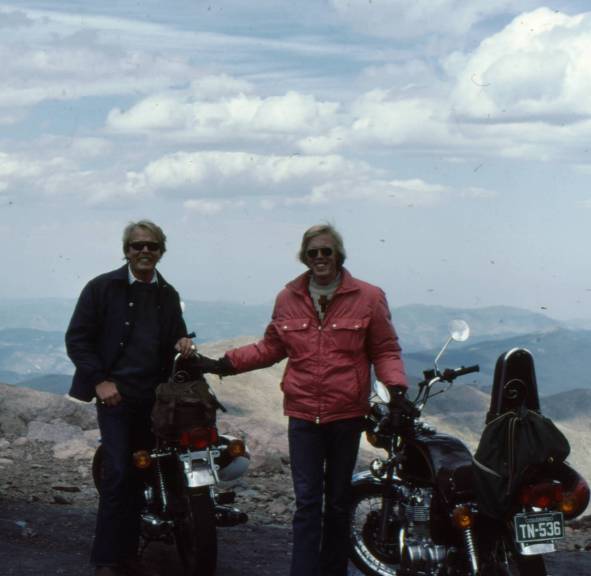
One day my youngest brother Stan and I decided to take a trip by motorcycle to the top of Mount Evans, one of Colorado’s 55 famed “fourteeners”, a 14,265 foot (4348 meters) peak in the front range and fairly close to Denver and one of two high peaks, the other one being Pike’s Peak near Colorado Springs, that have roads all the way to the top. The Mount Evans road has the additional distinction of being the highest paved road in North America. On the appointed day I borrowed my brother Richard’s motorcycle and Stan and I took off mid morning on our adventure. We wore fairly light clothing since it was a beautiful summer day, but we carried warm jackets and gloves for the later part of the trip since we would encounter much cooler high altitude weather as we got into the high mountains.

800px-Mt_Evans

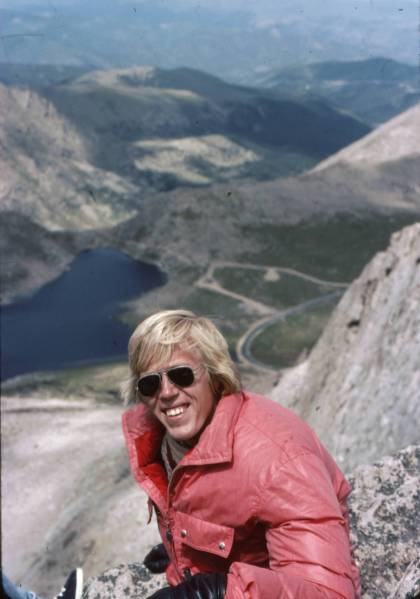
As we proceeded west from Denver on Interstate 70, the scenery changed to beautiful mountain valleys and forests as we ascended to around seven or eight thousand feet. We had stopped for a breather somewhere along the highway where I opened my 35mm camera, set it on automatic and hung it around my neck. After resuming our trip I took a couple of photos of my brother as we cycled along at 60 miles per hour or so.

I tried one photo of Stan as I moved ahead of him on his left. It came out bit blurry but still captured the moment and movement.

Image0178

Then a few seconds later, as I was behind him on his left, I called to him to turn around and took this shot.

Image0179

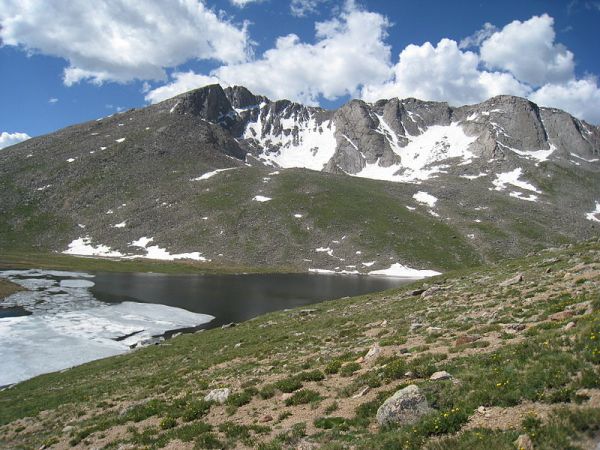
We left Interstate 70 at Idaho Springs at 8700 feet, paused to put on our jackets and gloves, and proceeded south on Colorado 103 steadily ascending in altitude for the 13 miles to Echo Lake at 10,600 feet. We then turned onto 15 mile long Colorado 5, the Mount Evans Scenic Byway, and continued on this undulating road, replete with multiple hairpin turns, for three miles to above timberline. We then continued to wind and circle upward past Summit Lake, another beautiful landmark, at 13,000 feet.

Image0183

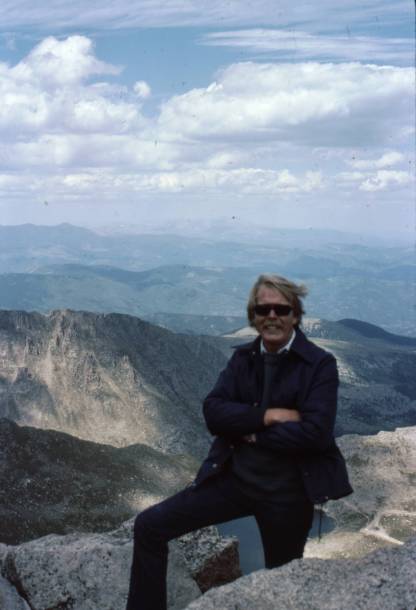
After a few more miles of steep winding road, we at last reached the summit parking lot where there were a few cars parked at the souvenir shop that is maintained for the summer months. We hiked the additional quarter mile to the summit to enjoy the view, took a few pictures, relaxed at the store for a few minutes and then headed back down the mountain to Idaho Springs, Interstate 70 and home

.Image0185

The excitement of motorcycling to such a high altitude with my youngest brother Stan made this a most memorable event which I have enjoyed recalling and reminiscing about for many years.

Image0189

The Kite Contest

14 Monday Jul 2014

Posted by ralphfriedly in Uncategorized

≈ Leave a comment

images

I have never been any good at winning. Under-aged and too small during high school, although I tried awfully hard, I was never the athlete I aspired to be. I ran fast but not as fast as others. I could throw, catch and hit but others could do it better. And others also passed or caught a football better than I.

This never-winning problem extended in later years to lotteries and casinos as well. While some friends became casino legends, winning easily on the poker machines or the slot machines, I only wasted my money. With lotteries I always lost except for one time when I came within one number of becoming a millionaire. Matching all the numbers but one on the Arizona Lottery at the time won me about $1300. But coming so close to the big prize and not getting it made me feel like I had lost.

But a long time ago when I was 12 years old, I did win something – a kite contest.

For some reason that I cannot now recall, the Stewart family sponsored a kite contest for local children and appropriately it was to take place in March. I do not recall any hard and fast rules – that you had to be within a certain age range or that you had to make it yourself or simply fly a kite bought at the five and dime store (remember those – with the wood pieces, the paper kite already with string in the edge folds rolled up together and sometimes even with a wad of string?) There must have been a make-it–yourself rule, otherwise where did the competition come in? Maybe since you bought the kite and assembled it you qualified as having made it. And, most importantly, what exactly was winning? Was it the biggest, the most colorful, the strangest shape? Was the winner the kite that flew the highest? All this I wonder about today but in the end, the way the contest concluded, it really didn’t matter.

What I remember vividly, however, is the process of making my kite. It was a traditionally shaped kite but extra big and extra strong. I began with some pieces of quarter-round trim my Dad had, then sawed them the right length, one about five feet long and the other about four. Then, securing them in the vise, I used his wood plane to shave off the curvature and make the sticks flat. Crossing these two pieces of wood and fastening them with string formed the five foot long by four feet wide frame of a very large kite. I then filed notches in the ends of the wood pieces and stretched some very strong nylon string around the frame.

images (14)

 I had obtained some plastic sheeting and cement, so then cut a piece of the sheeting a couple of inches bigger than the frame, then folded the edges over and cemented them. Now I had a very big and very strong kite, unlike many others I had flown.

images (11)

I punched a couple of holes in the plastic on the vertical piece of the frame and then used more nylon string to fasten what I think is called the bridle, a vertical string fastened to the longer piece of wood a little above the cross piece and about halfway down the bottom part of the longer piece. Then I punched holes in the plastic on the cross piece and tied a string between these points, wrapping it around the vertical bridle for stability. Then I fastened my kite string, also the same strong nylon, to the bridle at the point it was tied to the horizontal string.

I then made a tail for the kite out of pieces of cotton rag tied in bows and looped in another length of string and fastened it to the bottom of the kite. I still didn’t know if the kite would fly. I only knew that it was built using the correct dimensions but was simply much bigger. And it was so heavy, I knew it would need a serious wind to get off the ground – it likely would not fly in a mere breeze.

Then the day of the kite contest arrived. I was lucky – it was a very windy March day, a little chilly, not much sunshine but big gray-white clouds rushing across the sky. Well at least there was wind, quite necessary for the contest, but the wind was very strong and even seemed to be increasing in intensity on this March afternoon.

I think there were maybe eight or ten other kids who had brought kites that day for the contest. I don’t remember much about the other kites except that there were a several store-bought kites among them.

The appointed time came, and we contestants ran about to give our kites a push into the air and then reeled out enough string so they could continue upward. As I said before the wind was strong. Once up in the air, all of the kites had no problem ascending. But the wind, much stronger up high, started catching many of the kites and driving them out of control. Many spun crazily, broke and crashed to the ground. Others seemed to weaken and break more gradually, but still ended up spiraling dizzily to the ground in a pile of debris. Several that did not spiral out of control were driven so strongly by the wind that the string mooring them to their masters broke and the kites blew away, landing who knows where. Mind you, all of these collapsing and broken kites, despite their shape, were made of wood and paper.images (1)

But my kite? At first my kite, bigger than most of the others, was simply one of many. Then it was one of a few. And at last, my kite, made of strong wood and cemented plastic sheeting, and connected to its maker by strong nylon string was the only kite left in the sky, sailing high and majestically in this March gale, held upright by its long rag tail.

So what was Mr. Stewart to do? All criteria for winning had to be scrapped – it didn’t matter what the rules specified – my kite was the only kite that stayed in the air that windy day. Yes, I won, finally won something – in this case, a boy’s dream, a pocket knife with four strong shiny blades and a genuine bone handle.

boker-tree-110185-pocket-knife-side-large

More than Transportation

07 Monday Jul 2014

Posted by ralphfriedly in Uncategorized

≈ 1 Comment

Tags

1962 Chevrolet Corvair, 1963 Pontiac Tempest, 1966 Chevrolet Corvair, 1968 Chevrolet Camaro, 1970 VW Kombi, 1972 VW Camper, 1973 Porsche 914, 1978 Honda Accord

I have always enjoyed driving. And many of the automobiles I have owned over the years, especially in my more adventurous younger days, represented something considerably more than simple transportation. I owned a number of convertibles, which to me represented breezes, sunshine, youth and freedom, and (hopefully and futilely) rendered me more attractive to young ladies (it’s interesting that today all the people driving convertibles seem to be my age; today’s young people do not seem to be interested!). And at one time I actually owned a real sports car.

Image0190

In Hiawatha, Kansas 1962

In the 1960’s I owned two Chevrolet Corvair Monza convertibles – an aqua 1962 and a maroon 1966. The Corvair was a daring product for an automobile company like General Motors: a small compact car with rear mounted air-cooled all aluminum engine with six horizontal opposed cylinders and one of Detroit’s more innovative reactions to the increasing popularity of smaller German and Japanese cars. The Corvair also had four wheel independent suspension which, along with the rear engine, gave it superb handling characteristics. It is unfortunate that an early flaw in the suspension, quickly corrected in later model years, allegedly caused some crashes, described in Ralph Nader’s book “Unsafe at Any Speed”. This negative publicity resulted in a downturn in sales and the ultimate demise of this truly unique American car.

Image0191

I lived in Denver, Colorado in 1961 and 1962 and first became acquainted with this remarkable vehicle through a good friend who owned a 1961, from the Corvair’s second year of production. On our joyrides through the curves, inclines and slopes of the Colorado foothills and mountains, I was astonished at how well his car handled and vowed to get one myself, resulting in my aqua 1962 Corvair. Then my friend and I did some joyriding in my car as well and even took it on a quick road trip to and from New Jersey in 1962.

Image0192

Charlie, Richard and Stan

When I returned to New Jersey and resumed my education, my little brothers enjoyed riding with me in the “Monza” and Charlie, Richard and Stan had their picture taken in front of it one Sunday.

1963_Pontiac_Tempest_LeMans_Convertible_For_Sale_Front_resize

1963 Pontiac Tempest

Somewhere between the ’62 and the ’66 Corvairs, we bought a 1963 Pontiac Tempest convertible, one of GM’s “compact” cars from the 1960’s and another very unique car. The engine was a four cylinder, but a very unique four, consisting of the regular Pontiac 389 V8 with one bank of cylinders missing. To compensate for the missing four cylinders, a new driveshaft had to be manufactured for this strange engine, called the “slant four”. In addition, this car contained another GM innovation – moving the transaxle to the rear and connecting it to the engine with a flexible drive shaft, thus getting rid of the hump and flattening the floor. The car was fun to drive but owning this car ended badly. At that time we had absolutely no idea of how manage money and we discovered that we could not afford this car and were falling behind on payments. I called the GMAC office in Newark and arranged a voluntary repossession, drove the car to Newark, turned it in, gave them the keys and shamefacedly took the public bus system back to New Brunswick. So ended our affair with the Pontiac Tempest, but, surprisingly, giving the car up in this way actually improved our credit rating.

I guess it was some time after the Pontiac Tempest affair that we bought the 1966 Corvair convertible. This car served us well – taking care of our commuting and pleasure driving needs in New Brunswick for a couple of years and then taking us safely across the country in 1968 to Pinon, Arizona, my first teaching location on the Navajo Reservation. While at Pinon, this beautiful little car also took us reliably and efficiently to scores of National Parks and Monuments all over the beautiful American southwest.

Image0194

White Sands, New Mexico 1968

I had always serviced the car myself and took very good care of it. But after moving the next year to Rock Point, Arizona, the engine of this beautiful little vehicle failed on a trip to Tucson. The car was belching clouds of black smoke, running unevenly and burning lots of oil. I don’t know exactly what was wrong but it was likely a cracked piston or broken rod. Corvairs’ air cooled engines ran considerably hotter than water cooled engines and that fact could have been the cause of my problem. At any rate, I had to keep pouring cans of oil into the engine between Tucson and Phoenix, and not having the time to have it repaired, found a dealer there who would accept it as a discounted trade-in, and drove a ’68 Comaro (white with blue interior and yes, another convertible) back home to Rock Point, Arizona. I hated to say goodbye to my second and last Corvair but by that time GM had ceased production and this great automobile was history. Thank you, Ralph Nader.

Image0193

At Barbara’s 1967 – Sheila and Fifi

The Camaro convertible was a dependable car, not as good on gas but fine for driving around the Reservation and for the long shopping trips to Farmington, New Mexico. I remember one frightening incident with the Camaro. On the way back from a shopping trip to Farmington on US 160, somewhere around Red Mesa, I accidently shoved the automatic transmission handle into reverse while I was going about 60 miles per hour. The tires squealed and smoked, the rear end was fish-tailing and I thought I had lost the whole drive train, but I stopped and found that the transmission still worked and the engine was ok, and then proceeded on home. I think I was very lucky.

pic_69RS_r

1968 Chevy Camaro

The Chevy Camaro lasted us until we found out that we were going to move to Cambridge, Massachusetts for me to go again to graduate school and needed a car that would carry some significant cargo. After looking around, I decided to buy a new 1970 Volkswagen Kombi, the most stripped down Volkswagen bus imaginable, so stripped down in fact that there was no back seat – just empty space and a bare painted steel floor behind the front seats, quite simple and barren, but very serious cargo space. I later built a wood structure that brought the floor behind the seats up to the level of the floor over the engine so you could place a mattress and sleeping bags in the back and comfortably camp. This vehicle certainly fulfilled its purpose for transporting cargo, its box shape maximized space for a huge volume of personal possessions.

images (2)

1970 VW Kombi

Like all Volkswagen buses of that vintage it was woefully underpowered, causing extreme embarrassment when going up hills as a long line of angry frustrated drivers gathered behind and generally gave an angry glare and blast on the horn when they were finally able to pass. And the floor-mounted manual shift had so much give that it felt like you were shifting with a sapling. However, this vehicle (I can’t call it a car) served us well, through the last few months on the Rez, the year in Cambridge and the first years of my job in Duxbury, Massachusetts. It was the vehicle in which I did my own limited version of Steinbeck’s “Travels With Charley”, taking a wonderful trip by myself with the family dog.

Another pleasant memory relating to VW buses at that time was that you automatically became a member of a certain group or fraternity of other VW bus owners. Heading down the highway in this bus or my later VW Camper, the old “V” peace sign was always exchanged between drivers. This feeling of kinship could have been an assumption of kindred political opinion, for it seemed that VW buses were the preferred mode of transportation for hippies back in the 60’s and 70’s, or the peace sign indication of kinship among VW bus owners may simply have been a sign of shared frustration with driving these boxy, poor handling and under-powered vehicles. At any rate, I did enjoy feeling that for whatever reason, I was a member of that select group.
Soon after settling in to the Duxbury Public Schools job and building the first house we owned in Plympton, Massachusetts, I purchased my dream car, a 1973 Porsche 914. Anyone knowing anything about sports cars, knows that this car, with its mid-engine design, was superbly balanced and handled like a dream. Its engine was essentially a bored out and souped up air cooled Volkswagen engine, coupled with a very tight five speed manual transmission. I really enjoyed this vehicle, taking it on a trip west, visiting my Grandfather and Aunt Ada Friedly on the way, camping in Zion and Bryce National Parks and ending with visiting my parents and brothers in Denver. In its trunks (since the engine was in the middle, it had small trunks front and back) I had my suitcase, tent and camping equipment.

Image0195

Campsite in Zion National Park 1973

As an aside, I should mention that when I was comfortably situated in my campsite in Zion, seated at my picnic table, enjoying the peaceful beauty while sipping a Coors after a tasty supper of a bologna sandwich and Van Camps pork and beans, I was assaulted by a huge Winnebago with California plates and dirt bikes fastened to the bumpers, pulling into the campsite beside me. In no time the peaceful and relaxing silence of that heavenly place was violated by the noise of loud voices and laughter, TV and two-cycle engines, completely destroying the contemplative mood in which I had been basking. All I could do was drink enough additional Coors’ until I didn’t really care anymore.

Image0197

Utah vista 1973

On the way back to Denver after camping in Bryce Canyon National Park, I found myself on a very straight stretch of highway between Green River and Hanksville, Utah, and decided that this was my opportunity to see how fast my little Porsche would go. Pushing the gas pedal down as far as I could and keeping it there, it got me up to 115 miles per hour, still the fastest speed I have ever experienced in any car.

Image0250

Plymouth, Massachusetts 1973

By the way, this little sports car was great on gas mileage, a very valuable feature while waiting in gas lines back in the infamous days in the early 1970’s of “shortages”. After filling up, I was always able to avoid another gas line for a very long time.

When my sanity returned in the midst of building my second house in Plympton, Massachusetts (actually built by my talented brothers, Richard and Glenn – I was the unskilled labor), and knowing that I would have to be “camping” while finishing the house, I sold the Porsche (for more than I paid for it) and bought my second Volkswagen bus, this one a full fledged camper. The well-known “Westphalia” camping configuration inside this small vehicle was very efficient and utilitarian and could sleep a couple of adults and a couple of children quite comfortably. It was also large enough inside to enable me to transport large items needed for the continuing house construction. But on a trip home with some furniture items from the Jordan Marsh warehouse in Quincy one evening, all the lights on the dashboard went on when the engine seized up, the rear drive wheels screeching and skidding until I hit the the clutch pedal. My air-cooled, overstressed (again, a very small engine propelling a fairly heavy vehicle) and hot running Volkswagen engine had simply worn out, maybe threw a rod, as they say, simply broke or whatever. At any rate, I had the vehicle towed to a repair place where I had a rebuilt engine put in the vehicle.

download

1972 VW Camper

The final chapter in the story of my VW camper was quite serious. During the winter, while driving home from a friend’s house in what seemed to be just rain, the temperature had gone down and near my house the rain, unknown to me, had turned to the infamous “black ice” . The last thing I remembered before waking up in the Plymouth Hospital the next day was my camper slowing, spinning, totally out of control but still going 40 miles per hour. I was told by the police the next day that I had hit and knocked down a telephone pole and had put out the lights for miles around. The police found me covered with blood staggering around in the back of the vehicle. I had sustained a very severe head wound, a concussion and several broken ribs, the former from striking the windshield and the latter from hitting the steering wheel. The entire passenger side of the front was crushed three feet in. If I had hit the pole a little more to the left, I would certainly have been killed instantly. VW buses were notorious for their complete lack of crash protection in the front.

images (3)

1978 Honda Accord

Shortly after that incident, I became acquainted with the Honda Accord through a good friend, who owned a 1977, then a brand new design and entirely new kind of car from Honda, which previously was known mostly for motorcycles and the tiny Civic. After hearing my friend extol its many virtues I was convinced that the Accord was the kind of car I needed, so I bought a new aqua 1978 Honda Accord and quickly became completely convinced that it was one of the highest quality cars I had ever owned. It had great acceleration and gas mileage, handled beautifully, took to Massachusetts winter driving nicely with its front wheel drive and had many luxury features that were “extras” on other vehicles at the time. I loved this car, which marked the beginning of my “practical” car owning days, which included a number of other Hondas, a Plymouth Voyager, a Ford Explorer, a ’76 Chevy pickup with a camper, a GMC van, a Ford Escape, up to the present 2004 Dodge Dakota and the 2009 Toyota Corolla, all practical, none glamorous or exciting.

It’s been a great ride, owning and driving this variety of vehicles over many years. Like so many other things in my life, the people I have known and loved and the places I have lived and worked, each of my cherished vehicles added a distinct kind of experience, color and definition to my life.

← Older posts
Newer posts →

All Posts

  • Itching and Scratching August 17, 2024
  • Afterlives in the Here and Now July 12, 2024
  • What the Hell is Wrong with Us…and the World? July 10, 2024
  • Symptoms vs. Causes: Missing the Mark September 22, 2023
  • Our Grand Canyon September 18, 2022
  • On Turning Eighty June 18, 2022
  • The Blood of Children and the Tears of Parents June 8, 2022
  • Growing Up in the Pillar of Fire: A Memoir February 6, 2022
  • The Medicare Advantage Scam December 21, 2021
  • Yet Another Rant December 7, 2021
  • Majority Rule? Think Again – Why a Minority Rules America November 27, 2021
  • The United States of Incrementalism November 27, 2021
  • Short Story November 24, 2021
  • The Troublesome Challenge of Choice November 6, 2021
  • Down Memory Lane July 31, 2021
  • Face It July 24, 2021
  • Elder Statesmen July 20, 2021
  • A Covid Winter in Vermont June 15, 2021
  • A Way with Words: The Devious and Devastating Genius of Frank Luntz… and More January 14, 2020
  • Wooster High September 11, 2019
  • Vermont Redux August 6, 2019
  • Oh Please, Come On Now July 3, 2019
  • The Trump Whisperer June 15, 2019
  • Still Ranting June 8, 2019
  • Connections March 21, 2019
  • Rant February 9, 2019
  • “White Poison” November 1, 2018
  • What We’ve Lost October 12, 2018
  • The Vote: “Cornerstone of Our Democracy” September 26, 2018
  • Justice and Accountability  September 25, 2018
  • 6 November 2018 August 31, 2018
  • Flying August 11, 2018
  • On the Minus Side of Dying: Musings on End of Life May 23, 2018
  • Sanctimonious Hypocrisy May 9, 2018
  • Foresight in 2020 May 6, 2018
  • Black Ice April 24, 2018
  • Why We Drink April 22, 2018
  • Reasons for Seasons March 20, 2018
  • Fitness Frustration: Pet Peeves at the Gym January 18, 2018
  • They Are Missed December 23, 2017
  • Hollow Patriotism: Honoring the Troops December 21, 2017
  • Interstate of Mind: Reflections on Highways and the Trucking Industry December 7, 2017
  • The Real Problem With Taxes in America November 8, 2017
  • From Chaos to Clarity: My Undergraduate Education September 11, 2017
  • Should Ken’s Thoughts About Gender Offend Her? August 25, 2017
  • Simple Solution to a Perennial Problem: Raise the Fuel Tax August 25, 2017
  • Rx for a Sick Democratic Party July 5, 2017
  • Well, Trump Voters… June 19, 2017
  • Home Sweet Home June 11, 2017
  • Summer 1957 May 2, 2017
  • The Backwards Hat April 24, 2017
  • Sears, Roebuck and Company March 3, 2017
  • “Shared Values” February 25, 2017
  • Thank You, Trump Voters: Amateur Hour and Executive Disorder in the White House February 16, 2017
  • The Sounds of Music February 14, 2017
  • Is This a Conversation? February 13, 2017
  • My Hank Williams Movie February 10, 2017
  • The NFL and I January 23, 2017
  • Election Reflection II December 24, 2016
  • Election Reflection November 11, 2016
  • “Cat’s in the Cradle” Comes True? November 11, 2016
  • Daylight Saving Time….Why? November 5, 2016
  • When I Fell in Love with Country Music November 4, 2016
  • Obit for Obamacare October 8, 2016
  • Irwin Elementary School 1965-1968 August 23, 2016
  • Micro and Macro: Ruminations on Life and the Cosmos July 25, 2016
  • Rotten Apple July 13, 2016
  • Biblical Literacy July 13, 2016
  • Self-Driving Car? Really? Why? July 7, 2016
  • We Shall Over-comb July 4, 2016
  • Stressful Life Events July 4, 2016
  • Why? I’ll Tell You Why July 3, 2016
  • Generational Generics May 15, 2016
  • Let’s Change the U.S. Constitution April 18, 2016
  • Economics 101 April 18, 2016
  • Talk to Your Doctor About… April 12, 2016
  • Tractors April 7, 2016
  • The Noxious Cloud of Republican Orthodoxy April 7, 2016
  • A To-Do List for our Broken Congress January 20, 2015
  • Quitting Smoking: A Mindful Experience December 6, 2014
  • My World of Work November 8, 2014
  • Golden Rules for Living November 7, 2014
  • Tennis Anyone? September 10, 2014
  • Mirror, Mirror, on the Car August 30, 2014
  • Making Time July 23, 2014
  • Massachusetts Driving Rules July 23, 2014
  • Retirement July 18, 2014
  • Mount Evans by Motorcycle July 18, 2014
  • The Kite Contest July 14, 2014
  • More than Transportation July 7, 2014
  • Books that Influenced My Life July 1, 2014
  • The Death Penalty June 25, 2014
  • Dear Dad, June 14, 2014
  • Is There a Right Wing Conspiracy? June 10, 2014
  • Living in Vermont June 10, 2014
  • What Is a Billion? June 9, 2014
  • How to Become a Liberal May 29, 2014
  • Barbara My Sweet Sister May 29, 2014
  • A Winter Drive May 13, 2014
  • Dear President Obama, May 12, 2014

Meta

  • Create account
  • Log in
  • Entries feed
  • Comments feed
  • WordPress.com

Blog at WordPress.com.

  • Subscribe Subscribed
    • Ralph Friedly
    • Join 38 other subscribers
    • Already have a WordPress.com account? Log in now.
    • Ralph Friedly
    • Subscribe Subscribed
    • Sign up
    • Log in
    • Report this content
    • View site in Reader
    • Manage subscriptions
    • Collapse this bar
 

Loading Comments...