• About Ralph Friedly

Ralph Friedly

Category Archives: Uncategorized

“Cat’s in the Cradle” Comes True?

11 Friday Nov 2016

Posted by ralphfriedly in Uncategorized

≈ Leave a comment

Tags

"Cat's in the Cradle", Conrad Friedly, Harry Chapin, Torrey Malatia

When the children were young our home was always full of music. One of the first tasks I accomplished when moving to a new residence was to string speaker wire through the house via the attic or beneath the carpet from a switching unit behind my amplifier to sets of speakers strategically located throughout the house. Thus I could play music throughout the entire house or could direct it to a single or selected number of rooms.

This practice began at my house at in Plympton, Massachusetts which was built by two of my younger brothers, Richard and Glenn. Before the drywall went up we strung over a hundred feet of speaker wire through the studs throughout the house from one central location, the living room, where I had planned to set up my turntable, tape players and receiver and store my records and tapes. After the sheetrock went up virtually every room in the house had a hole in the wall with left and right speaker wires protruding.

Later married and having children I continued the habit. Because I attached a timer to my system as well, the entire family woke up every school day and work morning to classical music streaming from Phoenix’s classical FM station, announced with the mellifluous tones of Torey Malatia, then just starting out on his very successful NPR career. I do remember calling Mr. Malatia once and asking if he could perhaps limit the amount of opera in his early morning offerings because when just awakening, an aria from a full voiced tenor or soprano can be a shock to the system. Interesting though, my son Conrad enjoys opera very much today – maybe because of those days as a child in Phoenix?

OK, this has been a somewhat obtuse and circuitous way of introducing the main theme of this article so I‘ll try to finally get us there. There was a splendid song that we listened to quite often in our wired and speakered home – “Cat’s in the Cradle” by Harry Chapin. The song’s lyrics are very poignant, especially for a father and a young son and give them both much to contemplate:

My child arrived just the other day
He came to the world in the usual way
But there were planes to catch, and bills to pay
He learned to walk while I was away
And he was talking ‘fore I knew it, and as he grew
He’d say, “I’m gonna be like you, dad
You know I’m gonna be like you.”
And the cat’s in the cradle and the silver spoon
Little boy blue and the man in the moon
“When you coming home, dad?” “I don’t know when
But we’ll get together then
You know we’ll have a good time then.”

My son turned ten just the other day
He said, “Thanks for the ball, dad; come on, let’s play
Can you teach me to throw?”
I said, “Not today, I got a lot to do.”
He said, “That’s okay.”
And he walked away, but his smile never dimmed
And said, “I’m gonna be like him, yeah
You know I’m gonna be like him.”
And the cat’s in the cradle and the silver spoon
Little boy blue and the man in the moon
“When you coming home, dad?” “I don’t know when
But we’ll get together then
You know we’ll have a good time then.”

Well, he came from college just the other day
So much like a man, I just had to say
“Son, I’m proud of you. Can you sit for a while?”
He shook his head, and he said with a smile
“What I’d really like, dad, is to borrow the car keys
See you later; can I have them please?”
And the cat’s in the cradle and the silver spoon
Little boy blue and the man in the moon
“When you coming home, son?” “I don’t know when
But we’ll get together then, dad
You know we’ll have a good time then.”

I’ve long since retired, and my son’s moved away
I called him up just the other day
I said, “I’d like to see you if you don’t mind.”
He said, “I’d love to, dad, if I could find the time
You see, my new job’s a hassle, and the kid’s got the flu
But it’s sure nice talking to you, dad
It’s been sure nice talking to you.”
And as I hung up the phone, it occurred to me
He’d grown up just like me
My boy was just like me
And the cat’s in the cradle and the silver spoon
Little boy blue and the man in the moon
“When you coming home, son?” “I don’t know when
But we’ll get together then, dad
We’re gonna have a good time then.”

Yes, every time I heard that song I felt a little guilty and wondered if I really was spending enough time with my son. Looking back, really I think I spent considerable time with him and I think his own recollections would support this. Indeed I was frightfully busy – sustaining a complex family life, maintaining, repairing and improving homes, maintaining vehicles, working at a time-consuming job in a demanding field and even writing a doctoral dissertation. But I think I always found time for watching Laurel and Hardy with Conrad, teaching him how to ride a bicycle, to throw and catch a football or a baseball, building him (and the other children) all sorts of things, from assembling a swing set to constructing a sports court and an elevated playhouse. I also remember reading to my son quite often, although usually it was his mother that read to him nightly before sleeping. We also hiked the Grand Canyon together not once but twice – down and up, then rim to rim to rim. But could I, should I, have given him more time?

Amazingly, whenever we heard Harry Chapin’s song, little Conrad would get tears in his eyes and would almost begin to cry. I remember discussing his feelings with him a few times but could never fully understand what it was about the song that made him feel so sad. Was it the little boy in the song whose “smile never dimmed” and whose admiration for his father, persistently expressed in “I’m gonna be like you, dad. You know I’m gonna be like you.” never wavered but who never got his dad to play with him that brought the tears? Or was thinking about the harried, overworked father whose promises of time with his son were never kept and then at the end of the song and toward the end of his life, found that his son was indeed like him and too busy to give him any time? Or was he considering his own life….and mine, and seeing some parallels, or harboring fears about how our relationship might change in the future? Whatever in the song brought the tears to my little boy’s eyes and made me think, we have always found this song memorable and deeply moving.

And now, regardless of how much or how little time I gave Conrad when he was young, it seems that life has in fact brought Conrad and me around to the last stanza of the song and rendered the song still sadly meaningful in my life today. For indeed, my son, now a public defender in Gallup, New Mexico, carrying a constant and crippling 100 plus cases, struggling and fighting to give each of his indigent clients the best legal help possible, seems far too busy to talk with me. And with our shared intense interest in history, literature and politics, I miss hearing his opinions and his insights very much. Usually when I call, during his business day, or evenings or even weekends, I hear his voice saying “Conrad Friedly”, then leave my message and wait…and wait. Could it really be be that “…he’s grown up just like me. My boy was just like me….”? And had I really been that busy? Perhaps so – it certainly feels that the song has come true for both of us.

Daylight Saving Time….Why?

05 Saturday Nov 2016

Posted by ralphfriedly in Uncategorized

≈ Leave a comment

Tags

daylight saving time

Well tonight I have to reset all the clocks in the house – how is it – “spring ahead, fall back”? So since it’s November I guess I set them back. I have never liked day saving time and have never understood why we have it. I offer some explanation and clarification below.

daylight-saving-time

I have an exceedingly time-sensitive constitution. A change in time screws up my brain, my insides, my equilibrium and my opprobrium. For example I have a fairly accurate internal alarm clock. Usually at bedtime if I tell myself I need to get up at six o’clock, or five, or four, I do, and very precisely too. The imposition or lifting of daylight saving time messes up this handy alarm clock and it takes a long time to get it back in synch. Additionally, the one to three hour changes imposed by an airplane flight within the US cause havoc to my system and internal schedule. Even the more gradual time changes imposed by a cross country car trip mess me up. And for a metabolism like mine the massive changes imposed by the “jet lag” of intercontinental flights is absolutely cataclysmic. Melatonin doesn’t work, sleeping aids don’t work. Only time, and lots of it, gets me back in balance after the crippling blow of east – west or west – east transcontinental flight.

And all this makes me wonder – why on earth do we have daylight saving time anyhow? One of the states in which I live, Arizona, while foolish, reckless and embarrassing in politics, e.g. Governor Jan Brewer and Sheriff Joe Arpaio, is really considered and wise when it comes to daylight saving time – it doesn’t have it. We refuse to participate. But on the other hand, the huge Navajo Reservation within Arizona does observe daylight saving time. But the smaller Hopi Reservation within the Navajo goes along with the state and does not observe it. So….when driving across these areas in northern Arizona in the summertime, be prepared to change your watch not once but twice. And if you drive from adjacent New Mexico through northern Arizona and these reservations, you will change time not twice but three times. Oh, and three times back again when you are leaving.

ben-franklin

Good old Ben

Back to my question of why we have daylight saving time. Well it has an interesting history. First, in addition to his tiresome and cliched maxims that inflicted so much pain on us as children, like “early to bed, early to rise, makes a man healthy, wealthy and wise” and “a penny saved is a penny earned”, we have the venerable Ben Franklin to thank for originally conceiving of the idea. Then around the turn of the last century George Hudson, a New Zealand entomologist and William Willett, a British outdoorsman, both promoted the idea in their respective countries. Eventually daylight saving time was formally advanced by Robert Pearce, a British MP, but the Parliament was wise enough to vote down his proposal. The first country to actually try daylight saving time was Germany in 1915, ostensibly in order to save fuel to conduct its war. Then for the same reason  it was adopted by Britain and also by the US when it entered the war. This egregious practice of violating the laws of nature then went away for several decades, only to emerge again in the US in 1942 as a way to assist the war effort. President Roosevelt imposed it all year long, calling it “War Time”. The time zones were Eastern War Time, Central War Time and so on. But at least nobody had to “spring ahead” or “fall back” since it was imposed permanently. Later, after the confusion and inconvenience of a hodgepodge of states, counties and even municipalities choosing to adopt it or not, the US standardized daylight saving time in 1966 with the Uniform Time Act with only Arizona and Hawaii successfully petitioning to be left out.

One of the most dominant responses to the question of why we have daylight saving time is that it was needed by farmers in order to provide more daylight hours for planting, cultivation and harvesting of crops. Well, this response is dead wrong. Farmers generally oppose daylight saving time. Being fairly intelligent they simply get up when the sun rises to start their day’s work and conclude when the sun sets. To reset their clocks is an inconvenience to farmers – it just messes up market times and milking times.

daylight-saving-confusion

And what about the other reasons that have been touted to retain this needless practice? Some claim that it saves energy. It does not and likely does just the opposite, extending the need for air conditioning and increasing other energy consumption through extending other human activity. But golf courses make more money with the longer summer day. Well maybe golfers could rise earlier and get on the course more quickly. Daylight saving time “increases recreational opportunities”. I don’t know about this one either because movie theater attendance actually goes down with the imposition of daylight saving time. Countries and states that don’t ascribe to this dreadful practice don’t seem to be suffering. I know Arizona doesn’t. And Hawaii certainly doesn’t appear to have an evening recreational problem either.

Moreover, in the most heavily populated countries of Europe, tucked firmly in the boreal reaches of the northern hemisphere where the summer day is already impossibly long, why on earth would you want to extend a summer day when the sun already sets at 9:00 PM on standard time?

worlddstmap-10-10-10b

As of this year Turkey should be the “previous” color

Some countries are considering dropping DST or have already stopped it. Recently Turkey decided to do what Roosevelt did during World War II in the US – stay on “summer time” year round. Turks will not be moving clocks back this fall. And in the US many states, among them Florida, Idaho, Illinois, Michigan, Missouri, new Mexico, Oregon, Texas, Utah and Washington, have considered joining Arizona and Hawaii and abandoning the practice. And recently California joined the group, a good sign since California usually leads the rest of the states in keeping up with the times.

There are many reasons to drop daylight saving time. As noted above studies have shown that energy use actually increases with the extension of daylight hours. Obviously moving clocks ahead or back, or choosing to not move them, creates havoc with airline schedules and the timing of business phone calls and financial transactions. There is certainly lost productivity in the workplace when clocks are moved ahead or back. And there are safety issues for people driving to or from work in the dark and, more importantly, for children being picked up or dropped off from school in total darkness.

indian-opinion-of-daylight-saving-time

Maybe “government” should instead read “the white man”

So considering all the above, changing our clocks twice a year seems like a needless and inconvenient practice and needs to be scrapped. Let’s stay on standard time year round, or once we change to daylight saving time, let’s stay on that all year. It just doesn’t make any sense to keep changing our clocks. We’re not gaining anything – the day is still 24 hours long.

When I Fell in Love with Country Music

04 Friday Nov 2016

Posted by ralphfriedly in Uncategorized

≈ 7 Comments

Tags

1950's country music, Dion, Dion Dimucci, Don Larkin, Hometown Frolic, John Herald, Larkin Barkin', Sylvia Robinson, Sylvia Vanderpool, WAAT Radio

While growing up in the Bronx in the early 1950’s young Dion DiMucci, later of the famed “Dion and the Belmonts”, would run home from school to catch the last hour of a country music radio show called the “Hometown Frolic” on Newark station WAAT and ended up buying every Hank Williams record he could after first hearing Hank on the program. At about the same time, teenager Sylvia Vanderpool in New York, later the Sylvia of “Mickey and Sylvia” and the hit song “Love is Strange” fame and future Sugar Hill Records hip-hop mogul Sylvia Robinson, loved country music because her mother listened every day to the Hometown Frolic. Also during the early 1950’s, John Herald, later the key founding member of the “urban bluegrass” group The Greenbriar Boys, while at Manumit School in Bucks County, Pennsylvania, used to bolt his lunch in order to dash back to his dorm room to obtain his intoxicating doses of bluegrass music on the Hometown Frolic. And in the 1950’s, a kid growing up with seven brothers and sisters among the farm fields of central New Jersey discovered WAAT, Don Larkin and the Hometown Frolic and fell in love with country music.

img173

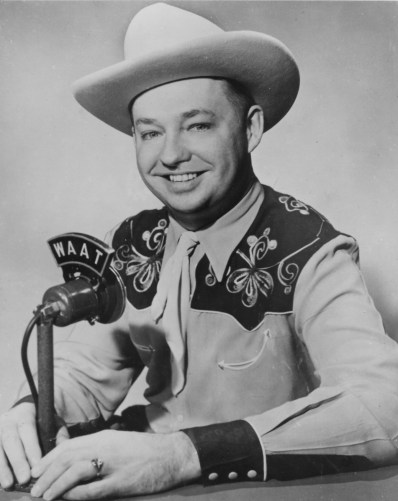
Don Larkin

I was a child of perhaps 10 or 11 when I joined the thousands of country music fans in New York, New Jersey, eastern Pennsylvania and Connecticut, who listened to Don Larkin on his Hometown Frolic show on station WAAT from Newark. It was on Don’s show that I first heard the driving rhythms and harmonies of Bill Monroe’s bluegrass music and the plaintive songs of Hank Williams and other country artists of that day. “Larkin Barkin’ ” began each show with Gene Autry’s “Back in the Saddle Again”  and ended with the same artist’s “Goodbye Little Darlin” . The Hometown Frolic opened up a whole new world for me – the country music of Williams, Ernest Tubb, Grandpa Jones, Hank Snow, Faron Young and so many others, and the bluegrass music of Monroe, Johnny and Jack, Flatt & Scruggs, the Louvin Brothers, Reno & Smiley and the Stanley Brothers.

img172

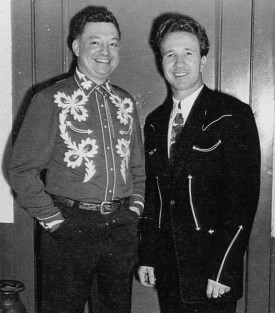
Don and Marty Robbins

As the 1950’s unfolded, my interest in recorded music expanded to rock and roll and to classical music, but country music has long been an important layer in the foundation for my love of music. And I owe this appreciation of country music to the Hometown Frolic and its fabled deejay, Don Larkin, who ran the show for 11 years, from 1950 when he took it over to 1961 when WAAT was sold, changed its call letters and cancelled the Hometown Frolic.

img160

Don and Patsy Cline


While spinning country music records for his radio audience, Don Larkin also became a concert promoter in the New York – New Jersey area, bringing live country music concerts for the first time to to audiences in this part of the country. Don brought artists such as Bill Monroe, Marty Robbins, Patsy Cline, and Johnny Cash to venues in Newark, Jersey City and Long Island. Don also successfully ventured into the songwriting business, seeing his “Stolen Waltz”, “Game of Broken Hearts”, “Don’t Keep it a Secret”, “Goodbye Maria (I’m Off to Korea)” and “She Said”, published and recorded by a variety of artists.

Earlier in his radio career, young Mr. Larkin, who played piano quite well, was prevailed upon to accompany a skinny young singer from nearby Hoboken making his radio audition. The name of the kid making his radio debut? Frank Sinatra. Don then left radio for awhile to earn his law degree but before he could use it, he joined the military to make his contribution to vanquishing the Nazis by serving as a spotter pilot in the European theater.

After his WAAT days and the termination of the Hometown Folic Don eventually left radio, ran a restaurant business in Pennsylvania for awhile and then moved to Phoenix, Arizona where he worked in real estate before retiring. And occasionally a client looking for a home in the Phoenix area must have exclaimed something like, “Don Larkin? Could you be the same Don Larkin I listened to on the radio when I was a kid? Wow, how wonderful to finally meet you!”

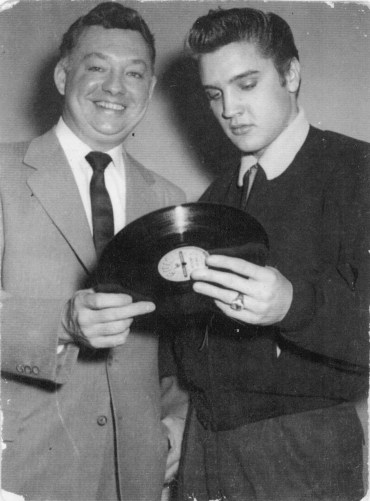
I basked in the memory of Don Larkin and his Hometown Frolic and continued to enjoy the music introduced to me by him so long ago, but never heard his name again, never met any others who had enjoyed his radio show or encountered anyone with any knowledge of his whereabouts until August of 1997. It was then, while home in Scottsdale, Arizona for the summer from my job at the American School of Kuwait, that on August 11, I happened to open a copy of the Arizona Republic and was astonished to see an article about none other than my childhood radio friend and hero, Don Larkin. img164The Republic article was prompted by the occasion of the 20th anniversary of the death of Elvis Presley, whom Mr. Larkin had met and at the behest of his then agent, Bob Neal, had played and promoted “Baby, Let’s Play House”, one of Elvis’ early Sun recordings, on his radio show.

img176

Don and Elvis Presley

Since I was returning to Kuwait in a week or so I took the article with me, resolving to somehow connect with Don in order to at long last express my admiration and appreciation for him and the music he shared with me when I was a youngster. Having no home address, I sent a letter to Mr. Larkin through Thomas Ropp, the Republic reporter who had written the article, requesting that he forward the letter to Don. This he obviously did, for in October I received the following reply from Don, sent to me care of my school in Kuwait. I have chosen to reproduce the entire letter because his obvious joy and pride at connecting with an old fan perfectly reflected my own happiness with finally locating and contacting him. And the letter is illustrative of the jaunty good humor which embellished his radio program.

img165

img166The following summer it was my pleasure to visit Don and his wife Peggy in their Phoenix home and reminisce about his time on the Hometown Frolic. Don was effusive and ebullient in describing the old days at WAAT and his years as a promoter of country music shows in the New York area. And I felt the same way with the pleasure of finally meeting Don and being able to talk with him personally. And it was a privilege to have my picture taken with my childhood hero and country music mentor.

img158

Don and I 1998

Over the next several years I called occasionally to say hello to Don and Peg and was saddened to understand that Don was gradually succumbing to Alzheimers and becoming an increasing burden for Peg. I was not aware until later that Don had passed away in the fall of 2003 at the age of 90 shortly after I moved to a new job in Izmir, Turkey.

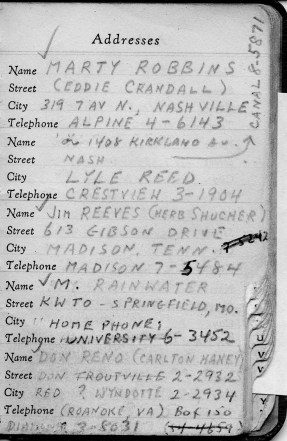
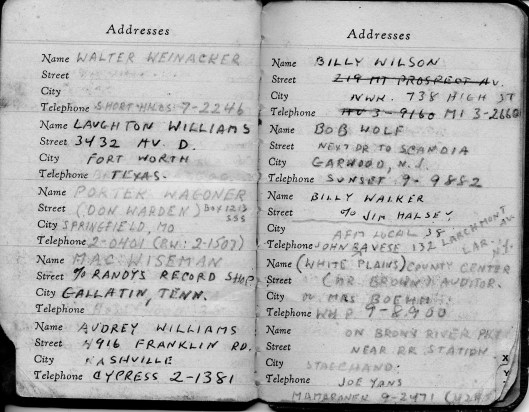
img177During  a subsequent contact Peg said she had put together a packet of mementos for me so I stopped by one day to pick up a tan envelope containing some real treasures. I felt very privileged to receive this gift, for in addition to pictures of Don at the height of his success and popularity as a deejay and the original (I think) letter from Bob Neal asking Mr. Larkin to play Elvis’ recording, Peg had given me the address book that Don had kept as a deejay and promoter. I was thrilled to leaf through this precious little “who’s who” of 1950’s country music and find so many familiar names (along with addresses and phone numbers), among them Hank Snow, Eddy Arnold, Chet Atkins, Elton Brimg178itt, Lefty Frizell, Stuart Hamblen, Freddie Hart, Grandpa Jones, Ralph Rinzler (member of the original Greenbriar Boys, booking agent for Bill Monroe and other bluegrass groups and later a folk music authority for the Smithsonian), Marvin Rainwater, Maxine Brown (of “The Browns”), Jim Reeves, Marty Robbins and…Audrey Williams, Hank Williams’ widowed spouse.


img180

img179

Also in the envelop of mementos so graciously gathered and presented by Don’s wife, was a copy of the September 1998 issue of Bluegrass Unlimited, which contained an entertaining, detailed and complimentary article about Mr. Larkin and his life and career, written by Bill Knowlton, who had also had the pleasure of listening to the Hometown Frolic as a youngster. This article also quoted Don’s recollection of my letter sent to him from Kuwait in 1997:
In August of 1977 the Arizona Republic did a feature on Don which was read by a former resident of New Jersey now teaching school in the Middle East. The reader was so moved by the article that he wrote to Don: ‘I love country and bluegrass music. But as a New Jersey native I am sometimes asked how I developed the love of this kind of music growing up as I did 30 miles from New York City. My stock reply is alway like: Well, when I was very young we didn’t have television and I listened to the radio a lot. There was this station WAAT from Newark and a disc jockey, Don Larkin, who played country music every day on this show. I grew to love Hank Williams, Hank Snow, Johnny & Jack, Bill Monroe, Patsy Cline, Elton Britt, Montana Slim and so many others because of Don and his program. Listening to ‘Larkin Barkin’ was one of the highlights of my childhood. Thank you and WAAT again for bringing so much wonderful music into my life in those early years”. Thank you Don and Mr. Knowlton for including this in the article.

Recalling the pleasure of listening to Don Larkin’s radio program so long ago and the later fortuitous discovery of where he lived and subsequent meeting with him and his wife Peg, also now well in the past, I have experienced great pride and happiness in writing this article about him and his work and what they meant to me and so many others. I feel very privileged to have also perhaps touched his life in some small way and to have been singled out by his lovely wife for the gift of precious mementos of his life and career. I am but one of the thousands of listeners he had back then but I earnestly hope that at least a few of the rest discover this paean to Don Larkin and the Hometown Frolic and enjoy reading it as much as I have enjoyed writing it.


Obit for Obamacare

08 Saturday Oct 2016

Posted by ralphfriedly in Uncategorized

≈ Leave a comment

Hardly a week passes without a negative Obamacare headline staring at me from the New York Times. The Affordable Care Act, also known as “Obamacare” was passed with great fanfare in March 2010 and was variously labeled as “the greatest advance in healthcare since Medicare and Medicaid” and as the “the most positive thing that this country has done since the civil rights legislation that was passed back in the ’60s.”

The Republican House has voted dozens of times to repeal Obamacare without ever offering a viable alternative. However, it certainly appears that the Affordable Care Act is dying a slow death all by itself without Republican assistance. Look at a few headlines from the last couple of years:

Big Changes in Fine Print of Some 2015 Health Plans

Seeking Rate Increases, Insurers Use Guesswork

Data Shows Large Rise in List Prices at Hospitals

Double Digit Rate Hikes Loom for Obamacare 2016

Sorry, We Don’t Take Obamacare

Think Your Obamacare Plan Will Be Like Employer Coverage? Think Again

Health Insurers Use Process Intended to Curb Rate Increases to Justify Them

Aetna will leave most Obamacare exchanges, projecting losses

Health-care exchange sign-ups fall far short of forecasts

Obamacare Marketplaces Are in Trouble. What Can Be Done?

These news headlines illustrate exactly why I think that the Affordable Care Act cannot continue to exist in its present state: a medical care system intended to ultimately cover everyone and reduce medical costs while relying on corporations whose sole reason for existence is profit.

Michael Moore’s brilliant and prescient film “Sicko”, released almost 10 years ago, made this abundantly clear (by the way, while he is dismissed as a kook by the right, Mr. Moore to me is a sage, prophet and patriot). “Sicko” pointed out that anything less than a single payer program, like “Medicare for all”, any program involving corporations and profit contains the seeds of its own destruction. The medical insurance companies must show a profit and must, like all capitalist enterprises, increase profit and grow. Stasis and balance are not part of the capitalist system. And how does a health insurance company grow and increase profit? By gaining more customers, paying less in benefits or charging more for premiums, a recipe for the failure of any corporate-run effort toward providing universal coverage.

Health care is a public issue and should be a public service like education, highways, water, and electrical service. It should not be viewed as a commodity to be bought and sold. One should not have to buy a health insurance “policy”, as if buying car insurance. Access to affordable healthcare should be a right and should be enshrined among all of our other rights, as it is in European countries. It is interesting to glance back at the “Second Bill of Rights”, proposed by Franklin Delano Roosevelt in 1945 and which surely would have been enshrined in the constitution had he lived. One of the articles in this wonderful document is: “The right to adequate medical care and the opportunity to achieve and enjoy good health”.

It might be useful to consider what health insurance companies do to earn their massive revenue and profits. Well they do essentially what the state bureaucracies operating the Canadian National Health program or the British National Health Service do. They take money from government or private sources and, based on the nature and level of service provided, pass it along to doctors, hospitals and drug distributors. Not very complicated is it? In countries with national health systems, this process is conducted very efficiently and economically. In the US, with United Healthcare, Cigna, Humana, Aetna and a host of other companies performing this simple function, it becomes very expensive because these companies have to make a profit to pay shareholders and to pay their CEOs’ multi-million dollar salaries. Something is indeed wrong with this picture.

So what do you suppose happens at Board meetings or at high level executive meetings in these companies? How do the highly paid “big guns” of United Healthcare or Humana or Aetna sit around their big shiny tables and brainstorm corporate strategy or new products or new markets for future growth? Well, considering what they actually do, they’re embarrassingly limited. A “new product” has to be a new “policy” which provides less service to the consumer or less compensation to the doctor or hospital. A new growth strategy is “how do we get more people or companies to sign up and buy our “product” or “how can we discourage the sick and chronically ill from signing up and encourage more young and healthy people to sign up? Or maybe the best and most simple strategy of all – let’s raise the prices of the health insurance policies we sell. Or better yet, let’s disguise an increase by having the consumer pay a higher deductible and keep the price the same. Or, let’s make the language describing the benefits we provide really confusing and deceptive, surreptitiously raising the deductible or the copay. Or, best of all, since we’re an integral part of Obamacare, how can we squeeze the government for more customers, for bigger subsidies, more money so we can increase profit? These are corporate strategies like none other – no investment in research, invention, engineering, design improvement, raw materials selection, creativity or test marketing. These healthcare corporations must be the envy of all other corporations – my God, they make profit, pay their shareholders, pay millions to their CEO’s for merely performing a simple bureaucratic function and with massive government assistance.

The history of providing healthcare in the US is depressing. While European countries and our neighbor to the north moved inexorably toward government funded universal coverage, effort after effort in the United States failed miserably. Proposals were condemned as “socialist” or “communist” or labeled as “interfering with doctor – patient relationships” or a making doctors “slaves”. President Truman’s valiant 1949 effort to provide a national program failed because of powerful conservative opposition from the likes of Senator Robert Taft who claimed it was “right out of the Soviet constitution”. The American Medical Association opposed the program also, with one of their pamphlets reading, “Would socialized medicine lead to socialization of other phases of life? Lenin thought so. He declared that socialized medicine is the keystone to the arch of the socialist state.”

President Johnson’s “Great Society” efforts in the 1960’s led to Medicare and Medicaid for the elderly and the poor, both supported by the medical establishment, but not to universal coverage for everyone else. President Clinton’s efforts to provide universal coverage, led by then first lady Hillary Clinton, also met with failure because of opposition from health insurance companies and the entire rest of the healthcare industry, exerted through intense lobbying of members of congress.

Another important reason that national healthcare efforts failed over the years was because of the growth of employer-provided health insurance and the companies that administered such plans. During World War II when competition for workers was fierce and employers were not allowed to raise wages, expanding employee benefits was the only way to attract workers so companies began to offer health insurance as one of those benefits. Also of course, companies could deduct the cost of employee health insurance coverage as a cost of doing business. So it’s no surprise that over the years employer provided insurance dampened the demand for universal coverage. The provision of employer provided medical insurance also gave health insurance companies the opportunity to become firmly planted in America’s corporate landscape.

Access to good health insurance is a prominent and consuming concern for most Americans. If your employer covered you and you switched jobs, you might lose your coverage. Employers could change the levels of coverage, requiring larger deductibles or copays to maintain the profit margins for the companies administering the insurance. And buying affordable coverage became almost impossible for the self-employed. I will never forget a statement made by one of my favorite nonfiction authors, Susan Jacoby, remarking in her book “Never Say Die: The Myth and Marketing of the New Old Age”, what an incredible relief it was for her to turn 65 and finally be covered by Medicare. Thank God, the struggles were over – no more worries about medical insurance. One of my brothers, self employed, pays about $25,000 per year to insure him and his spouse and is counting the days to age 65 and Medicare. Another, who receives his medical insurance from his employer, has seen his costs and deductibles rise while his coverage has diminished. And I myself, despite having always worked for employers who covered me and, for an additional charge, the children and the spouse if necessary, the size of deductibles and/or copays was always a concern, as was the cost of drugs required by a family member. And I could still have lost everything I owned if stricken by a catastrophic illness. What a relief for me when I turned 65 and for my spouse when she too became eligible for Medicare, that our worries were over. This is the way it should be for all Americans at all phases of their lives. A Canadian, a Dane, a German, a Frenchman, is simply and logically covered – for everything – no limits or exclusions, from the moment of birth to the moment of death.

The powerful influence of corporations has colored and flavored all recent “advances” in healthcare. First was the intrusion of health insurance corporations into Medicare with “Medicare Advantage” programs, through which they received funds directly from the government to administer and profit from their own enhanced versions of Medicare, further solidifying their positions on the corporate landscape. And the George W. Bush Medicare expansion to provide drug benefits was virtually written by the pharmaceutical corporations, guaranteeing huge profits for themselves through the disallowance of negotiated drug prices. And finally, Obamacare itself was written by the medical insurance companies with the complicity of their congressional lackeys. Retention of private corporations in the program and the exclusion of a “public option” were ways to radically increase the number of their customers at government expense. Like charter schools, the Affordable Care Act became simply another way to shovel public money into corporate coffers.

Obamacare’s invitation to “Come, compare policies and select the one that’s best for you and your family” rings hollow. These “policies” are extremely complex. Who is really prepared to weigh and compare deductibles, exclusions, copays, benefits, networks, costs and the many other variables in a typical health insurance company policy? This complexity is designed to result in one thing – concealment of gradual and incremental cost shifting from the insurer to the patient in order to increase profit, not improve healthcare.

Obamacare’s reliance on the fabled capitalist “market” and “competition” is also chimerical. With insurers now leaving the exchange markets in droves, there will soon be little or no competition. Also, the reduction of insurers into fewer and fewer players through buyouts and mergers will undoubtedly result in market collusion to maintain or improve profit, not competition to improve service or gain customers.

Another problem with Obamacare is administering the mandate requiring individuals to buy insurance and providing the subsidy for those qualified to receive assistance. The “punishment” for not buying insurance, imposed in end-of-year tax returns, is not immediate and therefore not effective. And the subsidies are “tax credits” and whether paid up front or at the end of the year are needlessly complex and confusing. All this complexity is the result of retaining the needless role of private corporations in providing health insurance. And many individuals are opting to remain uninsured and simply pay the penalty.

Many individuals covered by employers or purchasing private insurance prior to the ACA have seen their plans change dramatically, rendering President Obama’s assertion that “if you like your health care plan, you can keep your health care plan” and Senate Majority Leader Harry Reid’s claim that “you can keep your family’s doctor or keep your health care plan if you like it” totally fallacious. What actually happened is that insurers administering employer plans sometimes reduced benefits to match the minimums required under Obamacare or sometimes increased deductibles and/or increased copays. Individual plans also changed shape and size after Obamacare. Many self-employed people or people not covered by employers found plans they had purchased before Obamacare increase in price or reduce benefits.

The claim by Obamacare advocates that “market forces” and “competition” would work to keep prices down and benefits up is also false. When maintaining certain levels of benefits or a low price cuts into profit, those efforts are abandoned. This is why the biggest insurer, United Healthcare, has withdrawn from most state insurance marketplaces and why another healthcare giant, Aetna, has abandoned them altogether.

Obamacare has been reduced to the level that in order to maintain the involvement of private insurers, more government money has to be given to them. And to involve private insurers in the first place, Obamacare is incredibly complex and unwieldy. Just go to the website and take a look at what is offered, how subsidies are offered and so on. Your eyes will glaze over, your heart rate will increase, you will perspire and you will need a dose of healthcare yourself, then and there. And even though you hate your job, you will stick with your present employer because your insurance, no matter how meager, is provided for you. And even though your deteriorating physical condition dictates that you should retire now, you will stagger into work until you are 65 just so you can finally stop worrying about medical insurance. And when you finally do have Medicare, you will realize once and for all how important it is to provide health insurance as a right to everyone, regardless of age, employment, health or income.

Also, another important part of Obamacare, the expansion of Medicaid to cover the poor, was foolishly left up to the discretion of the states. Thus, states whose governors or legislators opposed Obamacare, or likely more accurate, disliked the skin color of our president, rejected Medicaid expansion.

So what to do now? When and how can we look at the provision of healthcare like a grownup nation instead of like an immature teenager, pandering to health insurance companies, and spending twice as much on healthcare as necessary? I am sure that the present difficulties will be handled for now by injecting more government money into the program to prop up insurers’ profits. But only a truly national program, arbitrarily enrolling every American of every age and of every measure of health, will provide a pool large enough that everyone can be covered at a reasonable cost. And the modest tax increase necessary to do this will be more than compensated for by reduced personal costs for each American.

The most recent headline in the Times about Obamacare’s problems, today October 3, 2016, reads, “Ailing Obama Health Care Act May Have to Change to Survive”, introducing an article rehashing much of what I have written above and concluding that inclusion of a public option, dropped during the writing of the law at the behest of private insurers, may now be necessary.

So Obamacare cannot survive as written and surely will die, unless changed completely from what was planned by corporations and their congressional servants. Above I have offered its obituary. Below I suggest an appropriate epitaph:

HERE LIES OBAMACARE
BORN 2010 LIVED BRIEFLY THEN DIED CIRCA 2016
CONCEIVED TO SERVE A PUBLIC NEED
KILLED BY PRIVATE CORPORATE GREED

Irwin Elementary School 1965-1968

23 Tuesday Aug 2016

Posted by ralphfriedly in Uncategorized

≈ 6 Comments

Tags

Albert Cavallero, Anthony Maranca, Barbara Garofalo, Barbara Thornley, Cindy Demarest, Daniel Thompson, David Cavadel, Dawn Bellettiere, Frank O'Brien, Irwin Elementary School, James Collins, Jane Armstrong, Judy Padilla, Kathy McNeff, Kathy Naddeo, Kevin Dunn, Linda Klimscak, Marianne Verzi, Mark Bigos, Michael Marosy, Michael Reynolds, Nancy kalbach, Pam Smith, Paul Heikkila, Richard Schaibel, Robert Bigos, Robert DePaul, Robert Plichta, Sonia Newmerzhycky, Sydney Bevington, Thomas O'Shaughnessy, Thomas Quijano

I have talked with many teachers about their first teaching experiences and all agree on one point – they remember their first students very well. I am no exception and remember most of my fourth graders from September 1965 at Irwin School, East Brunswick Public Schools in New Jersey quite well. The organizational pattern in which I taught there in my first teaching position was semi-departmentalized, where I taught reading and language arts to two groups of fourth graders, one in the morning and one in the afternoon, and my teaching partner, Mari Klett, taught the same two groups math, social studies and science. I taught most of my AM fourth grade children as sixth graders a couple of years later, so I knew that particular group extremely well. Also, they were my “homeroom” students, because I greeted them in the morning, took them to lunch and if I remember correctly, bid them goodbye in the afternoon when they returned to my room to get their belongings to take home.

img117

Grade 4 AM Class 1965  (We’ll see how I do) – Back row, L-R – David Cavadel, Robert Plichta, Albert Cavallero, Cindy Demarest, Judy Padilla, Barbara Thornley, can’t recall, Linda Klimscak, Richard Schaibel, Thomas Quijano;  Middle – Paul Heikkila, Jane Armstrong, Barbara Garofalo, Marianne Verzi, Kathy Naddeo, can’t recall, Kathy McNeff, Anthony Maranca; Front- Daniel Thompson, Michael Marosy, Robert DePaul, can’t recall, Michael Reynolds, Kevin Dunn, Thomas O’Shaughnessy

Now, some fifty years later, I can close my eyes and still see their faces and smiles and hear their voices clearly. Many times I have wondered how their lives turned out – what they have become and accomplished – as mothers, fathers, professionals, career people, artists or musicians – and have wondered if any of them have ever thought about me over these many years and wondered how I have been doing. I was but one teacher among many, to be sure, and they were just a few of the hundreds of children I have known, but they were the first so I remember them best. And additionally, seeing them in the hallways and lunch room when they were with Mr. Zezensky in fifth grade and then teaching many of them again in grade six, I knew them even better.

img118

Grade 4 PM Class 1965

I met my first classes as a brand new teacher with no student teaching experience. During my senior year in college I suddenly realized that I had to make a decision about what to do with my history major and English minor, thought I might enjoy teaching and took several education courses during spring semester of my last year in college. I also visited a couple of local schools and asked the principal if I could observe a few classrooms. I was thrilled to watch the interaction between teachers and students in a public school elementary classroom and was excited by the realization that not only “I could do this” but also “I could really enjoy this!”

So I responded to an ad from East Brunswick Public Schools, filled out an application, sent in my transcripts, and was invited in for an interview with Dr. Thomas Bowman, the superintendent. Looking back, I don’t think that the interview was a great success. I remember completely misinterpreting a question about “grouping” and answering it incorrectly, but I suppose my youth, energy and eagerness were enough that my poor response was overlooked by Dr. Bowman and I got the job. Also, there was a shortage of teachers in New Jersey that year so perhaps merely the fact that I had a pulse and a temporary teaching certificate were enough.

I was assigned to Irwin School, a typical suburban school in the middle class community of East Brunswick, a town that neighbored mine of New Brunswick. I have only dim recollections of orientation programs at the District Office and at the school itself. What I remember most vividly is the first day of school, and after the hassle of getting kids to the right room and teacher and the first class finally beginning, those 30 or so fourth graders in their new school clothes, hair brushed and combed, looking at me with their bright, eager eyes, waiting for me to begin teaching and then maybe deciding whether they liked me or not and accordingly what kind of school year they were going to have.

Most prominent among those first-day and first-year experiences was the feeling that I had really found something I loved to do. I fit into elementary education like a hand into a glove. Was it easy? No, it was very difficult but I enjoyed every minute of it. I recall a colleague at Johns Manville Research where I worked during my last year of college and resigned from to become a teacher, telling me that wow, it was going to be so easy for me from now on – short workday, summers off, Christmas breaks, and so on (https://ralphfriedly.com/2014/11/08/my-world-of-work/). Little did he know…or I at that time, what teaching was really like.

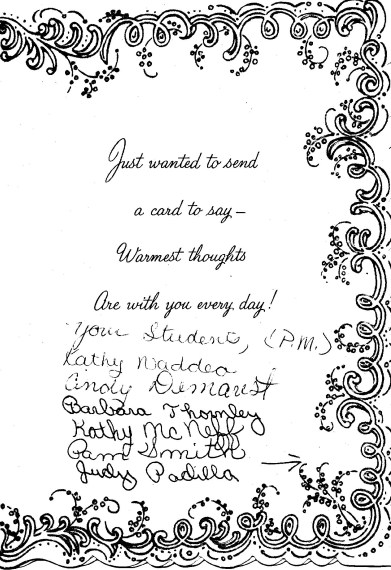
When I accepted an offer from the Bureau of Indian Affairs three years later and made plans to resign from my job in New Jersey and move to Arizona, I asked my AM fifth graders and my PM sixth graders (who were almost all my first fourth grade AM class) to write me a goodbye letter which I could keep to remember them. I still have that sheaf of letters and a few greeting cards from that day June 21, 1968 clipped together and filed under “Memorabilia” and have got them out from time to time to reminisce and remember those children. As I read the notes, I can still put a face and voice and sometimes a form or demeanor along with the name and remember these children fondly. Here’s the note from Robert Plichta – husky boy, pleasant, serious, and hard working; Tom O’Shaugnessy – good ball player, good student, gregarious, good sense of humor; Linda Klimscak – attractive, shy, demure, smart little girl; Robert DePaul – small stature, very animated, eager and talkative; Cindy Demarest – blond hair, personable, polite and helpful, used to join Kathy Naddeo staying after school and helping me; Barbara Thornley – tall, graceful, dignified, serious girl, good student….Anthony Maranca – energetic, polite, verbal, good worker, good athlete; Barbara Garafalo – very short hair, freckled face, cheerful, willing, but didn’t particularly enjoy school work; Nancy Kalbach – slim, friendly girl with a ready smile, remember her hair always pulled back with a ribbon (maybe it’s just the pictures); Paul Heikkila – gentle, soft-spoken boy with a crewcut; Judy Padilla – dark hair, shy, quiet, gorgeous smile; Michael Reynolds – usually a  flattop hair cut, pleasant, self-effacing, always a smile, Albert Cavallero – slim, pleasant, soft-spoken, cooperative, Kevin Dunn – always well-dressed, polite and neat, and on and on….sorry to leave a few out.

I remember David Cavadel very distinctly, with his droll sense of humor and quiet unobtrusive intelligence. I guess it was a 6th grade science class in which we were discussing how warm air rises and cold air descends and how, appropriately, the first flying machines were hot air balloons. As an activity we measured the temperature at the base of the classroom walls and at the ceiling and of course found a measurable difference. Then David had to ask, “Mr. Friedly, Mr. Friedly – if warm air rises and cold air sinks, then why is it colder on mountaintops than in valleys?” Well, I hemmed and hawed and probably weaseled my way toward some kind of inadequate answer, or better, perhaps I said brightly, “Great question, David, let’s all try to find the answer together”, but really, in view of what we had just discussed, I didn’t know. Because of his sense of humor, I thought for years that perhaps David had become a comedy writer, but Google tells me that he has become a chiropractor in his home community of Old Bridge. I was 23 years old when I began teaching. If David was nine or so that year, he is approaching the end of his career and could be retired by now.

Image0136

Daniel Thompson

And then there was Daniel Thompson, a little boy who had great difficulty reading and writing and, of course, spelling. Knowing next to nothing about dyslexia or learning disabilities, I really didn’t know what was wrong because Daniel was quite verbal and seemed quite bright. I remember on one of Daniel’s spelling tests he got only one word right – “U.N.C.L.E”, spelling it, of course, from seeing “The Man from U.N.C.L.E.” on television. Later that year and later still, when I taught Daniel again in sixth grade, I realized that Daniel did not absorb or exhibit much of his learning through reading and writing, but mostly through oral and visual instruction and presentation. I remember the class being astonished when Daniel made an eloquent and encyclopedic presentation about South American animals and his classmates exclaiming, “Daniel is so smart!”, “I didn’t know Daniel knew so much”. Daniel had obviously assimilated and practically memorized a couple of television programs about the animals of South America he had seen. Over the years with faculties and staffs, I have used this incident as an example of why we should teach the way a child learns, rather than expect them to learn the way we teach. I’ve tried to locate Daniel several times but cannot. I certainly hope that he’s enjoying a good life.

Image0141

PM 6th Grade Class 1968. Here goes -Front, L-R – Michael Reynolds, Paul Heikkila, Robert DePaul, Kevin Dunn, Daniel Thompson, Mark Bigos, Michael Marosy, Tom O’Shaughnessy, Albert Cavallero; Middle – Pam Smith, Jane Armstrong, Judy Padilla, Marianne Verzi, Nancy Kalbach, Barbara Garafolo, Kathy Naddeo, Kathy McNeff, Dawn Bellettiere, Sydney Bevington, Sonia Newmerzhycky (standing); Back Row – David Cavadel, Robert Plichta, James Collins (I think), Frank O’Brien, Richard Schaible (not sure), Barbara Thornley, Cindy Demarest, Kathy Ruby, Linda Klimscak

And little Kathy Naddeo was my right hand helper in class during both of the years I taught her. She used to enjoy staying after school and helping me clean up, put things away, arrange papers or decorate the bulletin board. Kathy also was kind enough to start and maintain correspondence with me long after I moved to Arizona. At some point we stopped writing to each other; maybe her life changed or maybe mine but it was so good to stay in touch with one of my first students for such a long time. I still wonder what Kathy is doing now, after all these years. I couldn’t find her via Google either.
Version 2

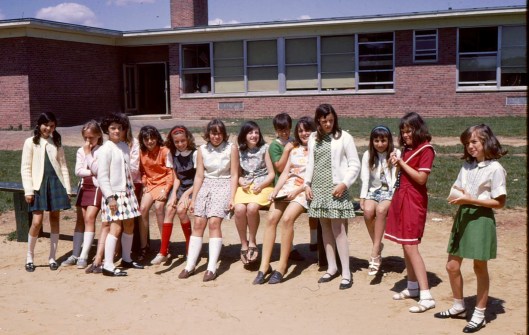
My 6th Grade Girls 1968. Left to right (wish me luck):  Judy Padilla, Sonia Newmerzhycki, Barbara Thornley, (behind) Kathy Naddeo, Marriane Verzi, Nancy Kalbach, Cindy Demarest, Kathy McNeff, Pam Smith, Kathy Ruby, Linda Klimscak, Dawn Belletierre, Sydney Bevington, Jane Armstrong (Pam, Dawn, Sonia and Sydney were new to the group, Barbara Garofalo not shown)

And the note from Kathy Ruby brings back the image of a vivacious personality and beautiful smile. I even saw Kathy a year of two after I left, during a trip back to New Jersey when I visited a parent’s home and saw a few of my former students. I have found Kathy’s name among many familiar others on a list of East Brunswick High graduates for 1974. There was an invitation to communicate by email but I had to be an East Brunswick HS alumnus to do so, which I was not. i would have loved to send an email to all my former students on that list of graduates if I could have.

And then Jane Armstrong, who, like the individuals mentioned above was in both my first fourth grade class in 1965 and my afternoon sixth grade class in 1968. Jane’s cute little freckled face is easy to remember as is her quiet voice and shy, occasionally moody demeanor. What I didn’t realize is that I had greatly misjudged her intellect and sensitivity for Jane wrote the most meaningful letter of all, which, not being able to scan it legibly, I have typed in its entirety: “Mr. Friedly, I will miss you as you go. A few tears while we cry. As you leave the school we all will miss you. We know how much you like us and we like you just the same. We hate to see you go. I bet you don’t want to go because of us. You have been the best teacher I have ever had. You have a way with students. I wish you the best of luck on your journey to Arizona. You’ll need a lot of luck. I guess I wasn’t your best student but I like you just the same. At times I may have fought a bit but still I like you. As long as I live I will never forget you. You are the best teacher I have ever had or seen. I don’t want you to go away from us or us go away from you. I will always look at the class pictures of you and will never forget you. If you ever come back or want to send me a letter my address is…” I have tried to locate Jane via google but have not been able to find her. I just hope she found the success and happiness that a person of her rare and wonderful qualities deserves.

Another boy that I remember well was Michael Marosy. His mother, whom I think may have been a PTA officer or our “homeroom mother” during that first year of mine, was very kind and supportive, visiting our class often and helping out in a variety of ways. Also, Michael is one of the few former students that I was able to locate via Google. Mike evidently became a police officer in the next-door community of South Brunswick and is likely now retired from what I hope was a productive and rewarding career in law enforcement.

Apologies to the many children I loved and appreciated but did not mention here. There were many – from my afternoon grade four class that first year, from both my AM and PM fifth grades my second year and from my morning grade five my third year. If any of you read this, I hope that you understand that I could not remember you with the same depth, breadth and detail that I remember the children I taught twice, in both 4th and 6th grades. But please know that I thought the world of you and thank you also for making my first years of teaching so enjoyable and rewarding.

Image0140

5th Grade (AM) class 1968

On their letters to me, my students were quite complimentary about my teaching. Sure, everyone was feeling positive on that last day of school and who would want to write something negative? And I thought that most of the compliments were truly sincere. However, reading the letters once again, I do feel some guilt because, certainly in my first year, I was not such a great teacher, although I gave all I had and did my best. I think that what I did give my students was honest affection, care and respect and I think that’s mostly why they “liked” me. But maybe those positive feelings facilitated some great learning, I don’t know. I certainly could not as a new teacher, have given them the highest quality instruction that I know they deserved.

During my three short years at Irwin School I often worked part time and also took a heavy load of graduate courses, earning a Masters Degree from Rutgers right before I left. Also each of those three years was like a brand new year, either through the subject matter or the grade level I taught. I also feel some guilt because perhaps I didn’t treat all the kids the same. I think I had favorites and probably neglected some children and didn’t recognize their considerable strengths. I also too readily categorized children as good students or less, well behaved or not, and didn’t provide everyone a proper opportunity to distinguish themselves in the group. I got smarter too late for these children and eventually learned to see all children as 100 percenters, with their relative percentages of intelligence, talent and potential just distributed differently.

I wish that I did not have to begin my career in a semi-departmentalized organizational pattern, something I have frowned upon my whole career for elementary education. To teach reading and language arts to 65 fourth graders that first year and math, science and social studies to two groups of fifth graders my second year and to a fifth and sixth my third year without ever seeing their skills and interests in the other subject areas was very limiting, preventing me from integrating disciplines to any meaningful degree. I just did not ever get the chance to see the totality of my children those years and, appreciating the self contained classroom the way I do now, I know that the children and I could have accomplished so much more and known each other so much better. Our feeling of community, mutual support and respect could have been developed more completely as well. Certainly that’s an important reason my first year AM 4th grade to which I taught language arts and reading and then math, science and social studies two years later in 6th grade, is remembered so well: I not only taught these children twice but finally could appreciate them as whole and complete learners.

Two notable events from those years at Irwin School come to mind. The first was probably the most embarrassing moment in my entire life. I was playing softball with the kids at lunch recess, wearing dress pants whose fabric and seams had obviously seen better days. As I squatted down to grab a ground ball, the seat of my old dress pants split from bottom of the fly clear around almost to the belt. My God, what a nightmare, what to do? I grabbed my jacket from the equipment cart, wrapped it around my waist, tied the sleeves, yelled to a colleague to watch my kids, told the office where I was going and why, dashed to my car, raced home, changed and got back just a few minutes after class had begun. Looking back, I don’t think any of my students really noticed or cared, or if they did they were considerate enough to not let me know, but I certainly should have been thankful that I was wearing decent underwear that day and had my jacket so handy!

The second was my attempt, during social studies class to have my students debate the Vietnam War, which had by the middle and late 1960’s really split the country. I had the children study the issues relating to the war, and then had them split up into two groups – the “Hawks” and the “Doves”, likely reflecting their parents’ opinion rather than their own, sat the groups across from each other and carefully, fairly and factually began to debate the issues. However, it didn’t take long for a parent to complain or my principal, Miss Addie Miller, to get wind of my activity and promptly put a stop to it. I certainly didn’t appreciate my great educational project being shut down so quickly and completely but looking back, I guess I can see Miss Miller’s point – the war in Vietnam was just too hot and passionate an issue at that time to debate in my little elementary classroom. But I think my students learned much from their preparation and would have learned even more if we had been allowed to proceed. Actually they may have inadvertently learned the most valuable lesson of all just seeing our efforts shot down

So concludes my reminiscences about my first years of teaching and finally paying homage to those wonderful first groups of children I had the pleasure to know. Now that their pictures and my words about them are preserved digitally, I may finally elect to dispose of the notes and cards from that last day of school that I have kept for 48 years. I don’t think anyone else will find meaning in them or care to preserve them after I am gone. But until my memory ceases to function, I will always remember these dear children. And I hope they all, now in their late fifties or early sixties, can look back on a life well-lived, and have occasionally thought of the tall, slim (then) blond haired (then, now lots of gray mixed in), bespectacled young man who loved them, whom they helped succeed in his first years of teaching and taught to love education, the career that he pursued for 45 wonderful years.
img131

img132


Micro and Macro: Ruminations on Life and the Cosmos

25 Monday Jul 2016

Posted by ralphfriedly in Uncategorized

≈ 1 Comment

Several weeks ago while reading my latest New York Review of Books I felt as though my head was about to explode. My mind was on fire trying to understand the concepts and ideas described in two different articles: one reviewing a book about cracking the genetic code and the other reviewing books about black holes and Einstein’s theories. The first dealt with micro concepts, the second with macro. And I struggled mightily with both.

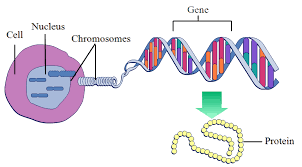
cell-nucleus-dna-geneH. Allen Orr’s review of “Life’s Greatest Secret: The Race to Crack the Genetic Code” by Matthew Cobb, dealt with DNA and RNA coding, amino acids and the secrets of the genome, heredity, and indeed life itself, all obviously very hard to wrap my head around. The exciting story of Francis Crick and James Watson’s discovery of the double helix structure of the DNA molecule opened the door for much additional fascinating research in molecular mechanics – the nature and composition of DNA, the proteins and amino acids attached in specific patterns to its “double helix” structure, the genes and how all this is packed into our cells and into the egg and sperm launching us into life resembling our parents. Importantly, these discoveries have also provided researchers with the keys to find cures for heretofore incurable genetic diseases. Also DNA research has played an increasingly important role in forensic science, resulting in conviction of the guilty and exoneration of the innocent. But regrettably, this research has also opened the door to “Frankenfoods”, the genetically engineered crops that fatten our livestock, anchor the processed food industry and enrich Monsanto.

Moreover these discoveries are fascinating because somehow they relate to the very nature of life itself – amazingly, all living organisms are made up of the same structures. After the “cracking” of the genetic code, the fundamental discovery was made that the code is nearly universal across all living organisms – “bacteria, fungi, plants and people”. So in our molecular composition, we are more similar to fruit flies and trees than not. All these infinitesimal structures – the proteins, the DNA, the genes, are virtually invisible, but they’re there….in all of us. They make sure we develop as fully formed human beings and not fungi or fruit flies. They signal the right cells to develop properly into bones. muscle, skin, digestive tract, nerve cells, blood and the arteries and veins for its transport. And finally, for better or for worse, they make sure we get the eye color, the hair, the particular nose, the intelligence, the talent, the physical ability, and indeed the emotional qualities and disposition of our parents, all determined by the genes in their DNA.

blazing-golden-sunOn this chilly day, while sitting outside for a few moments in the sun enjoying its warmth, I briefly glanced up at this dazzling bright star and wondered about its energy, so bountiful that it’s beyond understanding. I mean, the sun was warming me, warming the deck, the lawn, and all the trees and mountains around me. It was warming the state of Vermont, my home state of Arizona, the whole North American continent and in fact the whole planet. Yet in addition to warming the earth, it warms all the other planets that it illuminates in the solar system. But what about all the sun’s warmth, all the sun’s energy that does not strike our earth or another planet, and which is dissipated in billions of miles of cold empty space? What percentage of the sun’s light and heat goes off into this nothingness and is wasted – maybe 99.99 percent? What an incredible thought – that this bright blazing orb has been burning for millions of years and will burn for millions of more years, and will continue to warm this tiny little bit of the cosmos called earth, and bring it life. Yes, the warmth and light of the sun is the source of all life on earth – its energy transformed into the nourishment that sustains everything.
Other macro thoughts that stagger my mind relate to our solar system, our galaxy and other galaxies. First, it’s terribly hard to understand merely the size of our solar system. But it’s mind-blowing to consider that there must be hundreds (thousands?) more such systems in just our humble galaxy, the Milky Way. And there are millions more suns out there just like ours. And as my mind is stumbling toward some primitive understanding of our solar system and our galaxy, it heats up, flames out and stops working completely when it tries to understand that there are millions (or is it billions?) of other galaxies similar to the Milky Way in the universe.

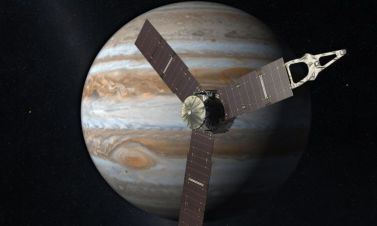
juno-spacecraft-jupiterAnd the recent news of Juno, our probe to Jupiter, the largest planet in our solar system, absolutely astonishes me. This cluster of instruments and machinery, assembled and packaged painstakingly here on earth, just traveled 1.7 billion miles to settle into an orbit around Jupiter. It traveled at the incredible rate of 130,000 miles per hour but even at that speed had to travel for five years to cover that distance. And yet this object traveling this far to get a good look at the largest planet in our solar system is really so insignificant since Jupiter, Earth, our entire solar system, and our galaxy are all just a tiny remote and insignificant configuration in the immensity of our galaxy and the universe.

Hubble Frontier Fields view of MACSJ0717.5+3745Then just several days ago, a New York Times article described a new array of radio telescopes presently being assembled as a unit in South Africa. And though just in its structural infancy, the first several units in the array reported that in a tiny area of the sky where 70 galaxies had previously been revealed, more than 1300 galaxies were now detected, some “erupting in cataclysms as massive black holes in their hearts spew radioactive high-energy particles across the dark sea of space”. Come now, over a thousand Milky Ways observed in a tiny area of the sky? Absolutely mind-boggling.

A stellar-mass black hole in orbit with a companion star located about 6,000 light years from Earth.Priamvada Natarajan’s article in the New York Review of Books that provoked these “macro” thoughts reviewed two fascinating books concerning Einstein’s concepts and theories about space, time and matter; gravity, black holes and relativity, pretty heavy intellectual lifting for me. For example, how can the speed of light be a constant, coming toward me at the same speed whether I am moving toward the source or away from it? And if the speed of light is constant, then time must become relative, speeding up or slowing down. Can time do this? How?


One of the books reviewed by Natarajan relates the fascinating account of the search for the mythical planet Vulcan. Applying principles of Newtonian physics to the wobble in the the orbit of Uranus led to the discovery of Neptune, so naturally a “tiny hitch” in the orbit of Mercury led astronomers to believe that there was another planet between Mercury and the sun. Not ever finding this planet led to another explanation years later – this by Einstein, that Mercury’s orbital jiggle was caused by a “perturbation resulting from the pocket in space-time created by the sun”, it being an object massive enough to warp space-time.

blackhole_gravity

Other “pockets”, dents or punctures in the space-time fabric posited and described by Einstein are created by black holes, a conception that again, is very difficult to absorb contextually. Black holes are “singularities” formed from collapsed stars possessing a gravity so great that light cannot escape from them and thus are invisible, perceived only because they bend light rays passing by them. As an example, to have the immense gravity of a black hole, “the earth would have to be packed into an object the size of a penny”!

Just as astonishing is the recent news that we have finally detected gravitational waves, which, according to the general theory of relativity, are caused by the collision of black holes. Yes, the Laser Interferometer Gravitational-Wave Observatory announced the first gravitational wavesdetection of these gravitational waves at very complex arrays of instruments constructed in Louisiana and Washington. Scientists determined that two black holes, 36 and 29 times the mass of our sun, collided and coalesced into a single black hole 62 time the mass of the sun (how the heck can they know this?).

All these macro concepts discussed in the article surprise, astonish, confound, and ultimately confuse me because I have so little of the prior knowledge context into which to place this information. But thank God there are minds like Einstein’s and those of many other physicists and astronomers today, that are able to grasp and assemble the speed of light, the fabric of space-time, black holes, light years, galaxies, quasars, gravitational waves and the like into cohesive and understandable constructs in their own minds and faithfully and persistently continue to try to impart them to us.

Back to the micro – considering my insignificant aging body and the marvels it contains, it is amazing to consider that the genes I received from my parents and have passed on to my son make us somewhat immortal. Those little pieces of me will go on and on through his children and their children – a little fragment of my intellect, my eyes, my hair color and composition, my stature, my strength, and, God help them all, my personality and disposition – through those little sub-microscopic things called genes.

stages-of-life_thumb1

Another “micro” thought – while science has been able to provide answers to so many questions dealing with life, health and disease, it has never really been able to answer fundamental questions that deal with reproduction and aging. How do all living organisms reproduce themselves? How does an otherwise dead and dormant seed suddenly come to life when encountering warmth, light and moisture? How does a life begin at that magical moment when conception occurs? And this magic of reproduction occurs in all living organisms from the mite, to the fruit fly to the whale. And as mysterious and incomprehensible as all this is, what about the “binary fission” reproduction of bacteria and the six step process of virus replication?

And while so much around me goes through an annual and seasonal cycle of life – the trees, flowers, grass, and the insects, while animals and I are on a longer and more linear cycle of birth, life and death, we really don’t know what causes aging. Indeed, efforts to counter aging, to confound the natural cycle of life, seem to be exercises in hubris and appear insulting in a way – who are we to dare understand aging and death, much less to challenge and try to change the natural order of things?

2079435_deeper-still_jfxeaqbh63vorhnrwcs4oomcjqoxpy7q62c4u66siw3t6qwph3oq_790x445 While I do not know if there’s a heaven, or if there is, whether I’m going there or not, I have to remind myself that I slept for an eternity before I was born and could simply sleep for another eternity when I die. Our human minds are such that a total obliteration of life when we die is incomprehensible – hence the invention and maintenance of religion, whose primary purpose is to somehow explain death and the purpose of our very finite lives.

eternityIn contemplative moments, when thinking about life and death, I sometimes think that when I die I will find myself in a kind of place where all knowledge will somehow be revealed to me. I will suddenly understand everything – all the why’s and wherefore’s relating to the above. I will be able to finally comprehend the content and the dimensions of the universe. Someone will successfully explain gravity to me. I will finally understand how and why every object, all the “stuff” in the universe – the Earth right here under my feet and all of the innumerable other entities near and far – are composed of the very same basic elements that are listed right there on my humble little “Periodic Table”. I will finally understand procreation, birth, life and death. I will finally make sense of stars, galaxies, black holes, infinity and eternity.

All these ruminations, these humble and meager little thoughts and questions that my limited mind conceives, deserve responses, don’t they? It’s not fair that I was blessed with the ability to ponder the questions but cursed with the limited intellect and finite life that prevent me from finding the answers. Yes, all these micro and macro concepts boggle my mind so I guess I should stop complaining, continue to marvel and just be thankful that at my advancing age I still have a mind capable of being boggled.


Rotten Apple

13 Wednesday Jul 2016

Posted by ralphfriedly in Uncategorized

≈ Leave a comment

Whatever happened to the American corporation of the ’50’s. ’60’s and ’70’s? I remember corporations as being good stewards of their communities. I remember CEO’s being paid reasonably and occasionally visiting the factory break room to chat with employees and even taking a stint on the production line to see what it felt like. During those decades American corporations seemed to exhibit a balanced interest in their respective stake-holders: customers, workers and stockholders.

Today that balance is lost: workers’ wages are stagnant and unions are dying and there certainly seems to be much less care about customers. Only the bottom line – profits and share price, in otherwords the stockholders, are truly valued. And one of the foremost corporations in the US, indeed in the world, now the most valuable corporation on the planet, Apple, appears to perfectly mirror this dramatic change. This corporation is now the quintessential embodiment of corporate greed – from obscene profit margins to outsourcing jobs overseas to stashing billions in low-tax havens.

imac translucent caseI have always loved Apple products. I experienced them in my various schools as an elementary principal supervising early “computer literacy” programs employing first the venerable Apple IIe, then various versions of the Macintosh including the iMac with its brightly colored translucent plastic case.
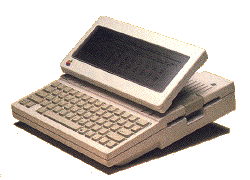
 

Apple IICThe first computer I ever owned was the Apple Iic, replete with the Apple Flat Panel Display, the first portable (somewhat!) computer from Apple. Even though the primitive flat screen was dim and difficult to see without a bright light, I used this computer’s word processing capability to type the entire first draft of my doctoral dissertation in 1985. Then after a multi-decade succession of Windows computers that I used as a professional because of compatibility with the technology used by the various school districts for which I worked, I moved back to Apple computers recently with the purchase of a MacBook Pro laptop on which I am typing this article.

1st iPhoneIn 2000-2003 when I was a superintendent on the Navajo Reservation I owned a Palm Pilot PDA (Personal Digital Assistant) and was so impressed that I could keep addresses, phone numbers, calendars, notes and lists in this handy little pocket sized instrument. And I could sync it with my office computer as well, to share information between the two. At that time I also used a cell phone for professional business and I remember many times holding my Palm Pilot in one hand to reference a phone number and holding my cell phone in the other awkwardly trying to dial one handed and saying to myself – why the heck doesn’t someone combine these two marvelous devices? Well in 2007 Apple did exactly that and more when they produced the iPhone, the first everything-in-one “smartphone”. I now am on my third iPhone and have loved every one.
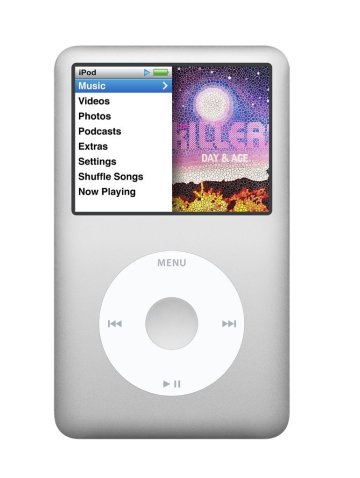
iPodBut looking back over my technological life, the Apple product that meant the most to me was the iPod. As an avid collector of and listener to all kinds of music, I had spent most of my life wrestling with finding the right LP, then finding the right track or racing through a reel to reel or cassette tape trying to locate the right song or symphony. So you can imagine my dizzy pleasure at being able to place virtually all of my favorite music onto my iTunes music library on my computer and then on that little hard drive miracle, the Apple iPod, where I could easily locate and play whatever I wanted whenever I wanted. Also, having purchased many LP’s and CD’s for only a few tracks and rejecting the rest, Apple’s iTunes store provided the opportunity to buy individual songs rather than albums. I simply cannot describe how much the iPod meant to me.


Steve Jobs and iPodSo you can imagine my shock when I attempted last year to buy another 160 GB iPod Classic from the Apple website and found it gone, simply gone, with no warning, no explanation and no announcement. Apple had simply made an arbitrary decision, presumably based on waning sales, that the famous iPod Classic with its huge capacity, distinctive click wheel control – the dream of music lovers like me, had to go. Why? Not enough profit yielded with sales diminishing. Simply a corporate decision based on profit, without the faintest sign of concern for faithful customers. And this after years of ads featuring a smiling (or was it cynical grimace) Steve Jobs extolling the virtues of this marvelous little machine.

Long ago I suspected that Apple might be discontinuing the iPod Classic at some future point but had always fancied that they would replace it with something else with similar or greater capacity. But all that’s left to carry on is the “iPod Touch”, with touch screen, limited capacity, a pile of useless apps and, of all things, a camera – simply an iPhone that you can’t use as a phone. I’m still numb with the realization that the iPod I have is all I ever will have unless I want to pay the grossly inflated prices being charged for the few leftovers still available on E-Bay.

My feeling of injustice at Apple’s discontinuation of the iPod is exacerbated by the iPod’s incredible sales record at Apple over the years. After the return of Steve Jobs the iPod was mainly responsible for the resurgence of Apple after its near-collapse in the late 1990’s, its huge sales carrying Apple until the introduction of the first iPhone. In January 2007, Apple reported record quarterly revenue of $7.1 billion, of which 48% was made from iPod sales. On April 9, 2007, it was announced that Apple had sold its one-hundred millionth iPod, making it the biggest selling digital music player of all time. And as of September 2012, Apple reported that total number of iPods (including the “Touch”) sold worldwide was 350 million.

After the introduction of the iPhone, iPod sales diminished yearly as a percentage of total revenue, not a surprising trend for Apple, as Apple CFO Peter Oppenheimer explained in June 2009: “We expect our traditional MP3 players to decline over time as we cannibalize ourselves with the iPod Touch and the iPhone.” Yet one would think that Apple could exhibit a corporate loyalty to the iPod classic somewhat similar to its customers’ loyalty to a music player so important to its financial success. But alas, at Apple there is only one corporate consideration – profits and share price for its stockholders.

Another example of Apple’s heartless, corporate, profit-at-all-costs, consumer-be-damned behavior is with its latest iteration of successive iPhone models. Traditionally, new iPhone models replacing the older ones contained doubled storage capacity for apps, pictures and information. For example the iPhone 4 came with 4, 16 or 32 gigs of storage and my iPhone 5 was available with 16, 32 or 64 gigs of storage. So when I shopped for my iPhone 6s I was amazed to find that the storage in the middle and top models was indeed doubled – to 64 and 128 gigs respectively, but the least expensive model, which I had planned to purchase, was still a measly 16 gigs, in spite of expanded storage requirements for its new camera and video capabilities. Apple had cleverly decided not to double the storage for the entry level model, assuming correctly that customers would need to buy the 64 gig model for $100 more. If the storage had been doubled for the entry level model to 32 gigs as I had expected, it would have been perfectly adequate for me and a host of other customers. Incidentally it costs Apple less than $20 to increase the storage from 16 gigs to 64, so they made an extra $80 profit on the thousands of these phones sold.

lightning to 30 pin.jpgIn addition, Apple has a nasty habit of changing other features so the customer has to buy extras. I was very disappointed to see that the connector on my iPhone 5 had changed from the 30 pin connector used on the iPod classic and the iPhone 4 to the new “Lightning” 8 pin connector, requiring the purchase of expensive converters, from Apple, of course, for my older chargers. And Apple connectors seem to always be proprietary, used only on their products and no others. Again, I suspect, despite being cloaked in terms like improvement, efficiency and convenience, changing these connectors was simply another way to increase profits.
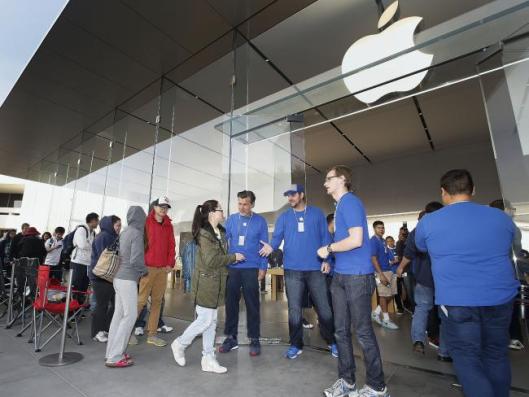
headphone jack

Gone?

And the latest tech gossip indicates that Apple is about to get rid of the headphone jack on its iPhones and replace them with some new kind of proprietary connection. Yes, just like Apple, yet another way to force customers to buy more and consequently increase profits. This change, if it occurs, is especially egregious, because the headphone jack is truly one of the few tech intercompatability standards left – I can plug virtually any headphones or earbuds into my Apple devices, other brands of tech devices, my stereo equipment. and the exercise machines at my gym. But if Apple has its way….and it likely will…. this will no longer be the case.

Apple has demonstrated its corporate greed in many other ways. It has continued to stick it to the American worker by assembling most of its products in China. But this has not made its products any cheaper – Apple continues to sell the most expensive computers and smartphones on the market, offers no discounts on its website or in its stores and has carefully limited discounts offered by retailers licensed to sell Apple products. Apple could easily afford to discount its products from time to time. Again, to hell with the consumer, but hail to the investor.

The young, well-informed, animated, energetic and enthusiastic people that work at Apple Stores all over the country are paid surprisingly low wages for the work they do for the wealthiest corporation in the world. They are not only salespeople – they are helpers, advisors and unabashed fans of Apple products. All should be paid appropriately – no less than $50,000 a year, instead of the measly $30,000 or so they earn now. Apple could easily afford to pay its store employees what they’re worth, not what the market will bear.

apple store

And Apple continues to operate with the largest profit margin of any tech company, averaging about 40 percent across all its products with iPhone profit at an ungodly margin as high as 69 percent. For example, costs range from $200 to $247 for iPhone 6 models that sell in the US for $649 and $849 without a contract.

With profits like this, Apple could well afford to be the model US corporation. It could demonstrate care for the US economy by manufacturing in the US instead of China and providing these US employees adequate compensation. And it could have emulated the fabled loyalty of its customers by continuing to manufacture the iPod classic with the sacrifice of a mere tiny sliver of its massive profits. Really, Apple could become the perfect “retro” US corporation, raising its concern for workers, customers and its corporate community to the level of its concern for share price and investors, with little cost to its bottom line.

But what does Apple do instead? The most valuable corporation in the US and in the world provides the most glaring example of corporate greed and national disloyalty by continuing to sacrifice the US worker and economy by manufacturing overseas and betraying its parent country by stashing its billions of obscene profits overseas, avoiding taxes, creating shell corporations and playing the tax avoidance game better than anyone else. Indeed the “most valuable corporation in the world” has disgracefully led the way in minimizing its taxes “better than anyone else in the world”.

Maybe Apple should heed the advice that the visionary leader of Intel, the late Andy Grove, offered in an oft-quoted essay he wrote in 2010 for Bloomberg. Grove warned that tech companies’ refusal to “scale up” their latest gadgets for manufacture in the US and rely instead upon the financial advantages of manufacturing in Asia was a serious mistake. It not only strikes a blow to the workers and the economy of the US but also allows the Asian country to develop the engineering skills and know-how that would have nourished the company’s potential for successful future innovation. In Mr. Grove’s words, ”Without scaling, we don’t just lose jobs – we lose our hold on new technologies. Losing the ability to scale will ultimately damage our capacity to innovate.” Keeping the brains, design and finance in the US and the manufacturing in Asia will ultimately backfire on us. It might be worth noting that in 2010 when Grove’s article was written, Chinese tech manufacturer Foxconn (where Apple products are assembled) employed more people – 800,000 in total – than Sony, Intel, Apple, Dell, Microsoft and HP combined. This company now employs over 1.3 million workers, all engaged in tech manufacturing that could and should easily be done here in the United States. Unfortunately, an important part of every tech start-up’s business plan is a “China strategy”. And Apple leads the way.

A final issue – maybe I’m wrong, but the revered, iconic and godlike Steve Jobs has always seemed as pecuniary as the company he named. In contrast to other billionaires, who are busy curing disease and empowering women and the poor all over the world (Bill Gates) or have pledged to give all their billions away (Warren Buffet), what did Steve Jobs or his heirs do with his estate of roughly $19 billion? Where is the “Steve Jobs Foundation”? Any diseases cured? Any wells dug? Any hungry people fed? How have his billions benefitted mankind? Just asking.

Perhaps Apple should critically examine its short-sighted profit-at-all-cost and consumers-be-damned corporate philosophy before it’s too late. Recent headlines from the New York Times: IPhone Sales Drop, and Apple’s 13-Year Surge Ebbs; from the UK’s Daily Mail: Apple Watch is a FLOP: Sales of the gadget have fallen by 90% since April, report claims and from a recent issue of Fortune: Apple Watch Sales Have Plummeted, Analyst Says, may be prescient.

Biblical Literacy

13 Wednesday Jul 2016

Posted by ralphfriedly in Uncategorized

≈ Leave a comment

Tags

Biblical literacy

No one in the English-speaking world can be considered literate without a basic knowledge of the Bible . . .our knowledge of Judaism and Christianity needs to be more detailed than that of other great religions, if only because of the historical accident that has embedded the Bible in our thought and language.
–E.D. Hirsch, Jr,, Joseph Kett, James Trefil,
The Dictionary of Cultural Literacy

Bible

The authors’ claim is true. The Bible is firmly embedded not only in our thought and language but also in our literature. Our everyday conversation is rich with common phrases that we may not realize have a Biblical origin. How often do we say or hear others recite phrases like “the writing on the wall”, “my brother’s keeper”, “beating swords into plowshares”, “cast the first stone”, “like a lamb to the slaughter”, living off “the fat of the land”, “Baptism by fire”, a real “Garden of Eden” or “forbidden fruit”. And certainly we have all heard of someone being referred to as a “Jezebel”, a “Judas”, a “good Samaritan”, a “doubting Thomas”, having the “patience of Job”, “as old as Methuselah”, a “scapegoat”, the “salt of the earth”, “antedeluvian”, a “prodigal son” or a “philistine” – all Biblical references. And we have heard battles or wars described as between “David and Goliath”, an”Armageddon”, “fight the good fight” or an “Apocalypse” – again, all from the Bible.

Biblical references and themes in literature abound – Cain and Abel, Noah and the ark, the Tower of Babel, Jonah and the whale, the wisdom of Solomon, the suffering of Job, David and Bathsheba, Alpha and Omega, the eye of the needle, killing the fatted calf, the strength of Samson (and the disappearance of that strength when his hair was shorn). All of these are referred to in countless works of literature, including many of the plays of Shakespeare.

According to Guinness World Records, the Bible is the best selling book of all time with over 5 billion copies sold and distributed. And expanding on the fact that 91 percent of American households already own a Bible, with the average household owning four, a New Yorker article several years ago noted that the Bible continues to the the best selling book of the year – yes, every year, selling on the average about 25 million copies annually.

Since there are millions of Bibles in American homes and the Bible continues to be the number one best seller, it certainly must be the favorite book of Americans. Indeed it is. In a 2014 Harris poll, it still ranks as America’s favorite book, ahead of “Gone with the Wind” and the Harry Potter series (it’s Donald Trump’s favorite as well, right ahead of “The Art of the Deal”!). The Bible also ranks high on many lists of “books to take if stranded on a desert island”.

But I think that in spite of its sales and ownership figures, the Bible’s “favorite” status in statistics and lists is somewhat gratuitous and misleading because people are not reading it much anymore. Reading and learning about the Bible are not the same as owning one. Survey after survey show readership down even among Christian church-goers. Presently only 37 percent of Americans report reading the Bible once a week or more. Recent surveys indicated that 60 percent can’t name more than five of the ten commandments. Twelve percent think that Joan of Arc was Noah’s wife and almost 50 percent of high school seniors think that Sodom and Gomorrah were a married couple. According to 82 percent of Americans, “God helps those who helps themselves” is a Bible verse. Many think that the Sermon on the Mount was preached by Billy Graham. And fewer than half of all adults can name the four gospels.

In addition, children are increasingly unfamiliar with the Bible and the personalities and stories that used to be standard fare for children’s reading. Many of us developed of our “Biblical literacy” reading and hearing Bible stories as children at home, in Sunday school classes.or other religious instruction. But children are not reading Bible stories like they have in the past because they are simply not popular anymore. With the explosion of a huge variety of children’s literature in recent decades, there is certainly vastly more quality literature to choose from for children than there was when I was young. And Bible stories themselves are often deemed too graphic and violent to be chosen for children’s reading by many of today’s more discerning parents.

And because for centuries the Bible has permeated our lives as a historical document and as a work of literature and as noted above, Biblical references and allusions abound in world literature, I fear that as knowledge of the Bible declines, many readers do not recognize the references and illustrations from the “good book” and thus limit and restrict their literary experience.

Two of my favorite anecdotes, while getting a chuckle from many listeners, will elicit only blank stares from some. One story features Mark Twain (or General Sherman or Oscar Wilde, depending on the story’s real origin) being stranded at a big city hotel at which a Methodist ministers’ convention was being held and describing himself feeling like “a lion in a den of Daniels”. Another concerns a teacher assigning the children to sketch their rendition of Joseph, Mary and the Christ child’s “flight into Egypt”. Instead of the typical picture of Joseph leading a donkey carrying Mary and the child, one little boy had drawn an airplane with four people in the cockpit and the little student , when asked by the teacher about the fourth person, pointed out that it was “Pontius, the pilot”. Obviously one needs sufficient Bible background to “get” these stories.

$_57

I still remember  all of the stories in my “Hurlbut’s Story of the Bible” bought for me by my mother in 1954. This special book, now reproduced conveniently for reading on the internet by the Baldwin Project, related the major stories in the Bible in a realistic and entertaining manner. Although there are many efforts today to increase knowledge of the Bible, it seems that the rapidly increasing popularity of social media and other electronic diversions guarantee that the very opposite will occur and that people will come to know even less about the Bible than they do today, further eroding their full understanding and enjoyment of so much discourse and literature containing Biblical allusions and references.


Self-Driving Car? Really? Why?

07 Thursday Jul 2016

Posted by ralphfriedly in Uncategorized

≈ Leave a comment

Tags

self-driving car

A few recent headlines: Obama Proposes $4 Billion Budget For Self-Driving Cars; Google, Tesla And Apple Race For Electric, Autonomous Vehicle; and, A Fatality Forces Tesla to Confront Its Limits. Obviously the race is on to perfect a self-driving car and  most major auto companies have committed as well as tech giants Google and Apple. But I have a real problem with this enterprise.

Front quarter view.jpg

Google’s self-driving car with LIDAR (light detection and ranging), a spinning range-finding unit on top of the car that creates a detailed map of the car’s surroundings as it moves.

I’m sorry, I have to question even the notion of a self-driving car. Why in heaven’s name would we want that? Are software engineers too bored with the status quo? Tired of improving inventory, ordering and shipping systems for Amazon? Tired of the creative challenges of designing software for NASA interplanetary space shots? Tired of designing software to more quickly access monstrous mountains of digitized information for Google? Tired of improving our computers and smartphones? I would think that there would be enough challenges in the world of technology to keep the “self-driving” car forever at the bottom of the list.

And why would anyone want to turn over the act of driving to a self-driving car? Ever since I first learned how to drive my Dad’s tractor and pickup truck as a kid, I have loved to drive. I have enjoyed starting, accelerating, shifting, the sound of the engine, the fresh breezes from lowered windows, the ever-changing scenery, but have enjoyed the power of control above all – why would I want to give up control? Why would I want to give up all this pleasure and power, the duty of staying between the white lines, staying on the right side of the road, and watching out for idiots, to a computer?

What’s this – a “single lens” look at the road? I have two lenses to see the road – one in each eye – this gives me something called “depth perception”, essential for driving I would think. I don’t think I’ve read about a “self-driving” car’s camera having two lenses and two electronic sensors. With my two lenses and two retinas feeding visual information to my brain, I have depth perception – I can not only see the outlines, shapes and colors of objects but I can tell how far away from me they are, how far apart from each other they are and how quickly I am approaching them.

If I don’t like to drive and fancy that I need a self driving car, I should take the bus instead. Or a taxi. Or just have someone else drive and enjoy the scenery from the passenger seat. Technology has gone too far: It wants to take the joy of driving away from me.

However good, the hardware and the software of technology are not infallible – it’s possible they both might get something called  a “glitch”. Once in awhile my computer has frozen. It hasn’t crashed yet but it might. What if the computer in my self-driving car freezes or crashes. I don’t want to be in the clutches and at the mercy of a computer when this happens. So I’m just going to sit in my “self-driving” car reading a book while my car runs off the road into a ditch or crosses the center line or median and heads straight for another car? No thanks, I don’t think so, I’ll do the driving myself.

Even when functioning as designed will the camera and guidance systems on these vehicles see well enough to avoid moving objects like pedestrians, cyclists or stray pets? And will they be able to detect common road hazards like foreign objects, potholes or the barriers for road repairs? Will they be “smart” enough to see a policeman directing traffic and accurately decipher his motions? Oh, and what about traffic lights and the meaning of green, yellow and red? And will they be able to “read” road signs and warnings?

Also, what happens during winter on snowy or icy roads? Is the computer system in this car going to sense what to do in such situations? I can feel the drive wheels slipping and can take measures to address the problem. I can feel the loss of control when I brake in snow or on ice, and can let up on the brake to regain control or can tap the brakes to slow or stop safely. I can also handle a skid with my steering wheel. Is the computer going to do all this? I don’t see how.

And what happens when cold (or heat), snow or ice affect the computer system itself, when the lens with the eye on the road gets fogged or iced up? Will the computer know that it can’t see the road properly and let me know?

Tesla Model S.jpg

The Tesla Model S uses a computer vision-based vehicle detection system composed of a forward facing camera, forward radar, ultrasonic sensors and GPS

Of course there are some unpleasant features of driving. Heavy traffic and traffic jams drive me nuts. Stupid drivers – inconsiderate drivers who don’t signal to let you know what they intend to do, oblivious drivers who blindly turn out in front of you, people who drive too slow or too fast, people who are on on their cell phone while driving, or worse, texting, all drive me crazy. But when things like this get unbearable, I will stop driving and take a bus or a taxi. I will not buy a “self-driving car”!

I have always been a little queasy about flying. Yes, it’s quick and it’s comfortable and yes, per passenger mile it’s much safer than driving. But…and this is a huge “but” – someone else is “driving” this huge machine through the air 30,000 feet above the earth with a huge crowd on board. If this person feels ill, suddenly loses consciousness, or if something goes wrong with the electronics or mechanics of the plane, causing a serious problem, it’s all out of my hands – I am helpless and powerless and totally at the mercy of these circumstances. When I am driving, of course I could feel ill or something could go wrong with the car, but I am still in control, not someone else, and could stop the car and address the problems.

The same principle applies to a “self-driving” car. Why would I want to have that uncomfortable feeling of vulnerability and powerlessness, of someone or something else being in control while in my car going to work or on vacation or driving across the country?

Also, how safe should we feel when encountering “self-driving” cars driving along with us or coming toward us on our highways and streets? Truly, even with all the idiots on the road, I think I would feel safer dealing with the idiots rather than dealing with cars driven by computers.

However, with the inexorable advance of technology, with the desire of manufacturers to create another product to sell and make profit from, and the eagerness of many people to own the latest gadget, I am sure that the march toward the “self-driving” car will continue. But count me out – I do not want to give up the pleasure and the power of driving my own vehicle and I definitely do not want to be the guy whose Tesla on “auto-pilot” hit a truck and killed him.

We Shall Over-comb

04 Monday Jul 2016

Posted by ralphfriedly in Uncategorized

≈ 1 Comment

Tags

comb-over

Baldness assaults many men over time and fortunately most deal with this unalterable fact-of-life genetic condition with resignation and consequent dignity. “Seinfeld” character George Constanza deals with his baldness with comic and graceful acceptance as does the man who invented him and served as the series’ main writer, the inimitable Larry David, through his minimalist writing and acting on his own HBO series “Curb Your Enthusiasm”.

Jason Alexander      Larry DavidAnd some men for whom nature has provided a too generous beginning, have chosen to complete the job by shaving their heads, preferring to exhibit the totally bald head rather than going about with the standard fringed pate. This category includes celebrities and politicians so the choice is a common and admired one. Actor Yul Brynner was one of the early celebrity examples of this phenomenon with many other actors and politicians joining in later. What’s gratifying about people who choose to “go all the way” is that they have obviously not only accepted their condition but have decided even to maximumly improve upon it, like actor Bruce Willis, pundit James Carville and Florida Governor Rick Scott.



Yul Brynner  bruce-willis-24jul13-10  117_1carville Rick Scott

Ah, but then there are those men who choose to deceptively delay the inevitable with the “comb-over”, which fails at both delay and deception but is nevertheless adopted by many. The “comb-over” is defined by Ari Stern in the Urban Dictionary as:comb-over

“n., a rearrangement of surrounding hair to cover a bald spot as completely as possible. Usually accomplished by flattening strands of hair in widely-spaced parallel stripes across the afflicted region. Rarely successful, often calls attention to the follically-challenged zone in question”.

Trump hairThe hairdo of “presumptive” Republican presidential candidate Donald Trump prominently exemplifies an extreme kind of comb-over with his inordinately long and strangely hued leftover locks gathered from an inordinately low part, then arranged in a helmet-like swirl hiding a seriously receding hairline, more like a “comb-up-over-and back”.

The giveaway for a comb-over is the location of the hair part, a feature of the male combed or brushed hairdo normally located well above the ear on either side of the head. When the part descends dangerously toward the ear, one can be sure that a comb-over is being utilized. The early comb-over and skillfully hidden bald spot of failed presidential candidate Marco Rubio was, I think, as much a reason for his failure as Trump’s “Little Marco” moniker, his frenzied clueless repetition of talking points, his perspiration, and his nervous lip-licking and tongue-thrust-in-the-cheek recitation of the cliches in his canned speeches.marcorubiosmile

This effort at deception and fancied delay is nevertheless popular with many , sometimes employed early in the progression of the inevitable, later perceived as futile and consequently abandoned with full acceptance of the condition, as seen in early John McCain and Rudy Giuliani compared with more recent versions of both.

mccain comb-over John McCain late.jpg giuliani early Giuliani late

But the comb-over continues to be used persistently in denial of the underlying condition, and with apparent imperviousness to what people observe or think. In most comb-over cases, the subject would be much better off and would appear much more honest and real .Senator Carl Levinif it were just completely abandoned and the bald condition honestly accepted. For actually male baldness is entirely natural and not necessarily unattractive. Imagine if you will how much more honest and serious retiring Democratic Senator Carl Levin would appear if he proudly accepted and demonstrated his baldness.

benjamin-netanyahuAnd our final example, perhaps Congressman/Senator Benjamin Netanyahu, representing our 51st state, would appear a little more benign and vulnerable, in other words more human and humane, if he abandoned his progressively more severe and pronounced comb-over and showed the world exactly what his bald head looks like.

Oops, I almost forgot. There is a variation on

chuck toddthe comb-over that has no name so let’s call it the “Comb-Forward” or “Comb-Up”. I guess this is chosen if one has a aversion to the “-Over”. This unseemly “do” is best exemplified by MSNBC’s Chuck Todd who actually wears it quite well.

Finally in celebration of this unique hairstyle, I offer Maine poet laureate Wesley McNair’s “Hymn to the Comb-Over”:

How the thickest of them erupt just
above the ear, cresting in waves so stiff
no wind can move them.   Let us praise them
in all of their varieties, some skinny
as the bands of headphones, some rising
from a part that extends halfway around
the head, others four or five strings
stretched so taut the scalp resembles
a musical instrument.   Let us praise the sprays
that hold them, and the combs that coax
such abundance to the front of the head
in the mirror, the combers entirely forget
the back.   And let us celebrate the combers,
who address the old sorrow of time’s passing
day after day, bringing out of the barrenness
of mid-life this ridiculous and wonderful
harvest, no wishful flag of hope, but, thick,
or thin, the flag itself, unfurled for us all
in subways, offices, and malls across America.

← Older posts
Newer posts →

All Posts

  • Itching and Scratching August 17, 2024
  • Afterlives in the Here and Now July 12, 2024
  • What the Hell is Wrong with Us…and the World? July 10, 2024
  • Symptoms vs. Causes: Missing the Mark September 22, 2023
  • Our Grand Canyon September 18, 2022
  • On Turning Eighty June 18, 2022
  • The Blood of Children and the Tears of Parents June 8, 2022
  • Growing Up in the Pillar of Fire: A Memoir February 6, 2022
  • The Medicare Advantage Scam December 21, 2021
  • Yet Another Rant December 7, 2021
  • Majority Rule? Think Again – Why a Minority Rules America November 27, 2021
  • The United States of Incrementalism November 27, 2021
  • Short Story November 24, 2021
  • The Troublesome Challenge of Choice November 6, 2021
  • Down Memory Lane July 31, 2021
  • Face It July 24, 2021
  • Elder Statesmen July 20, 2021
  • A Covid Winter in Vermont June 15, 2021
  • A Way with Words: The Devious and Devastating Genius of Frank Luntz… and More January 14, 2020
  • Wooster High September 11, 2019
  • Vermont Redux August 6, 2019
  • Oh Please, Come On Now July 3, 2019
  • The Trump Whisperer June 15, 2019
  • Still Ranting June 8, 2019
  • Connections March 21, 2019
  • Rant February 9, 2019
  • “White Poison” November 1, 2018
  • What We’ve Lost October 12, 2018
  • The Vote: “Cornerstone of Our Democracy” September 26, 2018
  • Justice and Accountability  September 25, 2018
  • 6 November 2018 August 31, 2018
  • Flying August 11, 2018
  • On the Minus Side of Dying: Musings on End of Life May 23, 2018
  • Sanctimonious Hypocrisy May 9, 2018
  • Foresight in 2020 May 6, 2018
  • Black Ice April 24, 2018
  • Why We Drink April 22, 2018
  • Reasons for Seasons March 20, 2018
  • Fitness Frustration: Pet Peeves at the Gym January 18, 2018
  • They Are Missed December 23, 2017
  • Hollow Patriotism: Honoring the Troops December 21, 2017
  • Interstate of Mind: Reflections on Highways and the Trucking Industry December 7, 2017
  • The Real Problem With Taxes in America November 8, 2017
  • From Chaos to Clarity: My Undergraduate Education September 11, 2017
  • Should Ken’s Thoughts About Gender Offend Her? August 25, 2017
  • Simple Solution to a Perennial Problem: Raise the Fuel Tax August 25, 2017
  • Rx for a Sick Democratic Party July 5, 2017
  • Well, Trump Voters… June 19, 2017
  • Home Sweet Home June 11, 2017
  • Summer 1957 May 2, 2017
  • The Backwards Hat April 24, 2017
  • Sears, Roebuck and Company March 3, 2017
  • “Shared Values” February 25, 2017
  • Thank You, Trump Voters: Amateur Hour and Executive Disorder in the White House February 16, 2017
  • The Sounds of Music February 14, 2017
  • Is This a Conversation? February 13, 2017
  • My Hank Williams Movie February 10, 2017
  • The NFL and I January 23, 2017
  • Election Reflection II December 24, 2016
  • Election Reflection November 11, 2016
  • “Cat’s in the Cradle” Comes True? November 11, 2016
  • Daylight Saving Time….Why? November 5, 2016
  • When I Fell in Love with Country Music November 4, 2016
  • Obit for Obamacare October 8, 2016
  • Irwin Elementary School 1965-1968 August 23, 2016
  • Micro and Macro: Ruminations on Life and the Cosmos July 25, 2016
  • Rotten Apple July 13, 2016
  • Biblical Literacy July 13, 2016
  • Self-Driving Car? Really? Why? July 7, 2016
  • We Shall Over-comb July 4, 2016
  • Stressful Life Events July 4, 2016
  • Why? I’ll Tell You Why July 3, 2016
  • Generational Generics May 15, 2016
  • Let’s Change the U.S. Constitution April 18, 2016
  • Economics 101 April 18, 2016
  • Talk to Your Doctor About… April 12, 2016
  • Tractors April 7, 2016
  • The Noxious Cloud of Republican Orthodoxy April 7, 2016
  • A To-Do List for our Broken Congress January 20, 2015
  • Quitting Smoking: A Mindful Experience December 6, 2014
  • My World of Work November 8, 2014
  • Golden Rules for Living November 7, 2014
  • Tennis Anyone? September 10, 2014
  • Mirror, Mirror, on the Car August 30, 2014
  • Making Time July 23, 2014
  • Massachusetts Driving Rules July 23, 2014
  • Retirement July 18, 2014
  • Mount Evans by Motorcycle July 18, 2014
  • The Kite Contest July 14, 2014
  • More than Transportation July 7, 2014
  • Books that Influenced My Life July 1, 2014
  • The Death Penalty June 25, 2014
  • Dear Dad, June 14, 2014
  • Is There a Right Wing Conspiracy? June 10, 2014
  • Living in Vermont June 10, 2014
  • What Is a Billion? June 9, 2014
  • How to Become a Liberal May 29, 2014
  • Barbara My Sweet Sister May 29, 2014
  • A Winter Drive May 13, 2014
  • Dear President Obama, May 12, 2014

Meta

  • Create account
  • Log in
  • Entries feed
  • Comments feed
  • WordPress.com

Blog at WordPress.com.

  • Subscribe Subscribed
    • Ralph Friedly
    • Join 38 other subscribers
    • Already have a WordPress.com account? Log in now.
    • Ralph Friedly
    • Subscribe Subscribed
    • Sign up
    • Log in
    • Report this content
    • View site in Reader
    • Manage subscriptions
    • Collapse this bar
 

Loading Comments...