• About Ralph Friedly

Ralph Friedly

Category Archives: Uncategorized

Books that Influenced My Life

01 Tuesday Jul 2014

Posted by ralphfriedly in Uncategorized

≈ Leave a comment

I am happy that we had books in the house when I was a child and that I had parents that read and taught me the value of reading. A precious memory of my father is seeing him always sleeping with a book or a magazine on his chest. Mom too always encouraged us to read and also was an avid reader, particularly it seemed, of the Bible, The Reader’s Digest, religious tracts and nutrition books.

During my childhood we had two periodicals always in our home: Time magazine and The Reader’s Digest. I read them both thoroughly. Even after becoming a college student at Rutgers, I spent lots of time, too much as indicated by my grades, in the stacks looking at old bound issues of Time, which brought back many memories. I remember as a youngster reading an article about the singer Patti Page with a mesmerizing photo of her in a 1955 issue of Time and was able to find that same issue in the stacks at Rutgers.

In the Reader’s Digest I read most of the articles and certainly all of the jokes under the different headings: “Laughter is the Best Medicine”, “Humor in Uniform” and “Life in These United States”. I also read many of the condensed books at the end of each issue. Several affected me deeply, among them “Little Boy Lost”, about a little boy separated from his parents during World War II and miraculously reunited with his father again, and two autobiographical books by Ralph Moody: “Little Britches” and “Man of the Family”, in which a little boy helps his family make a living on a Colorado ranch and later at age 11 when the father dies, with hard work, ingenuity and the help of his brothers and sisters manages to support the family.

Both “Time” and “The Reader’s Digest” embraced an essentially conservative, patriotic, view of America, reflecting my parents’ political opinions. I too was a good little Republican for many years, also embracing the views reflected in “Time” editorials and “Reader’s Digest” article selection.
Image

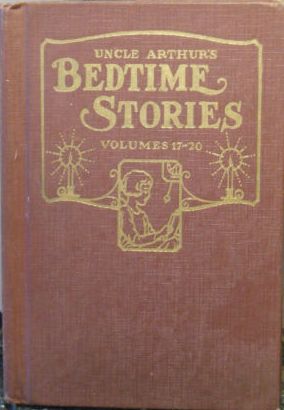
As a child in our first house in New Jersey, I became acquainted with the moralistic Sunday school books called “Uncle Arthur’s Bedtime Stories”. They were all stories with morals, maybe a bit like religious Aesop’s Fables. In these stories, bad things happened to the little boy who lied to his mother; the little boy who helped his mother and took care of his brothers and sisters would find a ten dollar bill on the sidewalk. How hilarious to later read Mark Twain’s “Story of a Good Little Boy” and “Story of a Bad Little Boy” in which nothing happened they way it happened in the Sunday School books: the good boy never was rewarded but was beaten and chastised for his good deeds and the bad boy enjoyed what he had stolen and didn’t fall out of the tree and break his arm. Looking back, I really used to think I would find a treasure someplace when I helped around the house, with which I could provide my parents and my brothers and sisters a better life than they had. But it never happened.

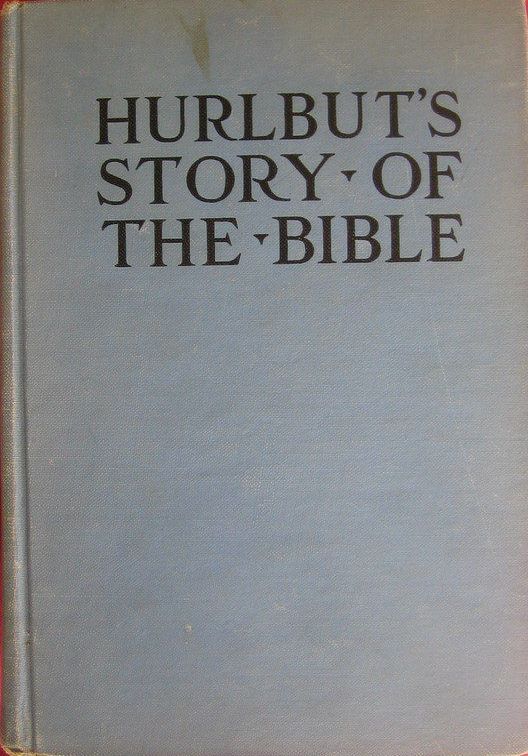
When I was twelve years old, I received from my mother a volume of “Hurlbut’s Story of the Bible”. This classic book went through countless editions over the years. My volume, which I still have, is the light blue cover 1947 edition. I read this book from cover to cover, even memorizing certain stories to tell on the “The “Children’s Hour” radio program over the church radio station, WAWZ.  The illustrations in the book were wonderful and I can still see many in my mind’s eye today. And in these old editions of “Hurlbut’s” all the difficult Bible names had phonetic spellings in parentheses.
Image

Also in the 1950’s, when they were visiting my parents and took a trip to New York City, I received a couple of books from my Aunt Margaret and Uncle Emil. One, called “American Statesmen” was not that interesting, but the other, titled “The Gudrun Lay”, was the story, in great prose as I remember, of Sigurd, Brynhild, Gudrun, Regin, Fafnir and the rest, and became a book that I read again and again. Unfortunately, that book has long disappeared and efforts to locate another volume have been futile. The closest I can get to it is “The Legend of Sigurd and Gudrun” by J.R.R.Tolkien, very academic and certainly not the book I read and remember.

Undoubtedly the books that influenced me the most were a set of “The Book of Knowledge”, probably a 1941 edition. Each volume was arranged in sections called “books” themselves: The Book of Familiar Things, The Book of Stories, The Book of Golden Deeds, The Book of Men and Women, The Book of Literature and others. All the classic fairy tales and classic poems were in these books, as well as biographies, lots of history, answers to perennial questions (The Book of Wonder), explanations of manufacturing, descriptions of famous cities and buildings, information about plants and animals and, in short, just about anything one could think of or might be curious about.

I do not remember ever looking up certain topics. These were books you simply picked up and then quickly got involved in something compelling and couldn’t put down. And they were books that you would usually find strewn all over the house – rarely together on their shelf. Though solidly bound, this set of books eventually became beat up and ragged, a pleasant indication of heavy usage.

Image

 “The Book of Knowledge” contained my first King Arthur stories and I can still remember the dramatic illustrations of Sir Lancelot, Elaine of Astolat, Queen Guinevere, Sir Gawain, Sir Galahad and Sir Percival. It was where I found the long poems I memorized: “Robert of Lincoln” by William Cullen Bryant and “Darius Green and His Flying Machine” by John Townsend Trowbridge. They were where I first learned about Marie Curie and Albert Einstein, about Shackleton, Amundsen, and Scott, and about photosynthesis and combustion. Bringing these marvelous books into the lives of me and my brothers and sisters is a tribute to the care of my parents, although I know nothing of when and how they were obtained. “The Book of Knowledge” was simply always there as long as I can remember.

Image


Image

When I was about 12 years old I remember reading a book of my Dad’s that maybe I was not old enough to read – “Out of the Night” by Jan Valtin, a 1941 best seller about the career of a communist spy who was captured and tortured by the Gestapo. This book made a powerful impression on my young mind, maybe not all of it good. I developed an unreasonable fear of communism and its incarnation in the “Comintern” (Communist International) and a horror of torture, as described in the book. The latter memory came back to me in a big way recently when my own country and its leaders employed and even tried to rationalize torture, something that, when reading this book as a youngster, I could never have imagined.

I mentioned in an earlier post that my father used to take us kids with him to the “Auction” on Route 206 near Somerville, New Jersey where I often visited a used book booth and bought a few books that I enjoyed very much. It was there that I bought my “Three Musketeers” and “Twenty Years After” by Dumas, my Mark Twain’s “Innocents Abroad”, Dickens’ “Great Expectations” and Margaret Mitchell’s “Gone with the Wind”, each costing me considerably less than less than a dollar. “Innocents Abroad” was actually a first edition, in very good condition but I unfortunately had no sense of its value and proceeded to completely abuse it and wear it out. And “Great Expectations” has taken a beating too since I have read it at least three times. But all of these books I still have and keep together in the bookcase because of their special importance and meaning in my life.

Another part of my childhood reading life is worth mentioning. My mother always did her best to make sure we went to sleep at an appropriate time and there were many times she made me stop reading and turn the light out in the bedroom that I shared with my younger brothers. However, there was always a hall light on and she allowed the door to be open a bit to give us a bit of night light. So I cut the top off a Dutch Cleanser container and hung its shiny bottom circle from a nail on the wall above the dresser. When aimed properly this circle of reflective metal would provide a spot of light on my bed which illuminated page after page of forbidden post bedtime reading. What fun, reading while everyone else in the house was asleep in total peace and quiet – something I still enjoy immensely to this day.

Image

So books were very important to me as a boy and are still are essential in my life. I enjoy so much standing in front of my bookcases appreciating and remembering. Books I have read are important but, so are the books I have not read. These are in special locations, beckoning to me, inviting me and demanding to be read. Since I am now in a late stage of my life and can reasonably speculate on how many years are left, I only hope and pray that there will be enough time. But sadly I know there will never be enough time since now, even this very day, I am reading reviews of newly published books that I add to my “must read” list. But no matter old I get, I hope I will always look forward to each new book experience with the same excitement and anticipation I enjoyed as a boy.

Image


The Death Penalty

25 Wednesday Jun 2014

Posted by ralphfriedly in Uncategorized

≈ Leave a comment

Tags

death penalty, Karla Faye

Another editorial about the death penalty in a recent New York Times and feelings and impressions still left by accounts of the botched execution in Oklahoma prompt me to express my opinion about the continuing shame and disgrace of the death penalty in the United States.

Most of us are familiar with facts about which countries still employ this medieval practice. But we should remind ourselves that over two thirds of the world’s countries have outlawed the death penalty, including all of the “advanced” countries, except ours. And we are the only country in the Americas that still employs capital punishment. In the countries still imposing the death penalty, the majority of executions worldwide in 2013 were conducted in China, Iran, Iraq, Saudi Arabia and…. the United States of America. Why have our national leaders placed us in this kind of company? And why do so many states in the U.S. still choose to conduct what amounts to state sponsored cold-blooded murder?


Image

The old “eye for an eye” adage from the Old Testament is often quoted by supporters of the death penalty. But read the reference to “an eye for an eye” by Jesus in the New Testament: the passage is about forgiveness and about “turning the other cheek”. And St. Paul has much to say about forgiveness in Romans 12. And of course, the good book says, “Thou shall not kill”. So forget Biblical support for the death penalty.

Another more popular justification for the death penalty is that it is serves as a deterrent to potential murderers. But does the prospect of being executed really ever enter the mind of a drug-crazed criminal shooting a clerk in a 7-11? Is the death penalty ever considered by the drunken jealous husband encountering his wife in bed with another man? I don’t think so. Is the death penalty ever a deterrent in the amoral mind of any criminal about to commit a heinous act when such a mind is incapable of imagining any negative consequence for a crime – even apprehension, much less trial, prison or execution. And statistics validate this point: the states without capital punishment have homicide rates at or below those states that have retained capital punishment.

With the revulsion we all feel for the act of murder, how can we accept and condone the machinery of the state grinding away to commit the same act. The careful preparation of the gurney or the electric chair for an execution, the ushering-in of spectators to view the horrid spectacle, bringing in the shackled prisoner and strapping him to a machine of death, and then the final gasps and spasms of death itself, are exercises in revulsion, horror and the macabre. High profile executions often attract a crowd of pro-death penalty savages, the same kind of  human detritus, flotsam and jetsam that attended and applauded public lynchings in our not-too-distant past.

 Image

Mistakes alone are a reason to halt capital punishment. According to Amnesty International, since 1973 in the United States, over 140 people have been freed from death rows due to evidence of mistaken conviction. And since the same date over 1200 have been executed. How many of these were really innocent? Execution is final. If innocence is established later, and it has, death cannot be reversed.

Capital punishment has an ugly racist tinge also. Although capital crimes are pretty much distributed evenly among US nationalities, the death penalty is imposed on people of color with strikingly more frequency than on whites. Also, although whites and African Americans have been murdered with equal frequency, killers of white victims are 80 percent more likely to receive the death penalty.

 Image

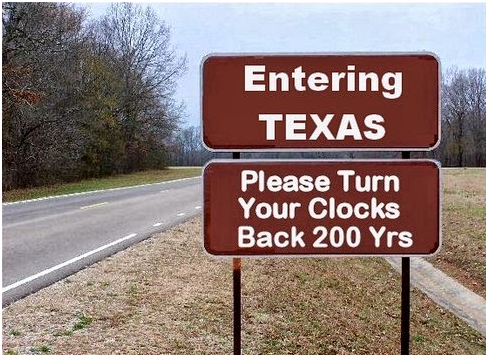
Of the states still retaining capital punishment, Texas is the killing champion. The total number of persons executed in the United States since 1976 is 1382. Of that shameful number, the great state of Texas has executed over one third – 515 people. Do you think that they were all guilty? Did all of these doomed individuals receive adequate legal representation? Were they mostly people of color? Were any of them mentally deficient? While he was governor, George W. Bush presided over 120 executions. And who can forget the bloodthirsty applause from the audience during a 2011 Republican presidential debate when it was noted by the moderator that during his decade as governor, candidate Rick Perry had allowed 234 Texas executions?

 Image

 There are many dramatic stories involving the death penalty but the sentencing and execution of Karla Faye Tucker, one of Texas’ more notorious, drew protests from around the world. Not only was Karla Faye the first woman to be executed in Texas since the Civil War, but waiting on Death Row for 14 years, she was completely rehabilitated and even married her prison minister. The last of her dozens of requests for mercy and clemency was turned down with a mocking smirk by Governor George W. Bush. On the night of the execution it was reported that a rendition of “Amazing Grace” by a gospel singer was shouted down by cries of “Kill the bitch!” from the pro-death penalty crowd gathered at the prison.

Image

 Shortly after her execution, Fred Allen, the prison official who had supervised more than 120 Texas executions, resigned his position with this statement: “I was pro capital punishment. After Karla Faye and after all this, until this day, eleven years later, no sir. Nobody has the right to take another life. I don’t care if it’s the law. And it’s so easy to change the law.”

Karla Faye Tucker’s redemption and ultimate execution have been the subjects of books, movies and music. To me one of the most affecting songs is Mary Gauthier’s “Karla Faye”.

A little girl lost, her world full of pain
He said it feels good, she gave him her vein
The dope made her numb and numb felt like free
Until she came down, down, down to a new misery

A junkie, a whore, living for the next high
She’d lie cheat and steal, she forgot how to cry
Wide awake for two weeks, shooting heroin then speed
When she killed in cold, cold blood all she felt was her need

It’s an eye for an eye, now you’re gonna die
A tooth for a tooth, it’s your moment of truth
There’s no mercy here, your stay is denied
Go on and pray, pray, pray, there’s mercy in the sky

Alone in her cell, no dope in her veins
The killer’d become little girl lost again
She fell to her knees, she prayed she would die
On the cold cement floor, she finally cried

And love came like the wind, love whispered her name
It reached through and held her, lifted her pain
Fifteen years on death row, her faith deeper each day
Her last words were, “I love you all”
Good-bye, Karla Faye

Now it’s an eye for an eye and you’re gonna die
A tooth for a tooth, it’s your moment of truth
There’s no mercy here, your stay is denied
Go on and pray, pray, pray

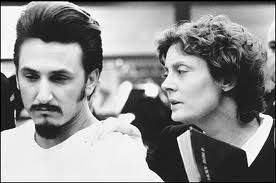
There have been many great movies over the years that have dealt with capital punishment, several describing the agony of the impending execution of an innocent person, among them, the classic Susan Hayward movie, “I Want to Live”. Documentaries like Werner Herzog’s “Into the Abyss” are also thoughtful examinations of the practice. However, the best movie about capital punishment has to be “Dead Man Walking”, in which the heinous nature of the crime committed by the character played by Sean Penn fades into the background in the account of his agonizing stay on death row and the gruesome scene of his execution.

Image

People have been questioning the death penalty for a long time. Victor Hugo in 1829 wrote “The Last Day of a Condemned Man”, a sensitive and heart-rending first person account of a man condemned to death. The novel never reveals what crime the man committed, or anything about his arrest and trial. It only paints a very depressing picture of what is going through the condemned man’s mind – never again to experience love, to hear leaves rustle on a tree or feel a breeze, or see flowers, birds, the blue sky and sunshine. He will never see his mother, his wife, or his little daughter, Marie, again. He doesn’t know when but knows he will be beheaded by the guillotine in the notorious Place de Greve.  One of the most impressive features of the novel is Hugo’s introduction, in which he paints a horrible and grim picture of capital punishment in France (finally outlawed there in 1981) and throughout the world.

I would think that in the year 2014 the United States of America would have joined the rest of the civilized world and moved beyond capital punishment (and mass incarceration, the subject of another upcoming article). While it unfortunately has not, there is, it seems, inexorable progress toward that goal. Presently 18 states have abolished capital punishment and many of the states that still have the death penalty on the books have chosen not use it. And the states where it is no longer allowed have seized the moral high ground and led the fight to abolish it nationwide. But we have a long way to go. All who oppose the death penalty need to support the organizations that are carrying this fight, among them Amnesty International,  National Coalition to Abolish the Death Penalty, Death Penalty Information Center, Students Against the Death Penalty,  and dozens of church organizations. The United States has no business supporting and practicing state-sanctioned murder.


Dear Dad,

14 Saturday Jun 2014

Posted by ralphfriedly in Uncategorized

≈ 3 Comments

Tags

Charles Ralph Friedly

It’s Father’s Day this weekend and I am thinking about you. My faith is as not as strong as some of your other children so I don’t really know if I will ever see you again. But you do still live in the hearts and minds of those who love you and remember you.

My childhood memories of you include your hero-like qualities to the people and kids at Zarephath. From throwing hay bales to hitting a baseball, your strength was legendary. This strength was also demonstrated when you tossed little children or did your little trick of grasping little hands thrust back between the legs and flipping the child over and back on his or her feet.

You were very popular among the students you taught and the friends you had (my friends used to tell me how lucky I was to have you as a father). I remember also you holding forth while giving haircuts in the barber chair corner of the printery, the buzz of the Oster clippers tempered with the observations and repartee of standers-by and flavored by the pleasant greasy smell of printers ink from the presses.

Image

I also remember your attempts to rid your gardens of groundhogs and crows and all the tricks you tried to triumph over them, from aiming your 16 gauge shotgun at a hole in the early morning until an unlucky groundhog poked his nose up, to dangling dead crows from a string on a stick to frighten the live ones away.

I recall with humor the time you came from Denver by bus for a visit to my home in New Brunswick with a paper bag of clothes, a huge Audobon bird book and half a binocular (a monocular?) strung around your neck (what must your fellow passengers have thought?!)

Some of my pleasantest memories were those I accumulated during adulthood on my summer trips to Denver to visit family. Being awakened by your early morning activity was really quite pleasant: from hearing you bang around with a shovel outside as you tended to flowers to hearing the rattle of the fenders on your bike as you returned from a trip to the college building to fetch milk.

I fondly recall the pleasure of sharing history with you. Even though we differed in our political views, we had wonderful discussions. I always felt close to you at those times when we discussed World War II or the Civil War. Of course, I could not match your knowledge of Winston Churchill so I mostly listened when his name came up. I guess I have made my own son the person in my life with whom I now share interest in history. For that I am so thankful, as you must have been for being able to share your interest with me.

Image

Dad, I enjoyed your sense of humor. I never met anyone that appreciated Mark Twain the way you did. Reading funny bits from “Sketches Old and New” or gems from “Innocents Abroad” to you was truly precious and I enjoyed joining you in the uproarious laughter that followed. However, the hilarity you generated from making fun of or ridiculing other people is a somewhat less pleasant memory.

I have never known anyone with a more genuine affinity for the soil which you enjoyed and demonstrated your whole life. I can still smell the freshly plowed New Jersey soil which you cultivated so patiently, hopefully and expertly. I can also remember your prescient bent for organic farming, always rejecting chemical fertilizer for tons of cow manure to enrich the soil, with an occasional dash of chicken manure as well. Although I rebelled as a 14 year old at having to “plant lima beans eyes down”, most of my memories of you and farming were pleasant. From your efforts to make rows as straight as possible by training the muffler of the tractor firmly on a distant downfield fence post or tree, to your pride in your newly purchased Farmall Super A, to your pride in your sweet corn and “Jersey Belle” strawberries, to the smells and sounds of picking sweet corn in the early dawn in the fields on the Millstone River flood plain, I remember all very fondly because I was with you and I was helping you. You loved to grow flowers as well, especially dahlias, an obsession that began at Lock Haven with dahlia bulbs planted in the burned out stump in front of the house, and continued to planting dahlias around the Belleview house and buildings.

Image

I remember how proud I was when you let me drive the new ’51 Chevy pickup into the garage at night, how crushed and ashamed I was when I erred and put a dent in the left front fender, and how relieved I was that you kept your anger and disappointment hidden. I also remember your kind effort to complement my saving for and purchase of a dream $1.99 fishing reel from Sears with a surprise fishing rod that I found on my bed one afternoon. And I remember the shame I felt when I foolishly and carelessly allowed that dream-come-true rod and reel to be stolen from me by a schoolmate and never recovered.

Very pleasurable to remember are the times on hot humid summer nights you used to take us on a drive around the township back roads with all of us in the back of the pickup truck. When an underpass was being constructed under the railroad in Manville, we used to drive over and check its progress. When little sister Elaine mistakenly called it the “underpants”, you teased her about it for months afterward.

And speaking of back roads, I felt so special to go with you several times to the Carfagnos’ home on one of those roads to watch the Papst Blue Ribbon Bouts on Wednesday night or Friday night boxing on the Gillette Cavalcade of Sports. These were the times I got to see Rocky Marciano, Jersey Joe Walcott, Archie Moore, Ezzard Charles and Sugar Ray Robinson, very special indeed.

Also, I enjoyed very much the times I and various other brothers and sisters accompanied you to the “Auction” (actually I think it was Packard’s Farmer’s Market) on Route 206 near Somerville on Wednesday nights or Friday nights. You sold sweet corn and vegetables wholesale to a vendor there and we kids were turned loose to visit the various booths and spend a little money. The books I purchased at the used book booth there still occupy a special place in my bookcase and in my heart.

 Image

 Dad, I am sorry I was so difficult to raise. I was certainly not the ever obedient and obeisant eldest son you desired. We had numerous disagreements and arguments when I was a teenager during which we both lost our tempers. After being expelled from the church school in Denver as a high school senior, you drove all the way from New Jersey to bring me back (never saying a word to me) and did your best to successfully get me situated again. I am grateful for those efforts, which resulted in my living with Aunt Margaret and Uncle Emil in Ohio, attending Wooster High School, and setting my life on a new course.

You seemed proud of me (but never said you were) when, after being accepted to Rutgers, you took me to the bookstore for my books, my dink (a beanie all freshmen were required to wear) and my tie (also required). But living in our chaotic home and commuting during those first years of college were difficult, as were the financial struggles. After losing my job at Ford because of my previously undetected scoliosis, a job which I expected to be my financial salvation, and after a bitter argument with you, I kissed my little brothers goodbye during the night and drove to Colorado with one of the family vehicles. I suppose you could have reported a theft and pressed charges. I am grateful that you did not.

Dad, although I often condemned you for consigning your family to a life in the Pillar of Fire church, perhaps I never properly appreciated the political tightrope you walked to keep us there. I often blamed you for not having the courage to leave and get us all out into the real world. I recall when I first went to teach for the Bureau of Indian Affairs and made good money teaching and paid only $50 per month for my very nice rental house. I urged you at that time to make the break. But you didn’t, or couldn’t. It is likely you thought that at least in the church the kids would always have food and a roof over their heads. I don’t think it was ever out of a true religious conviction that you kept us there but simply because you knew no other life.

It must have been difficult to accumulate money, any money at all, in those days in the church when we children were all quite young. I look back at the automatic washer we finally bought and the deep freeze, and realize that the money for those appliances came very dearly, from work in the “missionary field” or from raising and selling vegetables.

Along with these mostly pleasant memories, there are some sad ones too. Dad, I feel to this day the pain of hearing you extol the virtues of other young people. You were always commenting on someone’s uncommon strength, ability or intelligence or size of their hands, never realizing how much your thin oldest son (with smaller hands) craved some recognition too. You had favorites among your students in the classroom and even had favorites among your own children. This caused intense emotional pain for those not included in this favored group, among them me, and likely imposed a heavy emotional burden on those that were. You also enjoyed teasing your kids, I am not sure why. You can see a tearful Elaine, hurt by your teasing or a crying little Charlie in the old color slides and movies. I vividly recall another “teaser” that you enjoyed – extending a pencil to us and flipping it as we reached so we grasped your forefinger instead.

 Image

 When things got difficult at home – Mom not feeling well, the house chaotic and confused, full of needy children, piles of dirty dishes and buckets of soiled diapers, you were not there to take responsibility, exercise leadership, lend a hand and set things right. You found all sorts of reasons and justifications to be at Zarephath for twelve or sixteen hours a day, taking courses, teaching, working or much of the time I think, just escaping. Much of household management became the responsibility of the older children, a job we secretly resented and from which we tried to escape, each in our own way. And I recall how badly our shabby and leaking house needed attention and instead you helped other people paint and reroof their houses.

This perpetual absence was symptomatic of a general neglect of Mom back in those days which all of us felt. We all missed so much a Mom and Dad together in love and support and both parents giving us love and support in turn. You left the church and your family once to make a point with the church management and worked for Nides Appliances in Denver for about six months. I can remember a buzz among us children in the morning as the word spread that you had returned during the night. You and Mom responded to a cautious tap on the bedroom door and we kids crowded in to welcome you back. The sweetest thing about this event was observing a very happy Mom and Dad in bed together. This is the only time I can remember seeing you this way and feeling the joy it gave me. I am happy that in your retirement years, and prior to the onset of Alzheimer’s Disease, you and Mom apparently drew closer together as a couple, although Mom always seemed  the active and demonstrative provider of affection and you just the passive recipient.

Image

Dad, I feel to this day an aching void inside me. I never experienced the joy of you hugging me or kissing me. Nor did I ever experience the joy of you telling me you loved me or that you were proud of me. I suppose much of my need to achieve was driven by this futile desire to obtain your love and approval, which never came. Oh yes, you apparently told others that you were proud of my educational and professional achievements but I would have given the world to hear it from you. But Dad, even though it does not dry my tears or fill that void, I do realize that you simply never learned from your own parents how to show love and approval to your children. I sense in you the same defiance of your father that I had of you and the same false empowerment from your mother that I got from mine and I sense that your father never hugged or kissed you, told you he loved you or was proud of you either. My youngest brother told me of a time when, your eyes filling with tears, you responded to him that you had done the best you could. And I am sure you did.

Image

Dad, your last years were spent in confusion, desperation, madness and darkness from the onset and progress of Alzheimer’s disease. What a tragedy to see your fine mind totally destroyed and your engaging personality crumbled to nothing. How horrible to see a perfectly healthy elderly man, still with a good physique and no gray hair, not recognize his wife or children. I do remember an occasion, before any of us suspected what was happening, when I visited you and Mom in Colorado. You were both watching television as I entered the house and you both rose to greet me, but I could see from your eyes that you were startled and perhaps didn’t recognize me. However, you took cues from Mom and were properly cordial and civil. But I knew something was wrong.

Image

I surely wish I could see you again Dad and talk heart to heart with you. I will never know really how you felt about me. I only know that, like you, I did the best I could, with the emotional, intellectual and physical qualities I inherited from you and Mom. If you ever wished that you could have been a better father, I certainly have wished I could have been a better son.

On Father’s Day I, your oldest son, in this torrent of mixed memories and emotions, remember you with love.

Ralph

Is There a Right Wing Conspiracy?

10 Tuesday Jun 2014

Posted by ralphfriedly in Uncategorized

≈ 1 Comment

Tags

Right Wing Conspiracy

I am not paranoid, nor do I subscribe to any of the “conspiracy” theories surrounding the assassination of President Kennedy or other momentous events which lend themselves to such explanation, but in the case of the US political right wing, I do often suspect that there must be an evil wizard behind a curtain pulling the handles and throwing the switches. It really does seem at times that someone, somewhere, is orchestrating everything, calling the shots and issuing the marching orders – making sure that Republican legislatures and governors act in concert, making sure that all the right wing talk shows sing in the same key, making sure that right wing pundits write with the same pen, and making sure all Tea Partiers sing from the same hymnal.

Look at what’s happening all over the country with apparent lock-step order and precision. It’s as if the person or power calling the shots has presented the following playbook and insisted that all follow it without exception:

  • Reduce voting rights by claiming “voter fraud” and instituting requirements that reduce the franchise for the poor and minorities by requiring a picture ID, reducing poll times, limiting early or weekend voting and making registration more complex.
  • Reduce or abolish all business regulations by calling them “job killers” and a “drag on the economy” or “driving jobs overseas”, and in doing so, abolish or significantly weaken OSHA, and other agencies and laws whose role it is to protect workers.
  • Oppose the Affordable Care Act, refuse to accept the Medicaid expansion part of the law (but don’t come up with a better way to insure everyone).
  • Attack, weaken and ultimately abolish labor unions and workers’ rights through changing labor laws, calling them unfair to business and a hindrance to job growth.
  • Attack, weaken and ultimately abolish safety net programs like Social Security and Medicare, claiming they are close to insolvent and responsible for the budget deficit.
  • Reduce taxes on corporations and individuals, claiming that they are too high and inhibit growth and stifle initiative (even when the US is now the lowest-taxed of all developed countries)
  • Deny climate change despite overwhelming scientific evidence, oppose all efforts to slow it like capping emissions or imposing a carbon tax and instead support the entire fossil fuel industry from coal to fracking.
  • Attack public schools despite their being an egalitarian cornerstone of democracy and support privatization of education through vouchers and charter schools.
  • Support corporations and business against the consumer, the environment and government regulation.
  • Attack any and all gun legislation aimed at registration or background checks or other measures to keep us safer, support all legislative aims of the NRA.
  • Oppose choice for women, support “pro-life” politicians and laws, put abortion clinics out of business.
  • Oppose any kind of meaningful immigration reform, especially if such proposed legislation provides a path to full citizenship for illegal immigrants.
  • Proclaim the “budget deficit” the source of all of our economic problems and reduce it not by cutting a bloated defense budget or agricultural budget or by increasing taxes, but by cutting programs that help people, like food stamps, Medicaid, Medicare or Social Security.
  • Protect the “free market” at all costs, despite its obvious failings. Claim that the “free market” will take care of the poor, provide opportunity for all, and repair our crumbling infrastructure.
  • Oppose absolutely anything proposed or supported by our first black president, President Obama, without any regard for merit, common sense or popular support.

One day or a few hours of Fox News will contain mention of most if not all of the above as will a couple of broadcasts of Rush Limbaugh, a speech or two by Ted Cruz or another incoherent ramble by queen wingnut Sarah Palin.

So who is calling the shots? Is a to-do list or marching orders concocted at the very private and secretive semi-annual Koch brothers confab, this year held in late March at a luxury resort in Palm Springs and attended by dozens of billionaires (complete list of attendees obtained by Mother Jones)? Or are these concocted by think tanks like American Enterprise Institute and disseminated to all Republican congressmen and conservative pundits? Maybe it’s the American Legislative Exchange Council (ALEC), that has operated behind the scenes for so long and has presented laundry lists of pre-written legislation to Republican legislatures and governors across the country.

Perhaps there is no single power behind this list, or wizard behind the curtain, but the uniformity of conservative support for the above makes me wish for similar uniformity of purpose and support from Progressive forces in our country. But unfortunately, I am reminded of the famous Will Rogers quote, “I am not a member of any organized political party – I’m a Democrat”. Despite this unfortunate fact – Democrats and progressives are really all over the place – I am proud to be a Democrat, a Progressive, a Liberal and an Independent – and confidently and deliberately embrace the opposite position on every single item on the list.

Living in Vermont

10 Tuesday Jun 2014

Posted by ralphfriedly in Uncategorized

≈ 1 Comment

I love Vermont and the state’s recent courageous approval of a GMO labeling requirement has inspired me to write about it and describe why it is a truly unique state.

I live here for about six months a year. My spouse is a native Vermonter and our little house sits across a dirt road from the house where she and her brother grew up. Mountains rise nearby on both the east and the west. So the rising sun doesn’t strike this house until about 9:00 AM, and the sunset, because of high horizon to the west, is always early.

IMG_0643

There are trees everywhere. When my spouse points out where the barn and silo, or the “night pasture” or her grandmother’s house used to be, I get very confused because all I see are trees. When you take a walk around Scallop Drive, about two miles of brisk and scenic walking, first north about a half mile, then west uphill for a mile or so, then a turn to the south and finally east downhill back to home, all you see are trees. Yet this is where the hayfields, pastures and cornfields for the Baldwin dairy farm used to be. If you go into the woods directly east of the house, eventually you encounter the rusty skeleton of a manure spreader, the wood plank construction long since rotted away, trees growing up through it, and the rusted frame barely recognizable as the remains of a farm implement. This is the only evidence I have seen of the farm that used to be here.

The area around the house is typical of what you see everywhere in Vermont – Green Mountains. On a drive to anywhere in any direction, you encounter beautiful countryside,  gorgeous endless vistas of wooded hills and mountains, prosperous farms and pastures full of contented cattle, always punctuated with very small to small charming towns and villages, each with their requisite display of colonial houses and the single church steeple that typify the New England town or village. And you almost always see a main street with local family owned businesses.

E. Corinth, Vermont.jpg

About the weather – it has been said that Vermont has two seasons – winter and July. That’s a bit extreme but it’s to the point. The winters are generally very cold and snowy, spring and fall can be quite cold and the summer here is short. Occasionally, someone’s tomatoes will be killed by an August frost. The day after I arrived in Vermont this spring, April 14, I was greeted by a four inch snowfall. Today, May 31, as I am writing this the temperature is 70 degrees. I think we have had only a half-dozen days this spring that have reached or exceeded this level. Vermont just saw the end to one of its harshest winters in the last decade when all previous records for cold weather in March were broken. There are pleasant days here to be sure, but since they are rare they seem uncommonly and extraordinarily beautiful. At times during the summer the weather can turn uncomfortably hot and humid. The fall, especially October, is probably the best time of the year, with blue skies, crisp mornings and cool nights and colorful leaves. But in October of 2012 it rained for virtually the entire month. The caravans of “leaf peepers”, people from other states visiting Vermont to enjoy the fall color, were stalled in clouds of fog, mist and driving rain. I think there were but three days the entire month that were good for enjoying the beautiful fall color.

Vermont is one of the smallest of the states, actually number 45 in area and 49 in population. It is also one of the whitest states – very few faces of other hues and shades are seen. Its population of African Americans is less than one percent, making it the 49th state in percentage of black population, right before number 50, Montana. When considering all minorities, it is still among the whitest, with 95 percent of its population of 640,000 falling into that category. Vermont also has a very mature population with the second oldest median age in the country, right behind Maine. This is surprising because one would think that Arizona or Florida with all their retirees would rank quite high, but they in fact are far down on the scale. However, this high median age is an indication of a problem the state is trying to address – that young people are leaving the state.

Taxes are high in Vermont. Our little state is the ninth highest in the country, collecting 10.5 percent of average income for both local and state taxes, an average tax burden per capita of $4351. Property taxes vary according to where you live, as do the benefits received from the state or the local government from that tax. Here is Dorset, a high tax town, the bill for our humble little house on an acre of land is well over $4000. And with our own water supply and septic system, and paying a private company to pick up our refuse, our only benefits seem to be having the dirt road graded periodically and the privilege of using a small library in town. Oh, and also the privilege of listing “Dorset” as our address.

One of the useful nuggets of advice offered by my son who spent three years in Vermont going to law school, was, “Dad, never be in a hurry when you are driving somewhere or you will go crazy”. This was great advice, although I have had difficulty heeding it. Speed limits here are a throwback to the past, usually 40 miles per hour, with some (rare) stretches of roadway 50, and usually 30 or 25 through towns and villages, of which there are many, and even on  the rare stretches of Interstate Highway, you are limited to 55 or 60. Since most of the roads are two lanes without a shoulder, if someone is turning left, you stop…and wait…and wait. And if you are lucky enough on a trip to town to not encounter this, you may instead find guys in both lanes with signs saying on one side “Stop” and on the other “Slow” who are paid by the phone company or electric company to guide traffic around some repair work, often being done by one person: three people being paid but only one doing any useful work. Or you might see a  policeman, an expensive police vehicle, the same two guys directing traffic and only two men filling potholes.

The largest town (or city if you wish) in Vermont is Burlington, population 42,000. If you want to go to the state’s only Costco and only (recently) Trader Joe’s or Guitar Center, you travel to the Burlington area. So from here in Dorset, a shopping trip to Costco and Trader Joe’s, and maybe the Guitar Center, approximately a 200 mile round trip at an average speed of 40 miles per hour, is pretty much a tedious and frustrating all day affair. And simply getting to a Home Depot from here in Dorset requires a 56 mile round trip north to Rutland or a 60 mile round trip to Bennington. Burlington “International” (my quotes) Airport is a sleepy little terminal that claims international status because of a few weekly flights from neighboring Canada. I don’t think that flights from Paris, Berlin or London land at Burlington International.

Vermonters are remarkably community oriented. Church suppers and fire department pancake breakfasts are alive and well in Vermont. After the severe damage caused by Hurricane Irene in 2011, the state of Vermont did not wait for help from the Federal government. Neither did local communities wait for help from the state. Every able bodied person pitched in to rescue stranded neighbors, to repair washed out roads and clean up flooded buildings. Since a major exit on Interstate 89, near Montpelier, the Vermont state capital, was impassable, an enterprising Vermonter, drove off the interstate between exits and created “Exit 11-1/2”, in order to reach his community isolated by the storm damage.

Vermont is a state that values education. For such a little state, it is amazing to find 24 colleges and universities here, from big University of Vermont in Burlington, to distinguished Middlebury College in the middle of the state to small Bennington College in the southern part. Vermont Law School in the little community of South Royalton, which my son attended, is one of the better law schools in the country. Sixty percent of Vermont high school students attend post secondary schools. One third of Vermonters have at least a bachelor’s degree.

As is common in New England, Vermont provides much in the way of culture. Art museums, including our own Southern Vermont Art Center in nearby Manchester, abound and music concerts are plentiful, especially in the summer. Drama is easy to find in Vermont also, again particularly in the summer season – from our very own Dorset Players here at home, to the nearby Weston Playhouse, to the many offerings at Vermont’s many colleges and universities.

Many native Vermonters speak with a distinctive accent that is very difficult to describe or imitate. At times I even had a great deal of difficulty understanding my spouse’s father, his accent was so pronounced. And I was quite embarrassed when, after meeting a spouse’s cousin’s wife in northern Vermont, I afterward asked quite innocently what country was she from. I had a real problem understanding her as well and didn’t realize that she simply had an extraordinarily severe case of the Vermont accent.

Hunting is really important in Vermont. There are an unusual number of hunting seasons: approximately twenty separate seasons, ranging from “Bow and Arrow Deer”,  “Deer Muzzleloader”, “Moose” and “Black Bear” to “Gray Squirrel”, “Ruffled Grouse”, “Woodcock” and “Crow”. Don’t expect to get your car repaired, your house re-roofed or your appendix removed during the big one, the 16 day regular deer hunting season, because it seems that every able bodied Vermont man, plus many women, have deserted their posts and are all out hunting or in their “camps” drinking and telling stories.

The state of Vermont’s economy is remarkable. Although manufacturing companies which employed many Vermonters have packed up and left, the state still has an amazing 3.3 percent unemployment rate, second only to booming North Dakota. Maybe this number is artificially lowered up by the fact that many Vermonters may be looking for employment in other states, thus reducing the number of people ranked among the unemployed. But the economy of this mostly rural state is still amazing. Vermont’s dairy industry, despite many small farms being sold, closed or consolidated with others, continues to be healthy. Its cheeses (Cabot) and ice cream (Ben and Jerry’s) are sold throughout the country.

Cabot Cheese

Another noteworthy characteristic of Vermont is its local character. By this I mean that “local” is valued. Local family ownership of motels, restaurants, retail establishments is alive and well in Vermont. Motel chains and fast food chains are not very welcome here. Where other parts of the country are full of Days Inns, McDonalds, Appleby’s, Taco Bells, and Dunkin Donuts, such establishments are relatively rare here. The “Weathervane Motel”, “Ho Hum Motel”, “Mrs. Murphy’s Donuts,” “Little Rooster Café” and “Garlic John’s” are doing fine in Vermont. It is likely that God had to intervene for Costco and Trader Joe’s to set up shop in Vermont.

Related to this “local” value, it is interesting that many companies choose to include the state in their names because “Vermont” seems to connote high quality, sturdiness and tradition. And it works. What do you think of when you hear the names “Vermont Castings”, “Vermont Teddy Bear Company”, “Vermont Sandwich Company”, “Vermont Flannel” or “Vermont Country Store”? Yes, the name “Vermont….” does seem to mean considerably more than just the name of a state.

This little state is amazing politically. Our Governor, Peter Shumlin, is a man whom you know was elected for his brains and leadership – surely not for his looks. Governor Shumlin has been a fine governor, providing outstanding leadership during the Hurricane Irene crisis and leading the state to its legislative accomplishments in other areas.  Its small (just one Representative) congressional delegation is quite liberal. Although Senator Patrick Leahy and Representative Peter Welch do the people’s work very well in Congress, the most notable member of the delegation is Senator Bernie Sanders. Serving first as the mayor of Burlington, then elected for three terms to the House of Representatives, and now in his second term in the Senate, Senator Sanders has called himself a socialist and an independent at different times in his political career. He continues to speak up bravely and honestly for the common man and the middle class against the corporations and big money. It is hoped by many that Bernie will run for President. Although his chances for winning would be slim, since he accepts no corporate money and lobbyists have given up on him, the country needs to seriously debate the issues and progressive solutions espoused by Senator Sanders.

The state of Vermont has led the entire country, even progressive California, in several very crucial areas. First, the state is planning to set up the first single payer health care system in the country.  Although being fought every inch of the way by health insurance companies and drug companies, it appears the state will succeed. Second, as mentioned earlier, good old Vermont had the courage to pass a law requiring that foods containing genetically modified ingredients say so on the label. Not surprisingly, the state is now being sued by Monsanto, the industrial agriculture giant. Third, Vermonters should be extremely proud of their legislature’s recent mandate for a minimum of 10 hours per week of quality instruction for all three and four year olds in the state. Obviously, little Vermont leads the country in caring for its people.

So there is my own personal description of the Green Mountain State, where I live for six months each year. Even considering the negatives, Vermont is still a great place to live during the late spring, the summer and the early fall. It is served well by its people, graced by its beautiful scenery and strongly led by its responsive and sensible politicians. I am happy to be here.

What Is a Billion?

09 Monday Jun 2014

Posted by ralphfriedly in Uncategorized

≈ Leave a comment

At a time when not only are governments talking about taxes and expenditures in the billions of dollars, but multi-billion dollar corporations are also spending billions to acquire others (Pfizer’s recent offer of 119 billion dollars to purchase AstraZeneca), huge companies are sitting on billions of dollars in cash (Apple now has more than 159 billion dollars in cash on hand), and the number of billionaires in the US  is now over 500, it might be useful to reflect on this number, which is really beyond the ability of many of us, certainly me, to comprehend. While you can get some astonishing facts about how much a billion is from Wikipedia and other sources, I offer here a few of my own modest examples.

First, for proportion, let’s take a brief glance at a million. A million is ten one hundred thousands, a big number but still fairly easy to comprehend. It’s a number that can come in handy during your retirement, because a million dollars invested at six percent annual interest will yield $60,000 per year, not too bad a retirement income and you haven’t touched your principal. Also, if you wished instead to invest in real estate, your million dollars would buy five $200,000 homes. Renting these homes for $1000 per month would get you $5000 per month or again, $60,000 per year. And you would own the homes.

But a billion dollars is an entirely different matter. First, you need to simply consider that a billion is a thousand millions. OK, what’s so hard about that you might ask. But multiply my above descriptions of a million by a thousand and you are really in the stratosphere. Investing the billion at six percent per year would yield $60,000,000, a staggering retirement income. If you extend the homes example in this way, investing a billion dollars in $200,000 homes, you will have 5000 homes, a small city, and your retirement income from them, calculated the same way would be $60 million per year or $5 million a month, really quite a difference, and again a pretty good income. And you would own the city.

But let’s look at a billion in some other ways to really get some understanding of how huge this number is.  A Morgan silver dollar is .13 inches thick, making approximately nine in an inch high pile and 108 in a pile a foot high and 570,240 silver dollars in a stack a mile high. Got that? Well a billion silver dollars forms a column over 1750 miles high if my math is correct (feel welcome to check it). If I am right in my math, this is again well beyond human comprehension. And a stack of a billion one dollar bills at .004 inches thick would be over 63 miles high.

Some other facts about a billion dollars: if a billionaire spent one thousand dollars a day, it would take him (or her) over 2700 years to exhaust the billion. Well if it lasts that long, why not spend $10,000 per day, then it would last 270 years, or much more reasonable, spend $100,000 per day for 27 years. This too is beyond comprehension. How could anyone spend money at this rate?

And what about Sheldon Adelson, the repulsive billionaire who sought to buy the election for Republicans during the 2012 election? Do you think he’s going to go broke anytime soon spending a reported 150 million dollars on such causes? Well, with his estimated fortune of 21 billion dollars, he could do this again for 140 more election cycles, not counting the additional billions in future earnings from his sleazy casino empire. Thank God he’s old.

Some other illustrations:

  • A billion minutes ago (1902 years), in 112 AD the Roman Empire ruled by the Emperor Trajan was doing quite well and Christianity was becoming a major religion.
  • My son’s beginning salary as a New Mexico public defender attorney is $54,000 per year. If he received and saved every penny of his salary and never spent a dime, it would take him 18,500 years to save a billion dollars.
  • If on the other hand my son earned a billion dollars this year, his daily pay (five workdays per week for 52 weeks for 260 workdays per year) would be almost 4 million dollars a day, or even more amazing, for an eight hour day, $480,000 per hour.

These then are a few illustrations of the size of this astonishing number. Governments tax billions and spend billions. The Pentagon budget is over 500 billion dollars. Companies are worth billions and buy and sell other companies for billions. So we toss around this term only rarely considering how big it is.

Really I don’t think anyone should earn this much or own this much. It’s obscene to have this kind of money. Yet as noted earlier we have over 500 billionaires in our country. When it’s virtually impossible to spend this kind of money, why would anyone want it? Maybe it’s simply the ultimate badge of extraordinary achievement. In an age when money so easily buys political power, perhaps having a billion dollars or so is a pretty heady experience because of the power it buys. What are the Koch brothers going to do with their billions other than make more billions or buy more politicians?

I am reminded of the great populist demagogue, Huey Long, governor of Louisiana and later Senator from that state who addressed exorbitant concentration of money in few hands in his “Share the Wealth” proposal in the 1930’s. The “Kingfish” had it right. This obscene concentration of wealth, the billions of dollars owned and controlled by so few individuals while millions are in need, should not be allowed in a democratic society.


How to Become a Liberal

29 Thursday May 2014

Posted by ralphfriedly in Uncategorized

≈ 2 Comments

Republicans, Conservatives, Tea Partiers, are you fed up with the success of Obamacare?  And you can’t really get angry anymore about the old and tired Benghazi “scandal” or the IRS “conspiracy”? Are you tired of still claiming that Obama “stole” the last presidential election when he won it fair and square? Are you getting tired of defending a government bought by the corporations and the wealthy with the Supreme Court ringing up the sale? Tired of defending gun nuts when you know perfectly well that the Second Amendment refers to militias, not individuals and you know that background checks and registration make perfect sense? Are you getting just a little bit concerned about climate change and the rape of the environment by big energy and big business, tired of defending fools who deny overwhelming scientific evidence about global warming, and are you perhaps turning a little green yourself? Tired of millionaires, billionaires and corporations paying a smaller percentage of income in taxes than you do? Tired of defending Mitt Romney’s comments on the “47 percent”, when you know full well that you are part of the 47 percent? Concerned maybe about a Republican do-nothing House and a Senate hobbled by Republican filibusters? Fed up with trying to defend airheads still claiming that Obama was born in Kenya?…then maybe you should embrace another political philosophy – become a liberal…or a progressive…or, or, even a card carrying Democrat! But….you have been a Republican for too long, have grown accustomed to the drone of conservative talk radio and love the empty headed blond bimbos on Fox News. Your Republican parents trained you too well and it’s hard to make the break and besides, you don’t want to disappoint them. I mean, with all this, it’s really hard to make that left turn. You need help, you need a plan. You are in luck – I have such a plan. Here it is.

How to Become a Liberal  

Step 1 Get a heart – grow one, buy one, or steal one if you must, but you have to get a heart. You need compassion. You need empathy. You need to care. Care about the poor, the homeless, the less fortunate, the unemployed, the uneducated. People with hearts know that in the richest country in the world, everybody willing to work should have decent jobs, enough to eat, obtain adequate medical care, have adequate clothing to wear, have a decent place to live and provide security and a future for their families. People with hearts know that good health care should be a right, not a privilege. To believe all this, to embrace this, you do need a heart.

Step 2 Get an education, read – read newspapers, novels, history. Anybody who has read history and economics knows that Keynesian economics works and that the New Deal, the government providing jobs when the private sector fails, worked to get us out of the depression and that the biggest jobs program of all, World War II, was further proof of the efficacy of government action to end serious economic downturns. Read newspapers, maybe the New York Times, read columnists, read Harpers, The Atlantic, The Nation, the New Republic, the New York Review of Books, and even the Weekly Standard and the National Review if you must, but READ. Remember the quotation attributed to George Orwell:”Journalism is printing what someone else does not want printed: everything else is public relations”. Reading the novels of Victor Hugo, Charles Dickens, and Emile Zola will help you grow a heart (see Step 1 above). These authors wrote eloquently and passionately of the poor, the downtrodden, and the exploited. And get a new view of the history of the United States by reading Howard Zinn’s “A People’s History of the United States”. Or, never mind, read any history book. There is nothing like history to help gain an understanding of the world and why it is the way it is.

Step 3 Get your eyes checked. You may be suffering from myopia, blurred vision, blind spots, short-sightedness, lack of focus or simply inability to see the light. Vision problems have long been rife in the right wing. Conservatives simply can’t see that our country is being taken over by corporations and that corporate money now controls both houses of Congress and exerts its nefarious influence on the judicial and executive branches as well. They can’t see that corporations exist for profit, not public welfare and therefore need to be regulated. Conservatives can’t see clearly how corporate processed “food” is destroying our health. They are blinded by talk of “big government” when clear vision would reveal that government protects our water, our safety, the purity of our food and drugs, and builds our roads, bridges and airports. They are too shortsighted to realize that big banks have become gambling casinos rather than anchors of commercial communities and lenders to businesses.

Step 4 Think rationally, logically, maybe take a course in logic. If Keynesian economics helped us out of the Great Depression, why would it not help us out of the Great Recession. If most of the money in tied up in the one percent, and the middle class is dying, who is going to buy the cars, the appliances, the homes and the merchandise, to keep our consumer based economy going? Hey, the Koch brothers can buy only so many stoves, refrigerators and houses. If everyone who worked full time was paid a living wage sufficient to provide for a family’s comfort, security and future, they would spend that money and the economy would improve dramatically. See? Logic. And when we hear corporations crying about too many regulations and yet they are still able to poison our air, pollute our water, destroy the environment, feed us sugar and fat in processed “food”, lie to consumers about their products, pay full time employees less than a living wage, logic should tell us that we need more regulations, not fewer.

Step 5 Form opinions and make decisions with facts, not fibs, fiction or fluff. Read (see Step 2 above) climate change facts, corporate food facts, big pharma facts (surprise -the biggest health problems facing the world today are not COPD and erectile dysfunction) and inequality facts. Look at the facts about the income tax and corporate tax when our country had a strong middle class that could buy houses, take vacations and send its children to college. Look at the facts about the national debt and facts about Social Security and Medicare (surprise – they are not the reason for the deficit; they are not going broke, and with a few minor changes, will be solvent for many decades to come). Look at the facts about who makes money from wars; maybe corporations enjoy war and death and destruction – there is big money to be made. Look at the facts about infant mortality, longevity, happiness, satisfaction, upward mobility, education, daycare, and health and then think twice about those “socialist” countries in Europe.

Step 6 Read an economics book or take an economics course. Or at least read anything by Paul Krugman, Joseph Stiglitz, Robert Reich, David Cay Johnston, Richard Wolfe or the recent book by Thomas Piketty, or even something by John Maynard Keynes himself. Learn that the free market does not solve all problems. Learn that the natural end result of unregulated capitalism is self consumption, self immolation. Find out what socialism really is (surprise – President Obama is not a socialist!) and while you’re at it, find out what communism is (he’s not a communist either!).

Step 7 Change your listening and viewing habits. Turn off Rush Limbaugh and Fox News and tune in to NPR or maybe even Democracy Now. On your television, try watching MSNBC for starters. As you progress toward becoming a genuine liberal and quite properly develop a distaste for any corporate media, turn off MSNBC (it’s corporate) and watch an interview with Bill Moyers on PBS or watch Link TV or Free Speech TV and see what honest brave news reporting and truthful documentaries are like.

Step 8 Read (again, see Step 2) your Bible (or your Koran…or any other book anchoring a major religion) Jesus had much to say about wealth and the poor (See Matthew, Mark and Luke). Jesus cared about the poor, fed them and clothed them, was critical of wealth and drove the money changers out of the temple (He would have particularly enjoyed chasing out Lloyd Blankfein and Jamie Dimon!) In order to become a liberal you need to take a page from the Good Book and care for your fellow man. To become a liberal you need to ask what Jesus would say today about the huge disparity between rich and poor, about spending billions on war and the instruments of death instead of spending on education, jobs and helping those in need. What would Jesus (or Mohammed, or Confucius) say about rapacious banks, CEO’s making 300 times an average worker’s pay, or destruction of the environment?

There you are. Change your political opinions in eight easy steps. Follow the plan, disgruntled Republicans, conservatives and Tea Partiers, and you will finally be able to turn left, the right direction. Good Luck! You will feel much better!

Barbara My Sweet Sister

29 Thursday May 2014

Posted by ralphfriedly in Uncategorized

≈ 5 Comments

Tags

Barbara Friedly, Barbara Gross

Not long ago my sister Elaine reminded me of the date of our sister Barbara’s passing – April 27, 1984. I have always remembered Barbara’s birthday, May 26, but had forgotten exactly when she died, which was just a month short of her 46th birthday. When I think of her, I feel a void in my life that will never be filled. She had been not only my sister, but a friend and confidant for many years, someone with whom I shared good news and bad, success and failure, joy and sorrow.

Barbara was born in Salt Lake City, Utah at a Pillar of Fire Church home. Then the family of three moved to the church headquarters in New Jersey where Elaine and I were born. After an assignment at the Oakland, California church home we returned to New Jersey in early 1946, with Barb going on nine years old, me almost five, Elaine three and Robert an infant, to live in a church residence called Lock Haven. Already just a home of modest size, we shared it with an elderly couple, the Schisslers, in one separate part of the house and an elderly widower, Mr. Wittekind, in a furnished room upstairs. We occupied another area, large enough for the kitchen and eating area and living room on the first floor and upstairs a bathroom, Mom and Dad’s (and various infants’) room and small bedrooms for Barb and Elaine and for Robert, me and later Charlie, after he came along.

Since Barbara was almost four years older than me and was a girl, we were rarely playmates. She was more my boss or my teacher: giving advice and clarification, issuing deadlines, making sure jobs were done and so on. One of the common childhood chores was “scrubbing the bathroom, hall and stairs”, performed at different times by Barb, me or Elaine, with Barb always setting the standard and making sure the younger ones followed. With Barbara and Elaine on both sides of me, their common interests often bridged me, perhaps accounting for why I have always been a bit of a loner. However, I do remember taking some interest in a couple of their activities – playing with the furniture and figures in a dollhouse and playing with paper dolls. I remember helping Barbara cut out paper doll clothing, taking care not to cut through the little tabs which folded down to fasten the clothes to the doll figures. Image When we were little Barbara was often the one who made sure we got ready on school days and then led the way to catching the bus on time. Since Mom often was either pregnant or caring for little ones and Dad was absent much of the time, this help must have been greatly appreciated by her. Our home was always somewhat chaotic so each of us older children became very adept at carving out a little personal world of order and predictability. I remember Barbara being especially orderly, with clothing neatly arranged or put away in her area of the closet or her designated drawers of the dresser. Image A great memory from the Lock Haven days was listening to the big cabinet radio (Silvertone? Philco? Can’t remember) in the living room. On Saturday mornings Barbara and I would lie on the floor and listen to a show called “No School Today” featuring Big John and Sparky. Sparky, whose high pitched voice with clipped words and sentences was likely the taped and speeded up voice of Big John himself, opened the show by greeting by name all the children listening. Barb and I were thrilled to hear our names mentioned several times. Another show that we enjoyed was Bobby Benson and the B-Bar-B Riders, a child oriented western show, that like all radio shows in the fifties was fabulous to listen to because so much was left to the imagination.

The church used to show “movies” on Saturday nights which was a real treat for us to attend. The word is in quotes because seeing real movies was not acceptable in the church. So these were 16 millimeter educational films for the most part, enhanced occasionally with a cartoon or a comedy. Mom’s rule was that we could not go unless we took a nap on Saturday afternoon, so we all made the effort. However, then as now, I simply could not take a nap so used to emerge from the bedroom unsteadily with my eyes half closed so as to appear as though I had just awakened. I was crushed when Barb saw through my ruse and exposed it to Mom, claiming I was just pretending, that I was only squinting and had not really slept.

Image

An important event in Barbara’s childhood was raising a flock of ducks while at the Lock Haven house. On the house grounds there were several other buildings – a large barn, unused for the most part, a dozen or so bee hives and what we called the “bee house”, a small frame structure housing Mr. Wittekind’s bee-keeping equipment. Also there was a hexagonal wooden structure that became a home for Barb’s ducks. She raised them herself from downy little ducklings, feeding and watering them faithfully, so they became quite dear. I recall the sorrowful tears she shed the day when the ducks were sold for food.Image

Barbara always had a boyfriend or at least someone of the opposite sex in whom she was interested. And her pretty blond hair, ready smile and engaging personality assured that this attention was in most cases mutual. Such relationships among children and teenagers were frowned upon in the church schools we attended, so pursuit and conduct of these relationships and courting in general, had to be conducted surreptitiously. I enjoy recalling that when Barb was ten or eleven and I was six or seven, she had me sit between her and a boy named Joe Kruger so that they could hold hands behind my back without the bus driver or any of the children noticing. .Image As a little girl and on into her teens, Barbara was a big help to her mother, her sister and all her little brothers. She helped Mom with care of the children, washing and ironing clothes, house cleaning, cooking, washing dishes, canning and sewing. She developed marvelous sewing skills which she enjoyed practicing all of her life. As a student she used to sew her own brown and tan uniforms required by the schools and earned money by sewing uniforms for other girls. Also a good hairdresser, Barb during this time made a few dollars giving other high school girls permanents.

By this time the family had been moved to another church home, this one called “Morningside”, a house that we again shared with yet another family, the Chambers. This home was located in among some of the church crop fields, very fertile because they were on the floodplain of the Millstone River. As I recall, the move was necessary because of severe damage to the Lock Haven house by Hurricane Hazel in 1954. By this time there were two more additions to the family – Richard and Glenn.

As a teenager at the church high school, Barbara was very popular. She was well liked by everyone including her teachers and her friends. Barb was popular I think because she was generous – generous with her time, her good humor, her sympathy and her empathy. As noted above, she was always popular with boys, even going out over time with all three brothers from one local family, the Weavers. Another reason for her abundant friendships was that she was by nature an optimist, always looking for the good in a deed or event.  Barb rarely said negative things about others and always preferred to look for the personal difficulties that caused someone to behave badly toward her. Image One fond teenage memory involving Barbara was when she babysat for a church family living across the fields from our house. This family had television, which we did not, so Barb occasionally invited me along to stay up late and watch the “Million Dollar Movie” on Channel 9 (this show’s intro and theme music I will forever remember). These were among my first movie experiences so I enjoyed these opportunities immensely. Several times Barb also invited a friend, Phyllis Finlayson, to come over as well to watch and swoon over Perry Como on his weekly show earlier in the evening.  Image Sometime during Barb’s teenage years she began to have foot problems. While Mom was concerned and supported whatever measures Barb took, Dad was much more direct and blamed her problems on the “flats” that she and her teenage friends were wearing at that time, insisting that she wear unattractive and unfeminine lace-up oxfords, what we called at the time “Girl Scout shoes”, to give her feet more support. Wishing to assert herself, appear as attractive as possible and wear what she wanted, Barbara protested bitterly, but Dad insisted, bringing Barb to tears. The battle apparently ended in a draw since I can remember Barbara acceding to Dad’s dictum and wearing her lace-up oxfords but still wearing the flats as well, especially when the occasion required.

My love of reading was inspired in a large way by Barbara. When visiting the Zarephath library which served both the church high school and college, she was always ready to recommend staples of her favorite genre, animal stories. She loved reading the “Silver Chief” books there and on her recommendation I joyfully followed. Also I will always remember a favorite author of hers (I recalled the name instantly), Albert Payson Terhune, who I am sure was a favorite of hers for his famous book “Lad, a Dog”. We both also read and extensively talked about “Black Beauty”, a book that made both of us cry. But I do not remember questioning how a book about a horse could have been written in the first person. That strange fact never crossed our minds, we loved the story so much. Another book that we both loved and that Barb surely read first and then brought to my attention was “Smoky the Cowhorse”

Silver Chief to the Rescue JACK O'BRIEN 1937 Kurt Wiese color illus.   Vintage LAD A DOG Hardcover 1976 Printing - Excellent Condition - Albert TerhuneSmokey The Cow Horse Written And Illustrated By Will James 1954 Edition★ ★ ★ ★ ★BLACK BEAUTY BOOK BY ANNA SEWELL - Hard Cover Literature Book★ ★ ★ ★ ★

After high school Barbara worked for a short time at the RCA plant near Somerville, New Jersey, which if I recall correctly, manufactured transistors. Barbara was obviously a good worker at the plant because she was advised by the union shop steward to slow down and not work so fast. My anti-union Republican parents loved to tell others about this incident.

I remember very fondly the times as an adult I visited Barbara and her family at her various homes in and around Lancaster, Pennsylvania. I enjoyed so much the wonderful salads she would make and serve, full of all sorts of delicious greens, fruit, nuts, beans and other savory and healthy ingredients. Visiting Gross’ Natural Foods was always a thrill. Barbara introduced me to the Dr. Bronner’s products, notably the peppermint castile soap and the seasoning which was so good sprinkled on salads. Often her daughters would be helping out at the store as well and it was lovely to observe the expertise with which they would replenish stock or help customers.

But most of all, I enjoyed reminiscing about life and school at Zarephath, our little church town. We joyfully recalled social gatherings at “the fountain”, ice skating on the canal and the pond, what boy laced up which girl’s skates and who skated with whom. Barbara had a photograph album dedicated to her teenage years at ZA and I enjoyed so much when she got it out and we went through it page by page, picture by picture, remembering each person and specific incidents and occasions in which they were involved in our lives. Sadly, that album is now gone, neither her husband nor her daughters know its whereabouts. Her husband, however, did give to me a little stack of high school photos given to Barb by her high school friends, among them Genevieve Dobash, Phyllis Finlayson, Eunice Wilson, Lillian Hellyer, Miriam Snelling and Astrid Skeie. The messages to Barb on the back of the pictures are sweet and touching.

We joyfully shared memories of music in the church and the school, where everyone was expected to participate somehow in the musical life of both by singing in the chorus or playing a musical instrument. I remember the sound of Barbara practicing her clarinet and hearing her sing soprano or alto (her specialty) in the chorus. Of course Barbara, like most of us, took piano lessons as well. And we recalled the prayer meetings at the church, people getting “saved” or “sanctified” or simply “praying through” and thoughtfully mused on the guilt-driven nature of this process and about its veracity with certain individuals.

Barb and I drifted apart after high school as our lives moved in different directions. Barbara got married at 21 and embarked on a family life that had its share of both joys and sorrows. Two sweet little girls, Anna and Sheila, were born early in the marriage. Barb and Daniel hosted a wonderful Friedly family reunion at their Pennsylvania home in the summer of 1967.  And they opened their successful business, Gross’ Natural Foods, in Lancaster in 1969. They were eventually blessed with other children – Rhonda, Robert and Brian.

But I know there were also times when there was serious hardship, stress and need. At Bethany Fellowship, a missionary training institution in Minnesota where they began their married life, there were struggles to provide the basic necessities, complicated by Barb’s first pregnancy. After the move to Pennsylvania there were times when Daniel was sick or injured and could not work, and Barbara had to clean houses with a baby on her back to make ends meet. There was of course the tragic hubris of wholesale rejection of modern medicine and exclusive reliance on diet, holistic practice and quackery smacking of the occult to cure illness that contributed to the heartbreaking death of baby Vernon, their third child and to the misdiagnosis and maltreatment of Barb’s serious knee problem. When a real doctor was finally consulted a cancer diagnosis was made, but too late to save her leg. This hubris also played a role in the failure to properly monitor Barb’s condition afterward, resulting in the eventual recurrence and spread of the cancer, which took her precious life in 1984.

But through all of these troubles and tragedies, Barbara remained strong and resilient, and rebounded from misfortune again and again. Even when she lost that limb, she continued to be positive and look on the bright side. And she never lost the ability to burst out with the precious hearty laugh that was her trademark. To the last, she was always loving, kind and generous to friends and loved ones. Her children reflect those strengths today.

I miss my sweet sister Barbara still, after all these years.

A Winter Drive

13 Tuesday May 2014

Posted by ralphfriedly in Uncategorized

≈ Leave a comment

Image

We had been in Scottsdale for two weeks checking on the house, visiting my sister and doing a few things for our daughter. Since our son was flying from Vermont to  Albuquerque, New Mexico on December 22 for Christmas, we had to return to our home in Bernalillo, New Mexico by that evening so we could pick him up at the airport.

With much winter driving experience in the mountainous west and southwest, I had become accustomed to the vagaries of winter weather in this part of the country, where rain can unexpectedly become snow as altitude increases and snow intensity and accumulation can vary dramatically with altitude. So I knew what risks I was taking by traveling during December, typically the worst winter weather month in the southwest. But I never anticipated the risk and danger of what challenged my driving skills later that day and night.

As we left Phoenix at around 11:00 AM I remembered the weather forecasts I had read early that morning on the internet: In Heber, Arizona, on the downhill side of the Mogollon Rim, “snow flurries beginning in mid afternoon, becoming heavy snow later in the afternoon:; in Gallup, New Mexico, the highest and coldest part of our journey on I-40, “snow beginning late in the afternoon”. Naturally I hoped and anticipated that we would be through most of the journey across the Arizona high country before the snow presented a serious problem. And it appeared that we would avoid the worst on our way to Albuquerque, arriving in late afternoon or early evening. This is not how we found the conditions we encountered on this four hundred mile trip, which normally takes a little over six hours, taking us from Scottsdale on state highway 87 up the mountains into Payson, then highway 260 over the Mogollon Rim to Heber, then down the mountains on 277 and 377 to Holbrook and finally Interstate 40 straight east to Gallup, Grants and Albuquerque, New Mexico. Another factor considered was that Arizona winter storms usually come from southern California, cross east over the deserts and greater Phoenix as rain and then become snow as they cross the mountains and head into New Mexico and Colorado. And a good sign on this particular morning was that Phoenix was partly sunny with no rain. So with this combination of forecast information and prior experience we hopefully and confidently began what turned out to be the most frightening and dangerous winter driving experience in my better than fifty years of driving.

As we ascended the mountains toward Payson, the sky became cloudier, changing from a gray sky with some cloud definition to the dreaded monotonous and featureless all-gray sky which almost always portends snow. And indeed snow began in earnest east of Payson but the highway information sign there warned only of “winter driving conditions”, not “chains or four wheel drive recommended” or “required” as is sometimes the case, so thus encouraged, we kept going through the town of Star Valley on toward the steady and steep inclines ascending the Mogollon Rim. As we did so, the snow became significantly heavier and began accumulating, covering the road surface and showing the tracks of previous vehicles. We continued on in our little front wheel drive stick shift Corolla first alone and then coming up behind a pickup truck which seemed at first to be proceeding fairly well. But as many winter drivers will tell you, keeping up momentum while going up an incline on snowy roads is important, and the vehicle in front of us, while at first providing a sense of security since it was leading and we were following, slowed to an intolerable crawl. We finally found an area where it hopefully could be safely passed, so I did so successfully, though with both hands in a white-knuckled grip on the steering wheel. We were finally past the vehicle and moving ahead of it rapidly, but in the uncomfortable position of leading, with no one in front of us. Nevertheless, we were able to follow the still discernible but rapidly disappearing tracks of previous vehicles in the ever-increasing snow.

The snow increased dangerously in depth, but still the only signs of a snowplow were several of them stationary along with some highway department pickup trucks in the median of the road before one of the steepest inclines up the Rim. Needless to say there was no sanding of the roads going on either so our main objective was to keep the car moving onward and upward, to not lose momentum or lose sight of the sides of the road. I do not recall on this part of the journey any cars or trucks off the road. In the meantime the snow was increasing but thankfully bypassing our windshield. Even with moderate heat on in the car, no snow was melting and then freezing on our windshield. Finally we got to the top of the Rim on Highway 260 and proceeded on toward Heber with the snow getting deeper. In Heber, we quickly dispensed with our plan to stop at the Chevron and Dairy Queen because of the fairly steep drive up to the station from the highway and indeed there were several cars stuck in the snow up the street near the gas station and at the bottom of the gas station drive. Finally coming to Highway 277 toward Snowflake, from which we take 377 down the mountains to Holbrook, the snow seemed to lighten up a little. As we proceeded to the 377 junction, driving became much easier and we headed downhill toward  Holbrook on a much improved road surface, just snowy in spots and the snow coming down in occasional flurries. When we arrived in Holbrook and stopped at our favorite gas station (good prices and very clean restrooms) there was no snow at all, just very cold temperatures. My inquiries of a man at the pumps regarding road conditions on I-40 east were met with shrugs although he had heard of how bad the snow was between Payson and Heber.

So we hit the road east on I-40 with high hopes that we had encountered the worst of it. And indeed on I-40 between Holbrook and Gallup there was no snow so we drove the customary 80 miles per hour trying to make up some of the time we had lost through the Arizona mountains where we had averaged perhaps 30 mph. And yes our spirits were buoyed by the clear highway and no sign of snow on the vehicles coming west toward us. Also, again, since storms typically move west to east, we had good reason to think we were now ahead of it. But the sky remained a sullen, threatening solid gray, again, very much the “snow sky” that we knew only too well. And sure enough, as we came into Gallup around 4:00 PM, a fine powdery snow began falling, making it appear that the other vehicles and nearby buildings were in a fog. However, we were still quite positive that we had gotten through the worst of whatever was coming and, with only 140 miles to go to Albuquerque, usually a quick two hours, that we could get home easily and by a reasonable timeHowever, this positive outlook quickly changed to grave concern as the snow continued to fall rapidly and began to accumulate, slowing our driving speed to around 50 mph. Also the wind had increased significantly and drifts began to extend onto the roadway. With no snowplows in sight and the snow getting deeper, we and the rest of the traffic, including many trucks, kept heading steadily east, but slowed to between 30 and 40 miles per hour. I began to feel very tense and stressed, since by this time the snow had increased significantly and we began to see a few vehicles that had spun off the roadway into the median and a few stranded in the growing drifts on the sides of the road. Several times I got a sickening feeling as I felt the steering slipping in the snow or the wheels spin when I accelerated slightly. In situations like this, a driver has two choices, neither very good: To keep both hands on the wheel and keep moving or take a suitable exit and get off the highway. With our requirement of getting to Albuquerque to pick up our son sometime that night, we had no choice but to take the first choice and keep going. However, in making that commitment, one mistake – accelerating too fast, using the brakes impulsively, over steering, slipping off the road and on to the shoulder on the left or right, and the car would end up stuck like the others we had seen. I couldn’t take my attention from the road or my driving for a split second for fear of making a mistake – thus the incredible stress and tension. We had listened to the radio for awhile on I-40 between Holbrook and Gallup, but now the radio and the music were silent because frankly they were potentially disastrous distractions.

After what seemed like an hour of tense driving we were dismayed to see that we were only at Thoreau, a mere 25 or 30 miles east of Gallup, with a huge distance yet to go to Albuquerque. It had seemed that we should be much further east, but of course, we were used to the distance covered at more normal driving speeds. It was around Thoreau that we finally passed a semi that we had been following for some time but had slowed to a crawl. In a few minutes were came up behind a late model Honda Accord that seemed to be handling the snowy highway quite well, moving along steadily at about 30 miles per hour without hesitation, moving into the left lane to pass slower vehicles if necessary.

While following the Honda over the next thirty or forty miles (distance on this night was very difficult to estimate) our little convoy, including maybe a half dozen cars behind me, was constantly threatened by eighteen wheeler trucks, who, with their greater weight, kept passing. It was horrifying to look in the mirror and see the lights of yet another semi approaching in the passing lane. Several times I thought a truck would strike our little car on the left, so close were the vehicles and so dubious was anyone’s view of the highway lanes. Up one long incline, where the snow was getting quite deep, our Honda led us into the snowy passing lane to get around a semi that had jackknifed in the right lane and shoulder, the trailer sort of in the right lane and shoulder, headed east, with the tractor at right angles to the trailer, pointed south, to the right. It seemed that the worst offenders were Fedex trucks, which always seemed to be going too fast and were too eager to pass.

At about this time, we noticed many more vehicles off the road, some at crazy angles on the broad median strip, and some off the shoulder, apparently stuck in the snow. An increasing number of trucks appeared off the road as we got closer to Grants, some being assisted by tow trucks and accompanied by the crazy flashing red lights of police cars. At this time, I wondered why the highway had not been closed heading east and decided that perhaps we were just ahead of any closing and thus being allowed to try to complete the journey. I was certain that west of us, maybe just east of Gallup, I-40 must have been closed off.

As we followed the Honda, a terrible thing began to happen to our windshield, which up to then had been clear. Either it was getting colder or we had too much or too little hot air on the inside of the windshield, but a problem that I had experienced on other winter trips in the past, was occurring again. Our windshield wipers began to ice up and became less and less effective, leaving just a little window of clear glass to see through. Making them go faster, to shake off some of the ice, worked a little, but the problem persisted and then got worse. This was horrifying – as if the road conditions, the trucks, the vehicles off the road, driving with both hands in a death grip on the wheel, feeling that at any moment I could make a mistake and end up hitting another vehicle or running off the road and getting stuck, were not bad enough – now I could not see out of my own windshield. The only thing I could do was to stop the vehicle and get the ice off the windshield wipers by hand – but how to stop under these conditions, and how to get going again? We soon decided that there was nothing to do but let the cars following us get around us and then stop to clean the wipers, so I waited for the highway to go downhill and then pulled gently to the right, with my right blinker on, hoping the several vehicles behind me would pass. At first, the car behind me slowed with me and didn’t appear to be passing, but finally it got the idea and he and the cars behind him did pass. Then putting my hazard lights on and seeing that there was no one behind us, we stopped right in the lane and Bobbie and I jumped out, grabbed our respective wipers and slammed them against the windshield to get the ice off, and then madly picked the remaining ice off by hand. We did get going again since we were on an slope but with no one to follow and clouds of snow coming down, we found it very difficult to get our bearings and follow the tracks on the highway. It had been so much easier to follow someone.

I don’t remember how quickly we caught up to another driver – I seem to remember someone in a four wheel drive vehicle, maybe a Yukon or Explorer, and us speeding up to follow them. However, during the next hour the exact same thing happened to the windshield wipers and we had to find another slope, check behind us to see that there were no cars, and then stop again dead in middle of the highway, to perform the same surgery to the ice on the wipers. After doing this a second time, we barely got going when traffic approached behind us and I was shocked to see everyone pass me on the right. Then my wife shrieked that I was driving off the left shoulder into the median. Frankly I just couldn’t see where I was, had entirely lost my sense of direction in the blinding whiteness and had almost indeed drove us off into the median where we would have stayed the night. Finally, we seemed to be back in the right lane where we belonged and moved ahead to follow the last of the vehicles that had passed us.

Now somewhere east of Grants, the snow seemed to get better, that is, less coming down and less on the road. However, this was deceptive for later the snow and the accumulations increased again to dangerous levels, and to make matters worse, the snowflakes began to get larger, making visibility a problem as our headlights illuminated an opaque curtain of snowflakes coming toward us. At this time, heading down one of the long gentle slopes on I-40 we saw a nightmare situation for the westbound vehicles that were heading uphill. First there were trucks in both lanes going nowhere, probably spinning drive wheels and not moving. And behind them, as far as we could see, long lines of headlights of stationary vehicles, likely stationary for the entire night since it was highly improbable that the trucks could get going anytime soon with the snow coming down as it was.

Another horrible distraction among the vehicles heading east with us were the foolish drivers who drove through the snow with their hazard lights on. To have your taillights blinking off and on was not helpful to anyone – certainly not the traffic following. We unfortunately came up behind such a vehicle and were so distracted and upset by the constantly blinking lights that we simply had to pass since we could no longer follow this vehicle and maintain our sanity. Finally we came up behind a panel truck that seemed to be going just the right speed with just the right amount of skill and initiative. We were now approaching the To’hajiili exit, 40 miles west of Albuquerque, where Bobbie’s school is located and it seemed to us that, thank God, we were just about home.

Although close to home and the end of this dreadful trip, the snow continued right on into Albuquerque, though, thank God, in lesser quantity so that we could keep our speed up to around 50 miles per hour. It was close to one of the first exits in the Albuquerque area that I passed the steady and reliable panel truck that had led us on the last fifty miles or so of the trip, and, looking at the driver, we saw that it was woman, undoubtedly a very skilled and resolute woman, for her vehicle did not appear to be a four wheel drive vehicle. I silently thanked her for her skill and leadership – it was a great experience following her.

We finally reached the big Albuquerque junction of I-40 and I-25 and took the latter north toward Bernalillo. The first ten miles or so of I-25 were snowy but tolerable and as we approached Bernalillo, the highway finally cleared. There was no snow as we drove through town to highway 528 to our home. The driveway was clear and it was 11:00 PM. This normally six plus hour trip had taken twelve stressful and agonizing hours. I never appreciated a celebratory scotch on the rocks more in my life and was so thankful we had survived this terrible experience.

Our son’s flight was late, so we were in plenty of time and later drove into the Albuquerque airport to pick him up at 1:00 AM.

We had not seen an operating snow plow during the entire twelve hour trip.

Dear President Obama,

12 Monday May 2014

Posted by ralphfriedly in Uncategorized

≈ Leave a comment

I eagerly and joyfully voted for you twice and am happy that you are my president, especially when considering the opponents who ran against you and the reckless and shameful eight years preceding your election. Although not a wealthy person, I supported you with contributions during both elections. I have largely been happy with your presidency but am still troubled by a few things.

I am not going to mention the obvious – multiple pledges unfulfilled, not insisting on a public option in the Affordable Care Act, your dithering on Syria which has cost thousands of lives, and your continued caving in to corporations and Wall Street, to mention just a few disappointments.

No, I am going to complain about something else – the totally classless communications, exhortations and requests that come to me via my email connection to Organizing for Action, Barack Obama, First Lady Michelle Obama and DNCC.

President Obama, you are a very dignified person. Your intelligence, education, erudition and eloquence, are impressive. You inspire confidence in your speeches and press conferences with your choice of words, your sincerity, your expression, your demeanor and your common sense. But I have a real problem with so many email communications that fall far short of the lofty standards you have set in your appearances. I am insulted and demeaned by the flip tone, the careless and casual choice of words and the tenor of so many official communications from your office and those of your supporters. They need to show some class, some good taste, and some dignity, some maturity in addressing your faithful supporters. I know that I am not alone in this opinion and beg you to pay attention to what I am saying.

First Lady Michelle Obama, I respectfully ask that you please not send emails addressing your husband, the President of the United States as “Barack”. Please in your emails talk about yourselves as, “The President and I” or “President Obama and I”, not “Barack and I”.  Mrs. Obama, your husband in these communications should be referred to as “the President”, not “Barack”. Also, don’t use greetings like, “Ralph, it’s me…”. Come on, please say, “It’s First Lady Michelle Obama…” Or what’s wrong with simply, “Dear Ralph…”?

And Organizing for Action, DNCC and Barack Obama, please don’t insult me with greetings like, “Hey….,” or “Hey All”, or “Ralph, I’m blown away…” or “Ralph, I’m counting on you…” or “Ralph, can you confirm this?” or “Reporting back (spoiler – it’s awesome news)”. This is teenage or Facebook level communication, trivializing the communication itself and entirely unreflective of the dignity of your office.

I’m also very tired of messages like, “Ralph, sign Michelle’s card…” and “Top notch zingers from the President” or “Woot! Woot!” Last call!”, or “Sign here to wish the First Lady a Happy Birthday” or very recently, “…sometimes we have to share something awesome just to make sure you are having a good day”. I find the word “awesome” very overused today and seeing that word, I didn’t read the rest of the communication.

Mr. President, First Lady Michelle Obama and whoever is in charge of the other sources of emails, please, please treat your supporters as people with dignity and intelligence who do not need to be talked down to.

And another thing, Mr. President, please stop using the word “folks” so much. The use of this word by someone of your background rings hollow. You do not know “folks”, you have never known “folks”. Please use the word “people”, simple enough and much more genuine for you. Using the word “folks” rings false with you so don’t use it.

Mr. President, I respect you so much and I know that you have the toughest job in the world. But your lofty position requires that your supporters speak using dignified language and expressions appropriate to that position. I don’t wish to sever my email connection with your office or those of your supporting organizations. I just wish to be treated as an adult with dignity and intelligence.

Thank you very much,

Sincerely and still a supporter,

Ralph Friedly


← Older posts
Newer posts →

All Posts

  • Itching and Scratching August 17, 2024
  • Afterlives in the Here and Now July 12, 2024
  • What the Hell is Wrong with Us…and the World? July 10, 2024
  • Symptoms vs. Causes: Missing the Mark September 22, 2023
  • Our Grand Canyon September 18, 2022
  • On Turning Eighty June 18, 2022
  • The Blood of Children and the Tears of Parents June 8, 2022
  • Growing Up in the Pillar of Fire: A Memoir February 6, 2022
  • The Medicare Advantage Scam December 21, 2021
  • Yet Another Rant December 7, 2021
  • Majority Rule? Think Again – Why a Minority Rules America November 27, 2021
  • The United States of Incrementalism November 27, 2021
  • Short Story November 24, 2021
  • The Troublesome Challenge of Choice November 6, 2021
  • Down Memory Lane July 31, 2021
  • Face It July 24, 2021
  • Elder Statesmen July 20, 2021
  • A Covid Winter in Vermont June 15, 2021
  • A Way with Words: The Devious and Devastating Genius of Frank Luntz… and More January 14, 2020
  • Wooster High September 11, 2019
  • Vermont Redux August 6, 2019
  • Oh Please, Come On Now July 3, 2019
  • The Trump Whisperer June 15, 2019
  • Still Ranting June 8, 2019
  • Connections March 21, 2019
  • Rant February 9, 2019
  • “White Poison” November 1, 2018
  • What We’ve Lost October 12, 2018
  • The Vote: “Cornerstone of Our Democracy” September 26, 2018
  • Justice and Accountability  September 25, 2018
  • 6 November 2018 August 31, 2018
  • Flying August 11, 2018
  • On the Minus Side of Dying: Musings on End of Life May 23, 2018
  • Sanctimonious Hypocrisy May 9, 2018
  • Foresight in 2020 May 6, 2018
  • Black Ice April 24, 2018
  • Why We Drink April 22, 2018
  • Reasons for Seasons March 20, 2018
  • Fitness Frustration: Pet Peeves at the Gym January 18, 2018
  • They Are Missed December 23, 2017
  • Hollow Patriotism: Honoring the Troops December 21, 2017
  • Interstate of Mind: Reflections on Highways and the Trucking Industry December 7, 2017
  • The Real Problem With Taxes in America November 8, 2017
  • From Chaos to Clarity: My Undergraduate Education September 11, 2017
  • Should Ken’s Thoughts About Gender Offend Her? August 25, 2017
  • Simple Solution to a Perennial Problem: Raise the Fuel Tax August 25, 2017
  • Rx for a Sick Democratic Party July 5, 2017
  • Well, Trump Voters… June 19, 2017
  • Home Sweet Home June 11, 2017
  • Summer 1957 May 2, 2017
  • The Backwards Hat April 24, 2017
  • Sears, Roebuck and Company March 3, 2017
  • “Shared Values” February 25, 2017
  • Thank You, Trump Voters: Amateur Hour and Executive Disorder in the White House February 16, 2017
  • The Sounds of Music February 14, 2017
  • Is This a Conversation? February 13, 2017
  • My Hank Williams Movie February 10, 2017
  • The NFL and I January 23, 2017
  • Election Reflection II December 24, 2016
  • Election Reflection November 11, 2016
  • “Cat’s in the Cradle” Comes True? November 11, 2016
  • Daylight Saving Time….Why? November 5, 2016
  • When I Fell in Love with Country Music November 4, 2016
  • Obit for Obamacare October 8, 2016
  • Irwin Elementary School 1965-1968 August 23, 2016
  • Micro and Macro: Ruminations on Life and the Cosmos July 25, 2016
  • Rotten Apple July 13, 2016
  • Biblical Literacy July 13, 2016
  • Self-Driving Car? Really? Why? July 7, 2016
  • We Shall Over-comb July 4, 2016
  • Stressful Life Events July 4, 2016
  • Why? I’ll Tell You Why July 3, 2016
  • Generational Generics May 15, 2016
  • Let’s Change the U.S. Constitution April 18, 2016
  • Economics 101 April 18, 2016
  • Talk to Your Doctor About… April 12, 2016
  • Tractors April 7, 2016
  • The Noxious Cloud of Republican Orthodoxy April 7, 2016
  • A To-Do List for our Broken Congress January 20, 2015
  • Quitting Smoking: A Mindful Experience December 6, 2014
  • My World of Work November 8, 2014
  • Golden Rules for Living November 7, 2014
  • Tennis Anyone? September 10, 2014
  • Mirror, Mirror, on the Car August 30, 2014
  • Making Time July 23, 2014
  • Massachusetts Driving Rules July 23, 2014
  • Retirement July 18, 2014
  • Mount Evans by Motorcycle July 18, 2014
  • The Kite Contest July 14, 2014
  • More than Transportation July 7, 2014
  • Books that Influenced My Life July 1, 2014
  • The Death Penalty June 25, 2014
  • Dear Dad, June 14, 2014
  • Is There a Right Wing Conspiracy? June 10, 2014
  • Living in Vermont June 10, 2014
  • What Is a Billion? June 9, 2014
  • How to Become a Liberal May 29, 2014
  • Barbara My Sweet Sister May 29, 2014
  • A Winter Drive May 13, 2014
  • Dear President Obama, May 12, 2014

Meta

  • Create account
  • Log in
  • Entries feed
  • Comments feed
  • WordPress.com

Blog at WordPress.com.

  • Subscribe Subscribed
    • Ralph Friedly
    • Join 38 other subscribers
    • Already have a WordPress.com account? Log in now.
    • Ralph Friedly
    • Subscribe Subscribed
    • Sign up
    • Log in
    • Report this content
    • View site in Reader
    • Manage subscriptions
    • Collapse this bar
 

Loading Comments...