• About Ralph Friedly

Ralph Friedly

Monthly Archives: July 2021

Down Memory Lane

31 Saturday Jul 2021

Posted by ralphfriedly in Uncategorized

≈ 2 Comments

I can think of no worse thing to happen to a person than to lose one’s memory. The dreadful scourge of Alzheimer’s, which eventually took the life of my father, has to be far worse for anyone than the myriad diseases and deteriorative conditions that afflict the elderly. Personally I would prefer to be bedridden and immobile and still retain my mental faculties than be the picture of good health with a full head of still brown hair and not recognize either myself or my loved ones and not recall any of my personal history, which describes my father’s condition before he succumbed to a merciful death

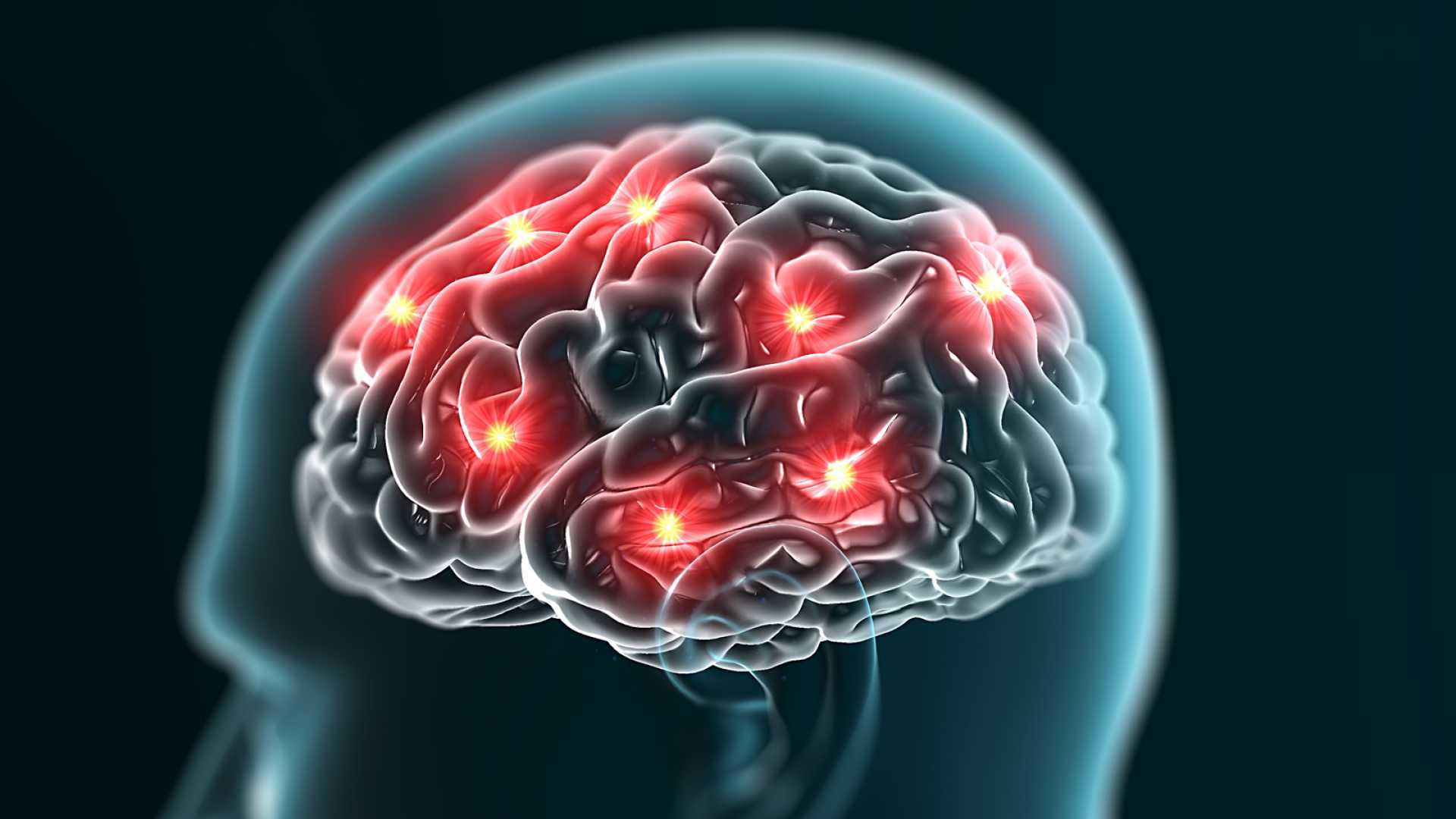
Memory is such an amazing and necessary quality. It makes you alive by placing you solidly along a continuum of life experiences. And even more amazing is how it works. I don’t know what the scientific names for them are but I’ll simply call them short term memory and long term memory.  At night when I am ready to go to sleep I often review the duties I should have completed to be ready for tomorrow.  Did I make the coffee? Yes, I recall rinsing out the carafe, filling it with water and pouring the right amount into the chamber. I also remember specifically being extra careful to make the measurer level with coffee since it was a bit strong yesterday. Did I take my pills? Yes, I recall filling a glass of water and taking them. Are my clothes ready for when I get up? Yes, tomorrow I plan to exercise downstairs, so my shorts, t-shirt and sweatshirt are ready, and my sneakers are where they should be. OK, I remembered all those events. But will I remember them tomorrow or the next day? No, absolutely not, because somehow my brain says that I shouldn’t have to. Why would I remember these specific events for longer than a day? Not necessary, so I am allowed to forget them. So memories of these routine activities are soon gone and gone forever, making room apparently for activities and events of greater importance or more proximate in time

Apparently there is also something that we could call “temporary memory” as distinct from “short term memory” – those memories that our brain “dumps” periodically to make room for more permanent memories. Short term memory contains those incidents, feelings, impressions that one can remember from last week or last month, that may or may not become part of long term memory, as opposed to all the minutiae of routines, incidents, feelings, impressions, smells, etc that clutter our brains for a day or two and then are forgotten. 

All memories when first formed are “short-term”.  But over time, the physical representation of the memory in the brain becomes more stable through a process known as called consolidation. The stabilized memories then become “long-term” memories. 

And my long term memory still is okay. When it’s quiet and there are no distractions and I am up alone in the early morning, my long term memory still functions quite well. Those childhood memories and impressions are still there. Those names of people I knew long ago, or worked with, still come back just fine. Yes, some names and faces are growing hazier with the passage of so much time (I’m 79 now), but for most purposes, my long term memory is working as well as my short term memory.

We are our memories. Our memories are our existence. Without our memories we are nothing. Our personalities and mannerisms are linked to memory. We are composed of all those events lodged in our memories. All those events – our childhood, our education, the trauma, the struggles, the losses and victories, come together and truly make us who we are. If all this is obliterated by disease or other incident, we essentially cease to be. We are nothing, although still perhaps still physically whole, because that essential quality, memory, is missing.

All of us, the children of Charles Ralph Friedly, our father, have to be very conscious of memory, I think, because of how Dad died. His wife, our mother, saw his memory and personality fade. She observed the growing helplessness and panic as he steadily lost the essence of himself. I am always asking myself (and I am sure my brothers and sister do the same) – can I remember what happened yesterday, the day before that? How about last week, last month? And do I remember the year before last? Hmmm, yes I can so for the time being I can rest easy. I don’t have Alzheimer’s…at least not yet. Yet, like most elderly people, there are times when I can’t remember the names of certain individuals, so I’m content to refer to that person for the time being as “what’s his name?’. Also, the names of certain objects escape me from time to time. So I’ll blurt out some nonsensical sentence like, “Does what’s his name still have that thing he bought years ago?” Or since these times are becoming somewhat more numerous, this inquiry becomes a more routine “Does whatsizname still have that whatchamacallit?” Yes, I know, a bit ridiculous but that’s old age coming on. I don’t think that it means the beginning of Alzheimer’s.

There was one time in my recent life, however, that I thought that my brain might be succumbing to some early signs of this dreadful condition. While in my last job, I experienced what I can only describe as a total memory blackout. The immediate circumstances I can’t recall. I may have been sitting in my office at my desk alone, shuffling through some papers or preparing to make a phone call. Or I might have been talking to someone sitting across from me or I may have been on the phone. But suddenly I was terrorized by the realization that I didn’t know who I was, where I was or what I was doing. I couldn’t even remember my own name. Some horrible mental cloud had momentarily obscured my actual existence. I had to look at some papers on my desk to find out my name, had to get my drivers license out of my wallet to see my face and realize that person’s face was really me. Yet nothing really clicked. The association of the name on the letter or the face and name on the driver’s license, the people in the family pictures on my desk, with me, the guy sitting helplessly at that desk, just was not there. The feeling of terror and shock that I didn’t know who I was, where I was and was suddenly nameless, was indescribable. My memory had stopped. Thank God, after a few minutes, this horrible feeling passed and all became normal again. But the experience was truly terrifying and I thought for awhile that this could mean the beginning for me of what happened to my father. 

Looking back, I think that this frightening experience could have been the result of some kind of momentary blockage of blood flow in my brain. Maybe it was caused by something I ate, or didn’t eat. Maybe all those scotches at the end of the day were catching up with me. All kinds of things ran through my mind. But really I think that the extreme tension and stress I was experiencing at that time on my job were the real cause. I don’t know precisely how stress affects the brain and memory but it certainly can’t be good. So sifting through all the potential causes, this seems the most likely. I can’t begin to describe that period of time on this terrible job, in fact, over the several years since, I have done my best to forget it. But the stress to which I was subjected undoubtedly took a temporary toll on my health, both physical and mental. 

As we get older, we seem to have more and more memory lapses or absent mindedness that worry us a great deal. However, most of these problems are commonplace and should not be a cause for worry. And we all have experienced them. A short article in an AARP publication lists them:

  • Blocking – can’t think of the name of that person or book or movie even though it’s right on the tip of my tongue.
  • Scrambling – remembering most of an event but not sure how or when it happened.
  • Fading away – you think you should remember something but cannot because too much time has elapsed and memory has been “swept away” by the brain to make room for more.
  • Struggling for retrieval – just met someone and already can’t remember the name, or the name of that movie or book you’re trying to recommend.
  • Muddled multitasking – getting so involved in a task that the first or second one is forgotten, e.g. something boiling away or overcooked on the stove while you are doing something else. 

And then there is another interesting aspect to memory that was described in an article in the New York Review of Books , which I resurrected from my files to reference for this article – the phenomenon of “reconstructive memory”. This occurs when there is an incident in our past which may have indeed happened, but over time, we tend to inadvertently embellish with a little bit of fiction – details that fit the general configuration of that central memory and perhaps enhance it. Sometimes these embellishments add to the notability or daring of the deed or occurrence we remember, or they perhaps they are gathered and attached to that specific memory in order to enhance our perceptions of ourselves. Often these fabrications are exposed when siblings or friends may recall an event at which they were present in totally different ways. Their respective memories are not necessarily faulty: it’s just that their memories of this single event have been enhanced, diminished, or detailed by each’s idiosyncratic personal fictions. Or, as the author Oliver Sacks related, a particular memory may not be one’s own at all but may be adopted from another, as long as it fits neatly into a previous memory structure of sufficient strength and importance.

I have experienced this phenomenon several times myself. Detailed memories surrounding a certain traumatic event in my childhood or early adulthood have proven to be fallacious or at least richly embellished, since they were perceived in strikingly different ways by siblings or others present during the occurrence. I have lived with the notion that certain of my vivid memories are immutable and have been surprised by the fact that they are malleable. One group of such memories relate to Hurricane Hazel which struck the eastern seaboard, including my state of New Jersey in 1954 when I was 12 years old. My memories of a tall chimney crashing down on the house yet not penetrating the roof were refuted because when Hazel smote New Jersey our family no longer lived at that particular house. However, my memories of seeing the WAWZ (our church radio station) transmission towers blown down and lying in the fields was in fact corroborated by others. Perhaps I had mixed my hurricanes up and it was another that took down the chimney when we did in fact live at that house. But what I thought was an accurate recollection simply was not.

Another interesting thing about memory is how we can commit what one might call “accidental” or “unconscious” plagiarism or, certainly more comforting, “legal plagiarism”, when ideas clearly gleaned from others, perhaps from their writing or lectures, find a solid place in our own memories because they fit so well with our own previous experiences. Thus, these ideas, now embraced as our own, are called up to embellish and illustrate our own thought and writing and we never think to attribute them to others. All of us have experienced this phenomenon in one way or another. Particularly, much academic writing must be of this nature. A student of a particular discipline writing about a subject within that discipline is never alone. He may endeavor to attribute certain ideas to others, like all academics should, yet little of his thinking is truly original but is really just what has been distilled from all of his reading over the years and embraced as one’s own. The real challenge is where and how to distinguish and draw a line between what can readily be attributed to another and what is an amalgam of personal experiences and knowledge which cannot now be separated into what is truly personal and what has been gleaned from others.

Thus plagiarism can be honestly accidental. Who knows the sources of the “deep insights” or the “epiphanies” or “revelations” that I experience while thinking and writing in the early morning. Are they my own or have they been derived from something I’ve read earlier and adopted and adapted for my own? They certainly seem to be my own but referring back to the article by Sacks, I’m not really sure. Sacks calls these incidents “auto-plagiarism”, or more precisely, an even more technical term, “cryptomnesia”, which I could not even find in my dictionary. 

Sacks relates a great example of this phenomenon – when George Harrison, of all people, was accused of plagiarism and was actually sued, when his song, “My Sweet Lord” was deemed too similar to another song, “He’s so Fine” by Ronnie Mack, recorded eight years earlier by The Chiffons.  Indeed, listening to them both confirms great similarity in melody and refrain. But apparently the judge in the case, although finding Harrison guilty of plagiarism, generously deemed Harrison’s mistake not deliberate, casting it into the category of accidental or inadvertent plagiarism described above.

It might be useful to tie all of these notions about the malleability of memory, i.e. “reconstructive memory”, “auto” or “accidental” plagiarism together with a great quote from Sacks, offered by Nicole Krauss in her review of his book, Rivers of Consciousness – “There is, it seems, no mechanism in the mind or the brain for ensuring the truth…. We have no direct access to historical truth … no way by which the events of the world can be directly transmitted or recorded in our brains; they are experienced and constructed in a highly subjective way…. Our only truth is narrative truth, the stories we tell each other and ourselves — the stories we continually recategorize and refine.”

Sacks’ opinion deals directly with one of the dreadful negative effects of reconstructive memory – the unreliability of eyewitness testimony in criminal convictions. Fully two thirds of wrongful convictions, those overturned by the introduction of DNA evidence, involve faulty eyewitness testimony. In these cases, “reconstructive” memory is faulty and may have been hastily adapted to fit a preconceived idea of the witness’s self importance. 

This phenomenon has been illustrated by tests done on a variety of people. For example, multiple individuals are shown a video of a car crash, yet each observer sees something different than the others. One can’t remember the colors of the cars or which car entered the intersection first; another can’t tell which was going faster, whether a man or woman was driving, who was standing in the intersection or whether a bicycle was actually there, and so on.

Eyewitness memories are usually “contaminated” by the stress endured by someone involved in the incident or by previous remembered experiences. The uncommon and exaggerated excitement or shock of observing a certain occurrence can easily get in the way of accurate recollection of the event. “Lineup” identification processes are similarly fraught and unreliable.

A well documented example was featured in the New York Times a couple of years ago – the dreadful experience of Penny Beerntsen, who misidentified her assailant, resulting in his spending 18 years in prison before being cleared by DNA identification of several hairs of the assailant. The incident was described by Debra Tolchinsky in her short film and in the Netflix series “Making a Murderer”, which features the story of her misidentified assailant without Beerntsen’s perspective.

Before closing this lengthy article I would like to mention several more remarkable characteristic of memory. One is outlined in Claudia Hammon’s fascinating article about time: that without memories of the past, we cannot exist in the present, nor can we predict a future for ourselves. When we think of the future – where we’ll be years hence, what kind of health we will enjoy, what we will be doing – all of this has to be considered in terms of the past and present. Evidently we employ the same part of our brain when considering the past and imagining the future. And it is this that allows us to consider different scenarios of the future before we decide which choice to make or road to take. This ability to simultaneously consider the past, present and future is what makes humans unique and is also what enables us to be creative and conceive and generate works of art. We’ve obviously known about this relationship between the past and the future for a long time, as Hammon reminds us that Aristotle “described memories not as archives of our lives, but as tools for imagining the future”.

And one other fascinating attribute of memory is recounted in Rosenfeld and Ziff’s article “Making Memories”, all based on a review of a book by Luke Dittrich about the famed patient “HM”, who had a part of his brain, specifically parts of the hippocampus removed. “HM”‘s unique condition and especially the nature of his memory loss spawned many useful studies of the brain and memory and the article discusses several of those.

It goes on to state that apparently all memories are subjective, idiosyncratic for the individual and tailored for that person’s unique “self”. In fact, for the memory to work properly it must have created a “self”, an image through which activities and events are actually lived and then remembered. This image of self also includes a three dimensional image of one’s body, dynamic and changing because of our movements, and created from sensory responses to those movements. With our eyes closed we have no problem touching a chosen part of our bodies in any attitude with the finger or hand. This “map” of the body explains why someone will remember a limb that has perhaps been removed and can actually feel it still there and even fancy yet touching it, though gone. The filtering of events through our unique body image ensures that memories of those events are subjective and are ours alone. Another experiencing the same event will over time and space remember it differently because of filtering it through their own self and image.

I have enjoyed this little jaunt “down memory lane” through the miracle and mysteries of memory itself and have found that the selected readings and attempts to digest and relate their content to myself and others dear to me have been stimulating and meaningful. What is rather sobering since I live now in old age is that, regardless of their quality and quantity and their value and meaning to me presently and to others, all those memories are but temporal. Certainly hard to conceive now, with my body and brain still functioning satisfactorily, that at the death of my body in the not too distant future, poof, all those precious memories will disappear.

Face It

24 Saturday Jul 2021

Posted by ralphfriedly in Uncategorized

≈ Leave a comment

I have a real obsession with faces. I see them everywhere. When gazing absentmindedly out of the bathroom window here in Vermont, suddenly a face will emerge from the irregularities in the grass on the lawn or from the bark on a tree. Yes, there are the two eyes, between them what passes for a nose and yes, below the nose is what could be a mouth. And sometimes there’s even the hair, a forehead or the ears or a chin. I don’t ever really look for a face but when my eyes will relax and go out of focus for a moment or two, it just sort of comes out. If I look away toward some other object in my view I may lose that particular face, but another may appear when looking a different direction or at a different surface. And when this occurs, it’s always a face, nothing else.

Faces are obviously important to me. If I meet a new person, perhaps the friend of a friend or a new service person who comes to my house to do a job, I will look intently at his or her face and eyes, trying to gauge what kind of person they are. I look for a kind, understanding face or perhaps one expressing respect, resolution or confidence. I think that faces are the passageway to the inside of a person and show what kind of person they are.

Now, from a developmental, evolutionary point of view, faces are even more important. We absorb a face into our memories, not a name, explaining why when we definitely remember a face we often forget the name. In ancient times, it was the face that identified a friend or foe, certainly not the name, reinforcing why faces are so important.

In my precious former profession, education, when interviewing teachers, I became accustomed to paying attention to teaching candidates’ faces, always looking for an expressive countenance, because I had noted over my career that the most successful teachers were those whose faces were mobile and expressive, who “wore their hearts on their sleeves” and were able to show children how they felt. Teachers with expressive faces were always the best disciplinarians. Their faces showed students that they cared, through easily showing pleasure, disappointment, surprise, concern and humor through their faces and body language. I have always claimed that good teachers control their children with the raised eyebrow, not the raised voice. Children inherently want to please us and we have to constantly demonstrate an appropriate response.

As an elementary principal I supervised many teachers over the years who never had a single discipline problem and also had a few that failed utterly at running good cooperative, joyful classrooms. Or one group of children would be “full of troublemakers” according to their teacher that year but the exact same group would go on to the next grade and be the “best class I’ve ever had” to another teacher. Why? The teacher’s expressive face, demeanor and body language, but especially the face, meant the difference.

With regard to remembering faces I should relate an amazing story about face recognition. Many years ago while at a Mexican restaurant in Tucson, Arizona, I was struck with the familiarity of the face of a waitress working there. I knew that face from somewhere in the past but could not remember where or how. After glimpsing her several more times as she conducted her job and noting her voice and body language I finally decided that I must know her from Cambridge, Massachusetts. I was convinced that she had been a cashier at the Harvard Coop, where I regularly went to buy LP records for many years after I had been a graduate student. She specifically had manned a cash register in the record department. But….how could this be, how could I be sure, after being so far removed from that Massachusetts memory, both in distance and in time? How could that face belong to someone whom I encountered in this somewhat insignificant role at least five years ago in the past at a place over two thousand miles removed from Tucson?

Upon mentioning this conviction to my wife, who shook her head in surprise and disbelief, claiming that I had to be mistaken, I resolved to approach the young lady and ask her about my strong belief that she once worked in the record department at the Harvard Coop in Cambridge, Massachusetts. Finally summoning my courage, approaching her and asking the question, she beamed with surprise and pride and said that yes, she had worked for several years in precisely that establishment before moving to Tucson. Absolutely amazing, the depth, power and memorability of a face. Oh sure, the fact that his young lady was attractive probably had something to do with my memory of her, but nevertheless, I will forever be amazed at this incident.

And speaking of faces, I have to discuss that of our President, Joe Biden. Listen, I’m awfully happy that he won the presidency. I shudder to think what our country would have been in for had our fascist friend Donald Trump won a second term. But of course I would much rather have had Elizabeth Warren or Bernie Sanders as our leader because of their authentic “for the people” propensities so evident in their careers and campaign proposals. 

Unfortunately there is little authenticity to former machine politician Joe Biden who for 34 years represented the Cayman Island-like state of Delaware, save the now hackneyed declaration that “he’s a good man” and that he is genuinely empathetic because he has “suffered loss”. Indeed, losing the loved ones President Biden has lost over the years would soften the hardest of hearts and souls and he wears the empathy badge quite genuinely. And I do think that he genuinely cares.

And during this horrible pandemic that has now killed well above half a million of our citizens and thousands more world wide, it has been wonderful to have a leader who can say the right words to us, to be a credible “comforter in chief” as it were. His recent speech on the subject, sympathizing with those millions who have lost loved ones, was impressive, made even more so by knowledge of his personal experience with loss.

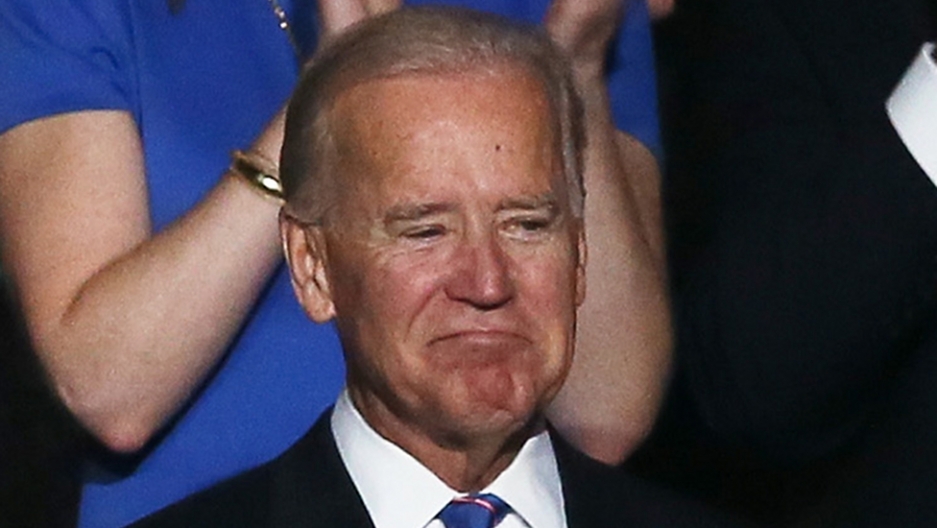
But when watching our president during any kind of emotional outpouring, something is missing. Perhaps I’m being petty, but I don’t see Joe’s face reflecting any anguish, sadness or empathy. Whether he has been outlining legislative goals on the campaign trail, accepting the results of the election, or extolling the virtues of the nation and pledging to uphold its values during his inauguration speech, Joe’s expression is pretty much the same – the same beady eyes, the same immobile mouth, turned down at the corners in a perpetual grimace, and of course, the same blindingly white teeth, big and lots of them…when he smiles.

As I noted above in a different context, I think the face is everything in human communication. The frown, the raised eyebrows, the smile, the knitted brow, the eye roll, the clenched teeth, can often convey emotion and understanding that words cannot and can certainly punctuate words and phrases and give them emphasis, additional meaning and emotional impact. Look again at President Biden’s speech about the pandemic – the words are perfect and quite meaningful, but we are left hanging without validation from his expressionless face. 

Now, we should ask why is this? Why is our president’s face so empty of expression…of whatever kind? Anger, laughter? When looking back at the many pictures and videos of Joe in the past, it is clear that his face has changed – dramatically. Remember his famous aside to President Obama after the Affordable Care Act became law? “This is a big f——-g deal!”, he chortled in the president’s ear, his whole face smiling and reflecting his glee.

The moment after Biden’s remark

Other pictures and videos from his many years in the Senate, show a face full of expression, able to show sarcasm, surprise, concern, or embarrassment quite easily. Actually, even when then Senator Biden ran against Hillary Clinton for the Democratic nomination in 2015, his face was fine. But something happened to that face between his run against Clinton and his run for the Democratic nomination in 2019. 

Biden 2012

Now, we all know about the vanity of politicians and Joe Biden was never an exception. As a balding senator, in fact the victim of a very unseemly process, where the hair seemed to thin severely but uniformly, no bald spot or receding hairline for Joe, his vanity response was his famous hair plugs – swiped from his neck and various other places where the hair was thick and then inserted into his scalp. Okay, baldness assaults the best of us and we all deal with it in different ways, including the famous “comb over” (https://ralphfriedly.com/2016/07/04/the-comb-over/). But Senator Biden’s answer for his problem was quite radical and obviously quite expensive. 

Biden then

Well, all this was fine – we got used to the “hair plug look”, but why mess with the face. Joe’s face, aside from a sagging double chin or wattle, was always fine. His smile and his hearty laugh were always engaging, as my son Conrad can attest, when Vice President Biden visited with and thanked his Peace Corps group in Jordan in 2008. Really, Biden’s engaging personality, favorably supported by those expressive characteristics, was one of his finest attributes. But apparently his vanity expanded unwisely well beyond those hair plugs after he ran against Clinton in 2015. It was during his run against Sanders and Warren for the Democratic nomination, that his supporters and we voters noticed a fundamentally altered face and its resulting negative characteristics.

Biden now

Yes, Joe Biden is old. Hmm, well maybe not so old since he was born in the same year I was, 1942. I’m already 79; President Biden will turn 79 in November. But he is without doubt the oldest person to become a US president. The closest to him was Donald Trump, who when he was elected in 2016, was 70 years old. But to me that’s not a good enough reason to change an engaging and expressive face to one that’s most times a complete cypher, in an ill advised effort to look younger. His wife, “Dr. Jill”, should have advised against it.

President Biden

But President Biden, a devoted exerciser, is trying to ensure that his body is up to the exhausting role of US President. He’s been known to challenge opponents to push-up contests, among them President Trump. And yes, he would have easily won. But in my humble opinion he should also have exercised, not excised, his charming and distinguishing facial characteristics, retaining the expressive face of the “lunch bucket Joe” that we grew to respect and love as Senator and Vice President.

Addendum

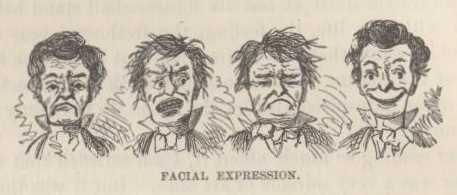
Another story about facial expression that I wanted to share but that would not fit easily into any of the above, concerns a Mark Twain book, me and my father.

I mentioned in another article that many of my favorite books were purchased at a used book booth at Packard’s Farmers Market on route 206 in Somerset County, New Jersey when I was a youngster. One of them, an ornately bound first edition of Mark Twain’s “Innocents Abroad”, was quite special. I remembered some clever illustrations in the book dealing with interpretation of facial expressions that I wanted to consider for this article but of course this precious book was on a bookshelf in my study in Scottsdale so I abandoned the idea.

But, would you believe it, after idly typing the title and author into google, a scanned version of exactly my first edition came up and after looking through the chapters and pages, I found the exact page, illustration and text that I wanted. Both the illustration and Twain’s text describing the expressions caused lots of uproarious laughter from both me and my father when sharing them. They still don’t exactly fit into the article but here they are, along with the text – I hope you enjoy them:

Twain’s text:

There is an old story that Matthews, the actor, was once lauding the ability of the human face to express the passions and emotions hidden in the breast. He said the countenance could disclose what was passing in the heart plainer than the tongue could.

“Now”, he said, “Observe my face – what does it express?”

“Despair!”

“Bah, it expresses peaceful resignation! What does this express?”

“Rage!”

“Stuff! It means terror! This!”

“Imbecility”.

“Fool! It is smothered ferocity! Now this!”

“Joy!”

“Oh perdition! Any ass can see it means insanity!”

Elder Statesmen

20 Tuesday Jul 2021

Posted by ralphfriedly in Uncategorized

≈ 1 Comment

I was disturbed by the worshipful reverence implied in the smaller news item inserted into the story of President Biden’s inauguration on January 20 of this year.

Sure, most Americans were happy to see the end of the chaotic, disastrous and disgraceful presidency of Donald Trump and happy to usher in what we all hoped would be a much more deliberate, thoughtful, honest and transparent presidency. Although Joe Biden’s tenure has yet to be judged, the end of Trump’s certainly has caused a national sigh of relief.

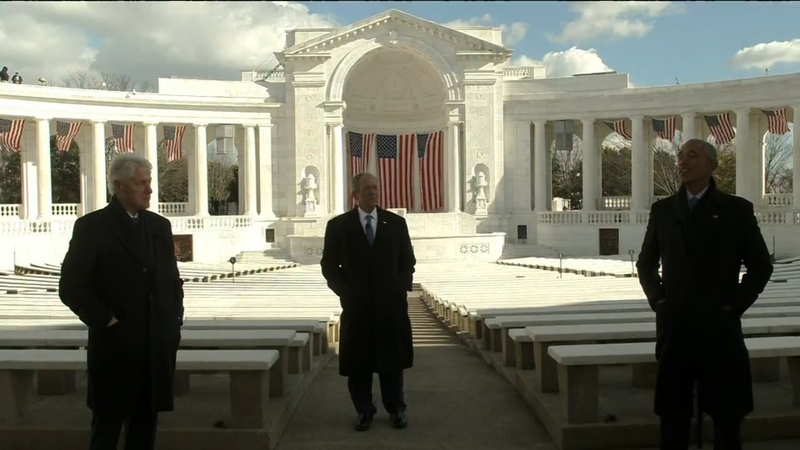
And I assume to help make that point we were treated to a dramatically posed and videoed meeting among three of our ex-presidents: Bill Clinton, George W. Bush and Barack Obama, where we could hear them reminisce and ruminate about the “peaceful transfer of power” in which they all participated and position themselves as contrasts to the last four years. For many viewers and observers perhaps it worked. I mean, who wouldn’t look good next to Donald Trump. Whose administration would not shine when compared to the destructive wrecking crew of ne’er-do-wells who populated Trump’s cabinet – from Betsy DeVos to Scott Pruitt – all bent on destroying that which they were appointed to protect. 

But I had a problem with this video – not with the sentiment expressed by these ex presidents about the peaceful transition of power, which was quite appropriate, but with being reminded as I looked at each one and remembered their respective eight-year presidencies, of how flawed our recent presidents and their legacies have been. The reflective gathering of these three should have been not a celebration but a commiseration. All three have huge black marks on their respective administrations that will define them forever and that history will not erase.

In order – Bill Clinton and his “triangulation” strategy caused no end of misfortune for America. His “middle ground” abandonment of principles of the Democratic Party that got him elected and embrace of right wing policies to ingratiate him with the Republican Party resulted in some disastrous legislation. His crime bill, in the words of NYTimes columnist Charles Blow, “…flooded the streets with police officers and contributed to the rise of mass incarceration, which disproportionately impacts Black men and their families. It helped to drain Black communities of fathers, uncles, husbands, partners and sons….”. 

And then there was Clinton’s welfare reform bill which would “end welfare as we know it”, when he took another page from the Republican playbook by changing welfare to a block grant program for each state, inadequate to begin with, and which assured significant disparity among more and less generous states. His program also dictated onerous work requirements which presented impossible transportation burdens for poor families and, worst of all, ran out at an established point, depositing many one parent and struggling families right back into the gutter of despair and hopelessness from which they were trying to escape and where they remained. 

Then there were Clinton’s clumsy foreign policy forays, which included “Operation Infinite Reach” – the bombing of purported terrorist havens in Afghanistan and a western built pharmaceutical factory in Sudan, claimed to be manufacturing nerve gas. These attacks were violations of international law and failed to achieve anything except enhancing Osama bin Laden’s reputation and strengthening the terrorist resolve that resulted in the disaster of 9/11. Along with his ill-conceived assault in Somalia culminating in the infamous Mogadishu firefight of October 1993, our friend Bill should be forever contrite and repentant.

Another signature bill of Clinton’s presidency was the oft-touted North American Free Trade Agreement, known better as NAFTA, which accelerated the departure of  manufacturing from America to low wage countries like Mexico. Why the hollowed-out cities of Michigan and Ohio with boarded up factory buildings? NAFTA is the reason. The loss of well paid, unionized manufacturing jobs was a huge contributor to destroying the middle class and making the United States the most unequal country among OECD nations. With NAFTA the corporations, their CEO’s and their stockholders got richer and their former employees got poorer.

The corporate takeover of Medicare also began with Bill Clinton. It was during his administration that private healthcare corporations were first allowed to administer Medicare programs to seniors. First called Medicare “Choice” programs, they eventually morphed into the myriad “Medicare Advantage” programs of today, which offer “enhanced” medicare providing additional benefits like dental care, hearing and drug coverage and so on at great taxpayer cost through requiring Medicare to pay a hefty annual coverage cost to private companies, who then profit by limiting coverage (See my upcoming article on this subject).

And then, of course, Clinton’s dalliance with a White House intern forever blemished the US presidency. Yes, one might argue that other presidents had their weak moments too, certainly FDR, Eisenhower and Kennedy come to mind. But Clinton’s were not tastefully hidden but blazoned in the headlines for all of us to see and feel. 

So perhaps President Clinton, standing so dramatically with those two other ex presidents, should have been apologizing to his colleagues and to the American people instead of discussing the “peaceful transition of power”.

Then there was George W. Bush, the biggest failure of all, standing in the twilight with Bill and Barack. He manipulated intelligence and initiated a catastrophic war of choice with Iraq which should be described with terms like “illegal. war crime, deception, lies, immoral, mass murder” that cost trillions of dollars and hundreds of thousands of lives while making the world a more dangerous place. In addition to the money, now calculated by Brown University’s Cost of War project at $1.922 trillion (averaging about $8000 for every US taxpayer) and the lives lost, estimated to be more than 300,000, we left a dreadfully unstable and still struggling Iraq. Plus our friend Mr. Bush gave the ok for “black sites” and legalization of torture, leaving a most shameful and permanent blemish on the character of our nation. Actually, the costs of Bush’s entire “War on Terror”, which would include not only Iraq, but also Afghanistan and military actions in more than 80 other countries all over the globe, and which accomplished little but further deterioration of our reputation, have tallied an astonishing cost of $6.4 trillion and 601,000 precious lives lost. Thank you, George W. Bush.

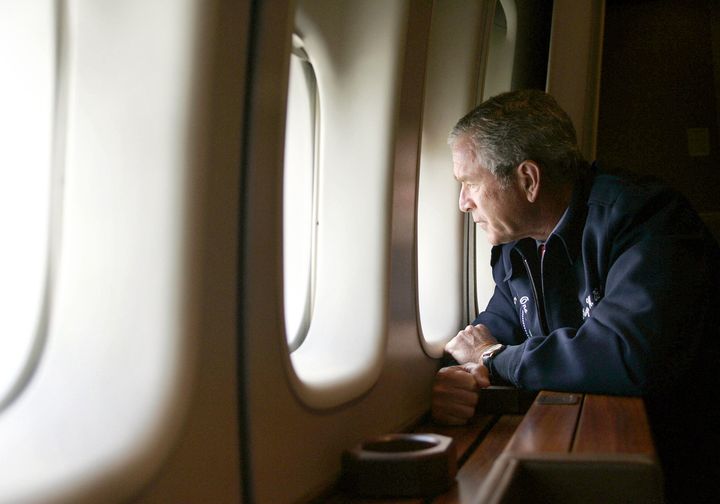
 And of course, we remember “W”’s disastrous reaction to Hurricane Katrina. It’s really hard to imagine a more detached, uncaring posture in the face of such a huge disaster, but there he was, after interrupting an already disgracefully long 27 day vacation on his Texas ranch, disdainfully viewing the deadly catastrophe from the distance and safety of Air Force One. Then, eventually on the ground and finally trying to lead, he comes out with his immortal statement to inept FEMA director Michael Brown, “Brownie, you’re doing a heck of a job”. This dismal performance as president in the face of terrible disaster will long be remembered.

And guess who privatized and deregulated the Texas power grid, severed it from those in adjacent states to prevent any federal oversight, and placed it under the control of the Electric Reliability Council of Texas (ERCOT)? Yes, George W. Bush did all this while serving as governor of Texas, calling it “The nation’s most extensive experiment in electrical deregulation” – an extraordinarily expensive and deadly experiment, with Texas residential consumers paying tens of billions more for their power than state’s traditional utilities, most of it going into the pockets of investors, power company CEOs, and the campaign coffers of Texas Republican politicians. And we all know what happened when the changing climate sent a huge cold wave to Texas this past winter – approximately 800 people died and the the state sustained billions in property damage. Thank you for that too, George W. Bush.

So Bush, as detailed in a superb New York Magazine article the “painter”, the “artist”, is trying to launder his reputation and sanitize his legacy with his vapid portraiture. Oh yes, “inspired by Churchill”, he is painting portraits of immigrants, including fellow war criminal Henry Kissinger and marketing a  book celebrating his “artistry” with all the power he can. Why? Does he need the money? Hardly – he’s been a multimillionaire for decades for whom politics and now art have been a hobby. He’s just doing everything he can to make us forget his disastrous presidency and unfortunately we’re mostly going along with him. And George W. Bush, war criminal, had the gall to appear on BookTV being interviewed by none other than his own daughter and expounding  on his new career and book. 

Oh, and let’s not forget that like every good Republican president, “W” also cut taxes for the wealthy in 2001 and 2003 under the guise of “tax relief”, a Frank Luntz term that I illustrated in another article. So George W., paint and pontificate all you want. You will never live down the legacy of being one of the worst, most disastrous of all US presidents.

And good old President Barack Obama, now basking in the riches obtained by he and Michelle’s movie production deal with Netflix and the considerable royalties from the first volume of his presidential memoirs, should be sadly looking back at a failed presidency. Oh sure, he was a distinguished leader on the world stage, might be the most eloquent of all of our presidents, and indisputably was our first black president, but he could have done so much more, were he not locked in the embrace of neoliberal orthodoxy. His vaunted “hope and change” never materialized – we all hoped but nothing much changed. 

Surrounded by advisors recruited from the ranks of Goldman Sachs he chose Wall Street over Main Street, bailing out the very same big banks that caused the financial crisis of 2008 instead of prosecuting them and failed to help the millions who lost their sole store of wealth – their homes. Yes, President Obama refused to prosecute those who caused the crash of 2008, in contrast to the thousands of prosecutions following the savings and loan debacle of the ’80’s and ’90’s and chose instead to bail out the big banks, the real culprits, instead of common people who were losing their homes. And the stimulus finally passed to stop the hemorrhaging of jobs and livelihoods was far too small, causing the recovery to drag on for much too long. Furthermore and very important, this choice fueled an era of populist rage and resentment that infected the country and paved the way for  the election of Donald Trump.

And while all of us hoped for something better, President Obama forever doomed American medical care to be a for-profit corporate “product” by allowing the Affordable Care Act to be virtually written by the health care and pharmaceutical industries. True, it extended “affordable” healthcare to additional millions of people but at the huge cost of government subsidies to healthcare corporations. “Obamacare” – ostensibly a compromise between liberals and moderates, was in reality a giveaway to the already corporatized healthcare industry. And Biden’s much touted “enhancement” of Obamacare and the aforementioned Medicare Advantage programs have tightened corporate America’s grip on American healthcare and have made transition to a much less expensive and far more efficient single payer government run program which would cover every single person in the country from birth to death increasingly difficult and now maybe impossible.

Also, it was President Obama who, perhaps unwittingly, signed the deceptively named Ensuring Patient Access and Drug Enforcement Act, which stripped the DEA of power to staunch the flow of opioid pills outside of normal avenues of prescription and distribution, protecting drug manufacturers and their distributors and making it easier for them to get away with exacerbating the epidemic of overdoses and death. And it’s interesting to note that the bill’s most passionate advocate, Representative Tom Marino of Pennsylvania, was later nominated by Donald Trump to be his “drug czar”.

Plus while president our friend Barack Obama embarked on a series of ill advised and illegal executions, an example of which certainly was the much ballyhooed “capture” of Osama bin Laden, who actually was murdered extrajudicially instead of being brought back to the US to face justice. Yes, our “constitutional scholar and professor” president who campaigned against the death penalty, actually kept a “kill list” and was only too happy to execute any number of Muslims without charges or trials, some of whom were US citizens, along with dozens of innocent bystanders, who likely were deemed mere “collateral damage”.

Another shameful feature of the Obama presidency was his treatment of whistleblowers. Of course, Mr. Obama, boasted of his administration’s “transparency”, promising “a new era of open government”, but betrayed that pledge time and time again, spearheading eight Espionage Act prosecutions, more than all US administrations combined. The Obama administration’s treatment of Chelsea Manning, Edward Snowden, James Risen, John Kiriakou, Jeffrey Sterling, Thomas Drake, Shamai Leibowitz, Donald Sachtleben, Stephen Kim and the very latest, Daniel Hale, whose prosecution began under Obama, continued through Trump and will conclude under Biden, was shameful and contrasts shockingly with the preferential treatment of David Petraeus, guilty of the same sharing of government secrets.

When considering the aforementioned, why President Obama received the Nobel Peace Prize remains a mystery. Conjecture suggests that this award was perhaps a veiled repudiation of the previous administration, or perhaps some “hope” based on Obama’s overtures to Muslim countries. But it is amazing that so many of his administration’s actions violated the honor of this recognition. Quite contradictory also, especially in view of his promises to work toward a “nuclear-free world”, which probably helped him win the Prize, was his authorization of a trillion dollar program to “modernize” the US atomic arsenal with its 5800 warheads already capable of destroying the world and everyone in it several times over. And, like presidents before him, he continued the coverup of Israel’s nuclear arsenal. In 2009, when a journalist asked him if he knew of “any country in the Middle East that has nuclear weapons,” Mr. Obama responded, “I don’t want to speculate”, making his efforts to keep Iran from obtaining nuclear weapons to maintain a “nuclear free middle east” disingenuous at best.

I should add that President Obama and his pompous blowhard Secretary of Education Arne Duncan, repeatedly betrayed and damaged my precious chosen profession, public education. Obama and Duncan, both private school products, demonstrated little knowledge of public education and its important role in American democracy and displayed little awareness of the causes of its problems. They continued the detached and useless tenets of George W. Bush’s “No Child Left Behind” involving standards, test scores, competition, and school reward and punishment, simply using different names – “School Improvement Grants” and “Race to the Top”. And both presented charter schools and “choice” as solutions to public school struggles, sucking away precious public school resources and depositing them in private pockets. 

And finally, the great humanitarian, President Obama, who so sensitively and eloquently reflected the grief and concern of the nation at at mass shootings in schools and churches, even singing “Amazing Grace” when he “ran out of words”, did absolutely nothing to impede Israeli land theft, settlement expansion and human rights abuses, all violations of international law, during his presidency and worse, sat by while the US funded Israeli war machine killed thousands of Palestinians during the Gaza “war” in 2014 including 551 children and 299 women, while injuring over ten thousand and orphaning more than fifteen hundred children, all the while mouthing the same tired platitude, “Israel has the right to defend itself”. Instead Mr. Obama rewarded this criminal nation by signing a 10 year, $38 billion aid MOU with Israel. This $11 million per day “tribute” to Israel has recently ballooned to $20 million per day as our politicians stumble over each other in their eagerness to “help Israel”. “

And one more thing – as a dedicated Democrat, I was terribly upset to see President Obama, the leader of my Party, and his dedicated supporters, throw virtually all of their effort and resources into his 2012 reelection, to the detriment of national Democratic concerns. During President Obama’s eight years in office, when Democrats like me could feel some pride in a Democratic presidency, the Party lost more House, Senate, state legislative and governor seats, a net total of 13 governorships and 816 state legislative seats than under any other president. Among the states lost by Democrats were Wisconsin, North Carolina, Iowa and West Virginia, all key to the victory of Donald Trump in 2016. 

So President Obama, enough with your well honed speeches and sanctimonious and thoughtful demeanor and enough with your “presidential memoirs” which gloss over your mistakes and failures. If you really want us to forget, why not impress us by trying your hand at building homes for the poor with Habitat for Humanity like President Carter did, or maybe join Stacey Abrams knocking on doors to expand voting opportunities for poor people of color. Oh, and one more thing –  it was Obama’s EPA that approved toxic chemicals for the fracking industry, that break down into deadly “forever” poisonous compounds called PFAS which threaten people and wildlife through soil and water contamination.

Before publishing this bleak assessment of our last three presidents’ legacies, it might be only fair to consider a few of the best things to emerge from their respective administrations. Hey, it wasn’t all bad.  However, what most consider to be Bill Clinton’s major achievements – NAFTA, his crime bill and welfare reform, I have asserted to be major failures. Yet he can be proud of the first balanced Federal budget in many years. George W. Bush has been lauded for PEPFAR (President’s Emergency Plan for AIDs relief),  a successful humanitarian effort to combat AIDS in twelve African countries. And ironically, what’s commonly viewed as Barack Obama’s greatest achievement, the Affordable Care Act, I include above as a major failure. But he should be recognized for the DACA program, his Consumer Protection Bureau, joining the Paris Climate Accords, the Iran Nuclear deal, reaching out to Cuba and for his active support for LGBTQ rights. But, all considered, in my view the achievements of these three remarkably flawed presidents were far outweighed by their errors, mistakes and failures.

All Posts

  • Itching and Scratching August 17, 2024
  • Afterlives in the Here and Now July 12, 2024
  • What the Hell is Wrong with Us…and the World? July 10, 2024
  • Symptoms vs. Causes: Missing the Mark September 22, 2023
  • Our Grand Canyon September 18, 2022
  • On Turning Eighty June 18, 2022
  • The Blood of Children and the Tears of Parents June 8, 2022
  • Growing Up in the Pillar of Fire: A Memoir February 6, 2022
  • The Medicare Advantage Scam December 21, 2021
  • Yet Another Rant December 7, 2021
  • Majority Rule? Think Again – Why a Minority Rules America November 27, 2021
  • The United States of Incrementalism November 27, 2021
  • Short Story November 24, 2021
  • The Troublesome Challenge of Choice November 6, 2021
  • Down Memory Lane July 31, 2021
  • Face It July 24, 2021
  • Elder Statesmen July 20, 2021
  • A Covid Winter in Vermont June 15, 2021
  • A Way with Words: The Devious and Devastating Genius of Frank Luntz… and More January 14, 2020
  • Wooster High September 11, 2019
  • Vermont Redux August 6, 2019
  • Oh Please, Come On Now July 3, 2019
  • The Trump Whisperer June 15, 2019
  • Still Ranting June 8, 2019
  • Connections March 21, 2019
  • Rant February 9, 2019
  • “White Poison” November 1, 2018
  • What We’ve Lost October 12, 2018
  • The Vote: “Cornerstone of Our Democracy” September 26, 2018
  • Justice and Accountability  September 25, 2018
  • 6 November 2018 August 31, 2018
  • Flying August 11, 2018
  • On the Minus Side of Dying: Musings on End of Life May 23, 2018
  • Sanctimonious Hypocrisy May 9, 2018
  • Foresight in 2020 May 6, 2018
  • Black Ice April 24, 2018
  • Why We Drink April 22, 2018
  • Reasons for Seasons March 20, 2018
  • Fitness Frustration: Pet Peeves at the Gym January 18, 2018
  • They Are Missed December 23, 2017
  • Hollow Patriotism: Honoring the Troops December 21, 2017
  • Interstate of Mind: Reflections on Highways and the Trucking Industry December 7, 2017
  • The Real Problem With Taxes in America November 8, 2017
  • From Chaos to Clarity: My Undergraduate Education September 11, 2017
  • Should Ken’s Thoughts About Gender Offend Her? August 25, 2017
  • Simple Solution to a Perennial Problem: Raise the Fuel Tax August 25, 2017
  • Rx for a Sick Democratic Party July 5, 2017
  • Well, Trump Voters… June 19, 2017
  • Home Sweet Home June 11, 2017
  • Summer 1957 May 2, 2017
  • The Backwards Hat April 24, 2017
  • Sears, Roebuck and Company March 3, 2017
  • “Shared Values” February 25, 2017
  • Thank You, Trump Voters: Amateur Hour and Executive Disorder in the White House February 16, 2017
  • The Sounds of Music February 14, 2017
  • Is This a Conversation? February 13, 2017
  • My Hank Williams Movie February 10, 2017
  • The NFL and I January 23, 2017
  • Election Reflection II December 24, 2016
  • Election Reflection November 11, 2016
  • “Cat’s in the Cradle” Comes True? November 11, 2016
  • Daylight Saving Time….Why? November 5, 2016
  • When I Fell in Love with Country Music November 4, 2016
  • Obit for Obamacare October 8, 2016
  • Irwin Elementary School 1965-1968 August 23, 2016
  • Micro and Macro: Ruminations on Life and the Cosmos July 25, 2016
  • Rotten Apple July 13, 2016
  • Biblical Literacy July 13, 2016
  • Self-Driving Car? Really? Why? July 7, 2016
  • We Shall Over-comb July 4, 2016
  • Stressful Life Events July 4, 2016
  • Why? I’ll Tell You Why July 3, 2016
  • Generational Generics May 15, 2016
  • Let’s Change the U.S. Constitution April 18, 2016
  • Economics 101 April 18, 2016
  • Talk to Your Doctor About… April 12, 2016
  • Tractors April 7, 2016
  • The Noxious Cloud of Republican Orthodoxy April 7, 2016
  • A To-Do List for our Broken Congress January 20, 2015
  • Quitting Smoking: A Mindful Experience December 6, 2014
  • My World of Work November 8, 2014
  • Golden Rules for Living November 7, 2014
  • Tennis Anyone? September 10, 2014
  • Mirror, Mirror, on the Car August 30, 2014
  • Making Time July 23, 2014
  • Massachusetts Driving Rules July 23, 2014
  • Retirement July 18, 2014
  • Mount Evans by Motorcycle July 18, 2014
  • The Kite Contest July 14, 2014
  • More than Transportation July 7, 2014
  • Books that Influenced My Life July 1, 2014
  • The Death Penalty June 25, 2014
  • Dear Dad, June 14, 2014
  • Is There a Right Wing Conspiracy? June 10, 2014
  • Living in Vermont June 10, 2014
  • What Is a Billion? June 9, 2014
  • How to Become a Liberal May 29, 2014
  • Barbara My Sweet Sister May 29, 2014
  • A Winter Drive May 13, 2014
  • Dear President Obama, May 12, 2014

Meta

  • Create account
  • Log in
  • Entries feed
  • Comments feed
  • WordPress.com

Blog at WordPress.com.

  • Subscribe Subscribed
    • Ralph Friedly
    • Join 38 other subscribers
    • Already have a WordPress.com account? Log in now.
    • Ralph Friedly
    • Subscribe Subscribed
    • Sign up
    • Log in
    • Report this content
    • View site in Reader
    • Manage subscriptions
    • Collapse this bar
 

Loading Comments...